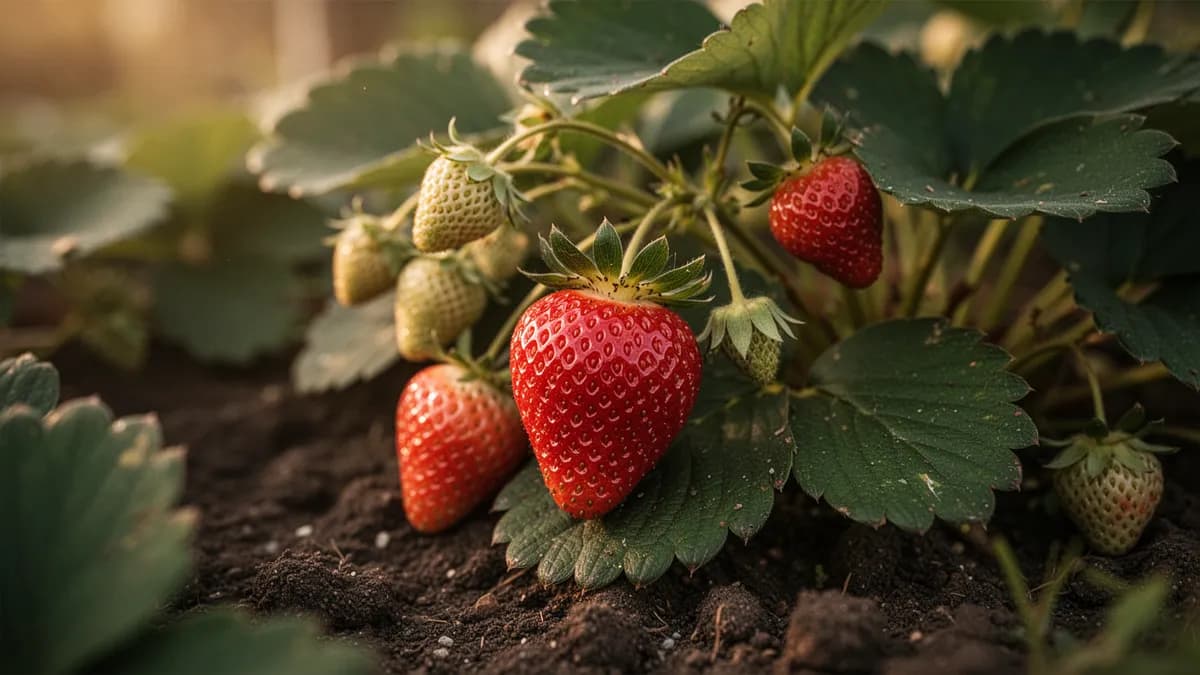
Strawberry
Fragaria x ananassa
At a Glance
It's planting season for Strawberry! Start planning your garden now.
A low-growing perennial producing sweet red fruits, spreading by runners and thriving in slightly acidic soil. Choose June-bearing varieties for a single large harvest or everbearing types for smaller pickings throughout the season. Mulch with straw to keep fruits clean, suppress weeds, and retain soil moisture during the fruiting period. Renovate beds after harvest by trimming foliage and thinning runners to maintain vigor and maximize production in subsequent years.
Planting & Harvest Calendar
Growth Stages
From Seed to Harvest
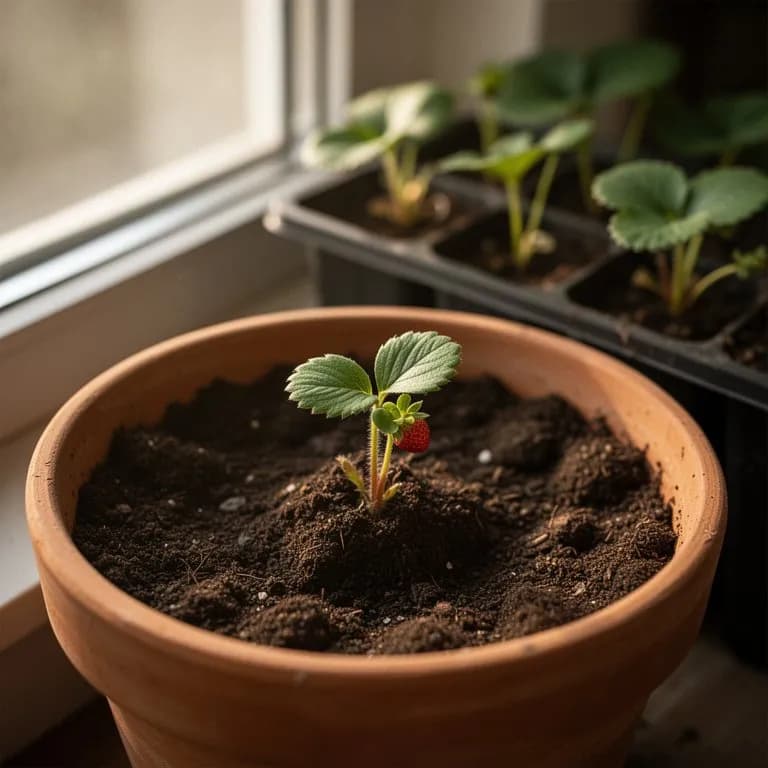
Dormancy and Early Growth
Days 0–21
Strawberry crowns break dormancy in early spring as soil temperatures rise above 5°C (40°F). New leaves unfurl from the central crown, and the root system begins actively growing. Plants that overwintered under mulch are uncovered gradually to acclimate to outdoor conditions.
💡 Care Tip
Remove winter mulch gradually over 7-10 days as new growth appears. Clean away any dead or diseased leaves from the previous season. Apply a balanced granular fertilizer around each plant, keeping it away from the crown to prevent rot.
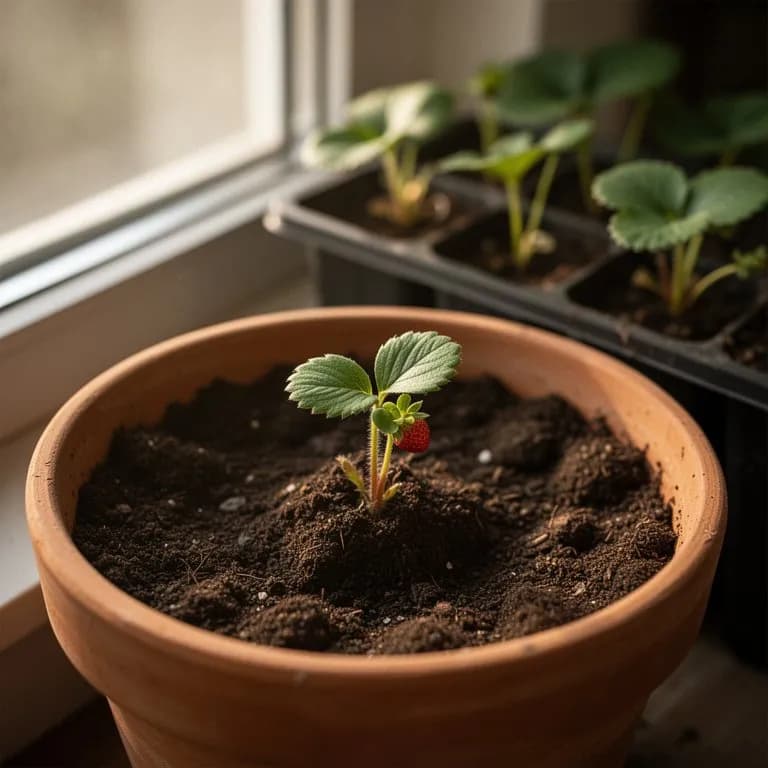
Newly planted strawberry starts establishing their root systems in prepared garden soil
Monthly Care Calendar
What to do each month for your Strawberry
May
You are herePeak flowering period for June-bearing types. Ensure adequate pollinator activity and avoid spraying any pesticides during bloom. Continue consistent watering at 2.5 cm per week minimum. Begin watching for gray mold (botrytis) in humid weather and remove any affected flowers or fruit.
Did You Know?
Fascinating facts about Strawberry
Strawberries are the only fruit that wears their seeds on the outside, with an average of 200 tiny achenes dotting the surface of each berry, and each achene is technically an individual fruit.
Straw mulch surrounding strawberry plants to keep fruit clean and retain soil moisture
Prepare your strawberry bed by working several inches of compost into well-drained soil with a pH between 5.5 and 6.8. Raised beds work especially well because they warm quickly in spring and provide the excellent drainage strawberries demand. Space plants 12 to 18 inches apart in rows 3 feet apart, setting the crown at soil level so it is neither buried nor exposed.
Plant bare-root strawberries in early spring as soon as the ground can be worked, or set out transplants in late spring after the last frost. Pinch off all blossoms the first year for June-bearing types to direct energy into strong root and runner development. Everbearing and day-neutral types can be allowed to fruit lightly after the initial pinch.
Mulch heavily with clean straw or pine needles to suppress weeds, retain moisture, and keep berries off the soil surface. Water consistently with one to two inches per week, preferably with drip irrigation to keep foliage dry and reduce disease. Renovate June-bearing beds immediately after harvest by mowing the foliage, narrowing rows, and fertilizing to prepare for the following season.
The modern garden strawberry (Fragaria × ananassa) has a fascinating origin story that spans two continents. While wild strawberries have been gathered and enjoyed by humans since the Stone Age, and the small woodland strawberry (Fragaria vesca) was cultivated in European gardens from the 14th century onward, the large-fruited strawberry we know today did not exist until the 18th century. The story begins with a French spy named Amedee-Francois Frezier, who in 1714 was sent to Chile and Peru to observe Spanish military fortifications. While there, he encountered a large-fruited wild strawberry species (Fragaria chiloensis) cultivated by the indigenous Mapuche and Huilliche peoples, who had been selecting for larger fruit for centuries. Frezier smuggled five plants back across the Atlantic, and these Chilean specimens were eventually planted near another American species, the Virginia strawberry (Fragaria virginiana), in the royal gardens at Brest, France. The chance cross-pollination between these two species produced the first hybrid garden strawberry around 1750, combining the large fruit size of the Chilean parent with the superior flavor and hardiness of the Virginian. French botanist Antoine Nicolas Duchesne first described this hybrid in 1766, and from there it spread rapidly across Europe and eventually back to the Americas. The 19th and 20th centuries saw intensive breeding programs that produced thousands of named varieties optimized for different climates, seasons, and uses. Today strawberries are grown commercially on every continent except Antarctica, with annual global production exceeding 9 million metric tons. The fruit has become one of the most beloved and economically important berry crops worldwide, cherished equally in backyard gardens and industrial farming operations.
While most strawberries are propagated from runners or purchased transplants, they can be started from seed with patience. Stratify seeds by placing them on a damp paper towel in the refrigerator for three to four weeks. Sow stratified seeds on the surface of moist seed-starting mix under bright lights, as they require light to germinate. Germination takes two to three weeks at 65 to 75 degrees Fahrenheit. Transplant seedlings outdoors after the last frost when they have three to four true leaves.
Strawberries thrive in well-drained, loamy soil with a pH of 5.5 to 6.8. Amend heavy clay with compost and perlite, and add sulfur to lower pH if needed. Apply a balanced 10-10-10 fertilizer at planting and again after harvest for June-bearers. Feed everbearing types monthly with a light application during the growing season. Avoid high-nitrogen fertilizers during fruiting, as excessive leaf growth reduces berry production and quality.
Check Your Zone
See if Strawberry is suitable for your location.
10°C – 26°C
50°F – 79°F
Strawberries grow best between 10-26°C (50-80°F), with optimal fruit production occurring at daytime temperatures of 20-25°C (68-77°F) and cool nights around 12-15°C (55-60°F). Plants are cold-hardy and can survive winter temperatures down to -12°C (10°F) with proper mulching, but flowers and developing fruit are damaged by frost below -1°C (30°F). Heat above 30°C (86°F) reduces fruit set and can cause sunscald on exposed berries.
Common issues affecting Strawberry and how to prevent and treat them organically.
Poor fruit set often results from late frost damage to blossoms or inadequate pollination during cold, rainy springs. Misshapen berries typically indicate incomplete pollination by insects. Runners overrunning the bed reduce fruit size and yield, so thin them regularly. Yellowing leaves may signal iron chlorosis from high soil pH. Birds are a persistent problem and are best deterred with netting installed before berries begin to color.
Lettuce and spinach serve as effective ground covers between strawberry rows, shading the soil and retaining moisture without competing for nutrients. Thyme and borage attract pollinators to improve fruit set and may repel certain pest insects. Borage is also thought to enhance strawberry flavor and vigor. Avoid planting near brassicas such as cabbage and broccoli, which are heavy feeders that compete for nutrients and may harbor shared diseases.
Strawberry runners extending outward to produce new daughter plants for propagation
- 1Plant strawberries in early spring as soon as the soil can be worked, setting bare-root crowns so the midpoint of the crown sits exactly at soil level. Too deep causes crown rot, too shallow exposes roots to drying out.
- 2Choose a site with full sun receiving at least 8 hours of direct sunlight daily and well-drained soil with a pH between 5.5 and 6.8. Avoid areas where tomatoes, peppers, or potatoes grew in the past 3 years to reduce verticillium wilt risk.
- 3Apply 5-8 cm of clean straw, pine needle, or shredded leaf mulch around plants after planting to suppress weeds, retain moisture, and keep developing berries clean and free of soil-borne disease.
- 4Water strawberry plants at the base using drip irrigation or soaker hoses rather than overhead sprinklers. Wet foliage promotes gray mold (botrytis) and leaf spot diseases, especially during flowering and fruiting.
- 5Remove all flowers from newly planted June-bearing strawberries during the first year to redirect energy into strong root and crown development. This sacrifice results in a significantly larger harvest in year two.
- 6Renovate June-bearing beds immediately after harvest by mowing foliage to 7-10 cm, narrowing rows to 30 cm wide, removing excess daughter plants, and applying balanced fertilizer to stimulate healthy regrowth.
- 7Protect ripening berries from birds by draping lightweight bird netting over the bed, secured at the edges with stones or landscape staples. Install the netting as soon as the first berries begin to color.
- 8Feed strawberry plants twice per year: once in early spring as new growth begins with a balanced granular fertilizer, and again immediately after renovation of June-bearing beds. Avoid high-nitrogen fertilizers which promote foliage at the expense of fruit.
- 9Inspect plants regularly for common pests including slugs, tarnished plant bugs, and strawberry root weevils. Use beer traps for slugs, remove plant debris where bugs overwinter, and apply beneficial nematodes for weevil larvae.
- 10Propagate new plants by selecting the first daughter plant on each runner and pinning it into a small pot of compost while still attached to the mother plant. Sever the runner after 4-6 weeks once the daughter has established a strong root system.
Harvest strawberries when they are fully red with no white or green shoulders remaining. Pick in the morning when berries are cool and firm, grasping the stem just above the berry and pinching it off to avoid bruising the fruit. Leave the green cap attached to extend freshness. Check plants every one to two days during peak season, as ripe berries deteriorate rapidly in warm weather. Refrigerate unwashed berries immediately and consume within two to three days for best quality.
Store fresh strawberries unwashed in a single layer on paper towels in the refrigerator for up to three days. For freezing, wash, hull, and spread berries on a baking sheet to flash-freeze before transferring to airtight bags for up to eight months. Strawberries also preserve beautifully as jam, preserves, or fruit leather. Dehydrated strawberry slices make excellent snacks and additions to cereals and trail mixes.
Plan your garden with ease
Love growing Strawberry? Use our free garden planner to design your beds, track planting dates, and get personalized care reminders.
Nutritional Info
Per 100g serving
32
Calories
Health Benefits
- Outstanding source of vitamin C, providing nearly 100% of the daily recommended value per 100g serving, more than oranges by weight
- Rich in manganese (0.39mg per 100g), a trace mineral essential for bone health, metabolism, and antioxidant enzyme function
- Contains significant levels of folate (24mcg per 100g), important for cell division and particularly vital during pregnancy
- Loaded with anthocyanins and ellagic acid, powerful antioxidant compounds that give strawberries their red color and may help protect against chronic disease
- Low in calories at just 32 per 100g with a low glycemic index of 41, making them suitable for blood sugar management
- Good source of dietary fiber at 2g per 100g, supporting digestive health and promoting feelings of fullness
💰 Why Grow Your Own?
A single strawberry plant costs $2-5 and produces berries for 3-5 years, yielding 400-700g of fruit per season per plant. A modest bed of 25 plants can produce 10-17 kg of berries annually, equivalent to $60-170 worth of organic strawberries at retail prices of $6-10 per kg. Over a three-year lifespan, the initial investment of $50-125 for plants and supplies can return $180-510 worth of premium fruit, representing savings of 70-80% compared to buying organic berries at the store.
Quick Recipes
Simple recipes using fresh Strawberry
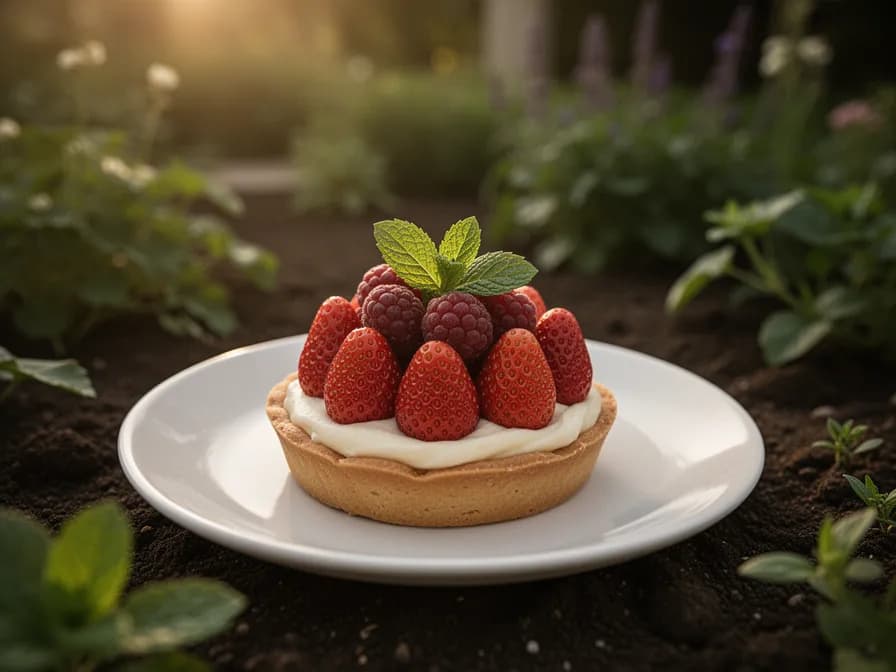
Classic Strawberry Jam
45 minutesA traditional small-batch strawberry jam that captures the essence of freshly picked garden berries. This recipe uses less sugar than commercial jams to let the natural strawberry flavor shine through. Perfect spread on toast, stirred into yogurt, or used as a filling for pastries and cakes.
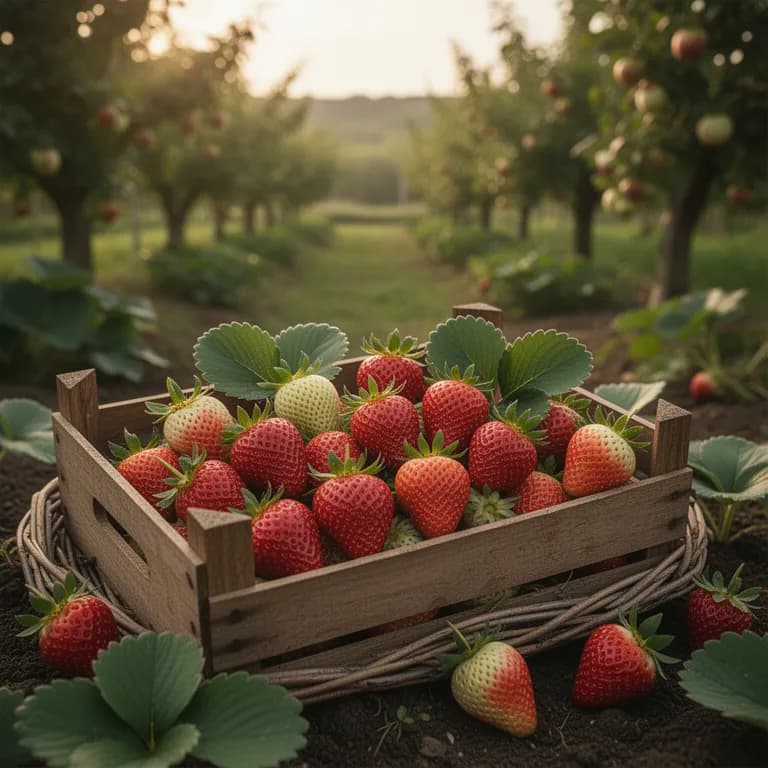
Fresh Strawberry Spinach Salad
10 minutesA bright and refreshing salad that pairs sliced garden strawberries with tender baby spinach, toasted pecans, and crumbled goat cheese. Finished with a light balsamic vinaigrette, this salad makes an elegant starter or a satisfying light lunch during peak strawberry season.
Strawberry Frozen Yogurt Bark
10 minutes plus 2 hours freezingA simple, healthy frozen treat that requires almost no cooking. Sliced strawberries are pressed into a layer of sweetened Greek yogurt and frozen until firm, then broken into rustic shards for snacking. Children love helping to make and eat this refreshing summer dessert.
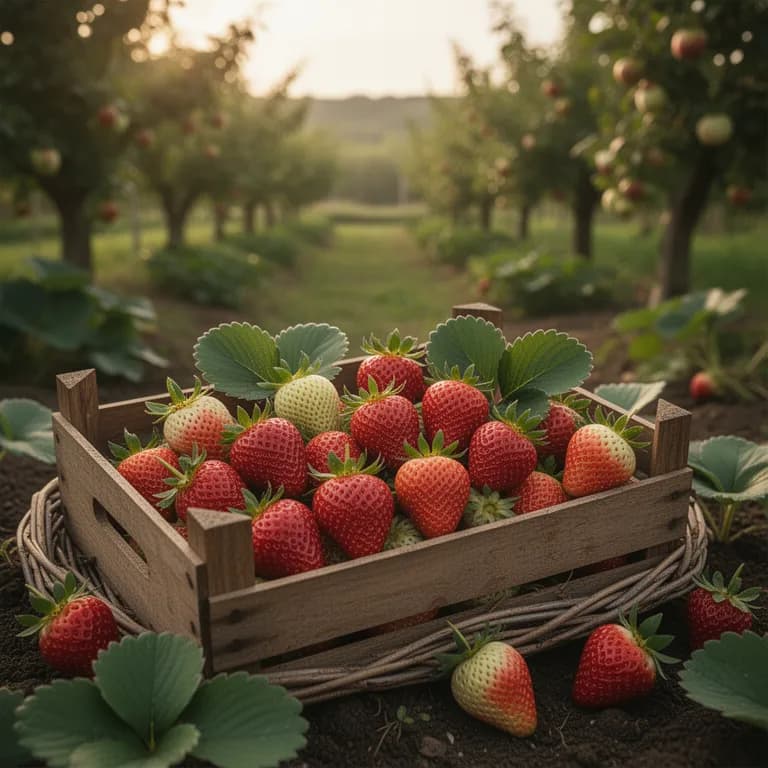
Harvesting perfectly ripe strawberries in the morning for the best flavor and shelf life
Yield & Spacing Calculator
See how many Strawberry plants fit in your garden bed based on the recommended 30cm spacing.
16
Strawberry plants in a 4×4 ft bed
4 columns × 4 rows at 30cm spacing
Popular Varieties
Some of the most popular strawberry varieties for home gardeners, each with unique characteristics.
Chandler
A June-bearing variety known for large, firm berries with outstanding flavor, widely grown in commercial operations and home gardens.
Seascape
A day-neutral everbearing cultivar producing medium to large berries continuously from late spring through fall.
Earliglow
An early-season June-bearer with exceptional sweetness and disease resistance, ideal for northern climates.
Albion
A day-neutral variety prized for its firm texture, high yields, and excellent resistance to verticillium wilt and crown rot.
Jewel
A reliable mid-season June-bearer producing large, glossy berries with balanced sweet-tart flavor.
Popular strawberry varieties from large June-bearers to compact alpine types
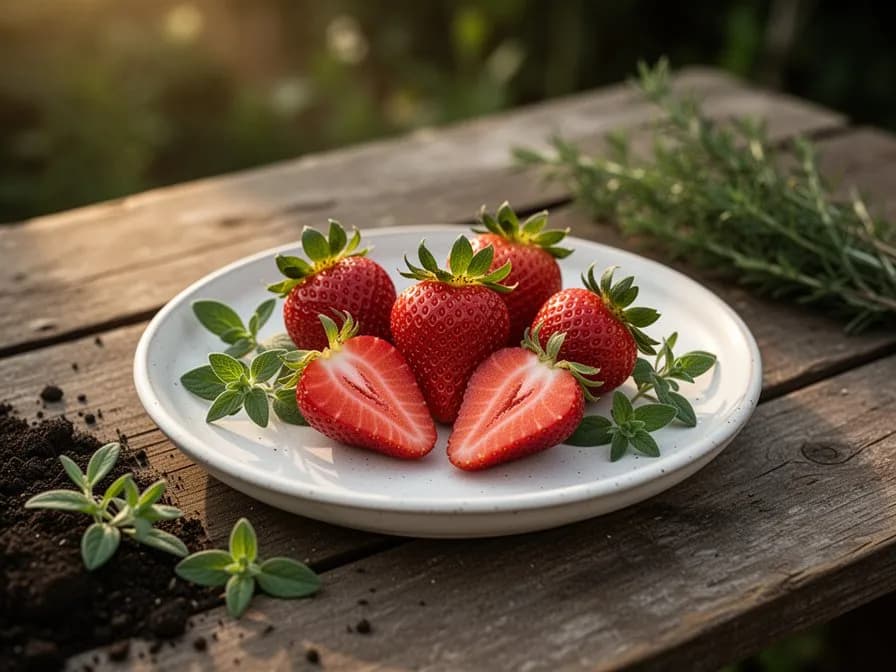
Strawberries shine fresh in salads, shortcakes, and as dessert toppings. They pair beautifully with chocolate, balsamic vinegar, basil, and cream. Use them in smoothies, pies, and ice cream. Nutritionally they are an excellent source of vitamin C, manganese, and antioxidants. Macerated strawberries with a touch of sugar create a versatile sauce for pancakes and yogurt.
When should I plant Strawberry?
Plant Strawberry in March, April, May. It takes approximately 60 days to reach maturity, with harvest typically in May, June, July.
What are good companion plants for Strawberry?
Strawberry grows well alongside Lettuce, Spinach, Thyme, Borage. Companion planting can improve growth, flavor, and natural pest control.
What hardiness zones can Strawberry grow in?
Strawberry thrives in USDA hardiness zones 3 through 10. With greenhouse protection, it may be grown in zones 1 through 11.
How much sun does Strawberry need?
Strawberry requires Full Sun (6-8h+). This means at least 6-8 hours of direct sunlight daily.
How far apart should I space Strawberry?
Space Strawberry plants 30cm (12 inches) apart for optimal growth and air circulation.
What pests and diseases affect Strawberry?
Common issues include Gray Mold (Botrytis), Strawberry Root Weevil, Verticillium Wilt, Spider Mites. Prevention through good garden practices like crop rotation, proper spacing, and companion planting is the best approach. See the detailed pests and diseases section above for symptoms, prevention, and treatment for each.
How do I store Strawberry after harvest?
Store fresh strawberries unwashed in a single layer on paper towels in the refrigerator for up to three days. For freezing, wash, hull, and spread berries on a baking sheet to flash-freeze before transferring to airtight bags for up to eight months. Strawberries also preserve beautifully as jam, pre...
What are the best Strawberry varieties to grow?
Popular varieties include Chandler, Seascape, Earliglow, Albion, Jewel. Each has unique characteristics suited to different growing conditions and culinary preferences. See the varieties section above for detailed descriptions.
What soil does Strawberry need?
Strawberries thrive in well-drained, loamy soil with a pH of 5.5 to 6.8. Amend heavy clay with compost and perlite, and add sulfur to lower pH if needed. Apply a balanced 10-10-10 fertilizer at planting and again after harvest for June-bearers. Feed everbearing types monthly with a light application...
What is the difference between June-bearing, everbearing, and day-neutral strawberries?
June-bearing varieties produce one large concentrated crop over 2-3 weeks in early summer and are best for preserving and large harvests. Everbearing types produce two to three smaller flushes of fruit in spring, summer, and fall. Day-neutral varieties produce fruit continuously from late spring through frost, regardless of day length, providing a steady but smaller supply of berries. For home gardens, a combination of June-bearing for preserving and day-neutral for fresh eating provides the longest harvest season.
Why are my strawberries small and misshapen?
Small or misshapen berries are most commonly caused by poor pollination, which results when cold weather, rain, or lack of pollinator activity prevents all pistils on the flower from being fertilized. Other causes include drought stress during fruit development, boron deficiency in the soil, or damage from tarnished plant bugs feeding on developing flowers. Ensure adequate watering, maintain pollinator-friendly habitat nearby, and control plant bugs during bloom to improve fruit quality.
How do I protect my strawberry plants over winter?
In regions where temperatures drop below -5°C (23°F), apply 10-15 cm of clean straw or pine needle mulch over the beds after several hard frosts in late autumn but before temperatures consistently stay below -7°C. The goal is to insulate crowns against damaging freeze-thaw cycles, not to keep plants warm. Remove mulch gradually in early spring as new growth emerges, leaving some around the plants as ground cover. In mild climates with light frosts, winter mulching is optional but still beneficial.
How often should I replace my strawberry plants?
June-bearing strawberry beds decline in productivity after 3-4 years and should be replaced or fully renovated. Day-neutral varieties are typically grown as annuals or replaced every 1-2 years as their vigor drops noticeably. The most productive approach is to start a new bed from healthy runner plants every 2-3 years and retire old beds on a rotating cycle. This ensures you always have at least one bed at peak production. Signs that a bed needs replacing include declining yields, smaller berries, and increased disease pressure.
Can I grow strawberries in containers?
Strawberries are excellent container plants and thrive in pots, hanging baskets, window boxes, and specialized strawberry towers. Use a container at least 20 cm deep with good drainage holes and fill with a high-quality potting mix amended with compost. Day-neutral and alpine varieties perform best in containers due to their compact habit and continuous fruiting. Water containers daily in warm weather, feed every 2-3 weeks with liquid fertilizer, and replace plants annually for the best production since container plants exhaust their growing medium faster than in-ground plants.
What causes gray fuzzy mold on my strawberries?
Gray mold (Botrytis cinerea) is the most common strawberry disease worldwide and thrives in cool, wet, and humid conditions. It appears as a soft gray-brown fuzz on ripening fruit and can spread rapidly through a bed. Prevent it by ensuring good air circulation between plants, using straw mulch to keep fruit off the soil, watering at the base rather than overhead, and removing any infected fruit immediately. Picking berries promptly when ripe and avoiding leaving overripe fruit on the plant also significantly reduces botrytis pressure.
Ready to Grow Strawberry?
Add Strawberry to your garden plan and start designing your perfect layout.

Vladimir Kusnezow
Gardener and Software Developer
Zone 6b gardener. Growing vegetables and fruits in soil and hydroponics for 6 years. I built PlotMyGarden to plan my own gardens.
Jump to Section