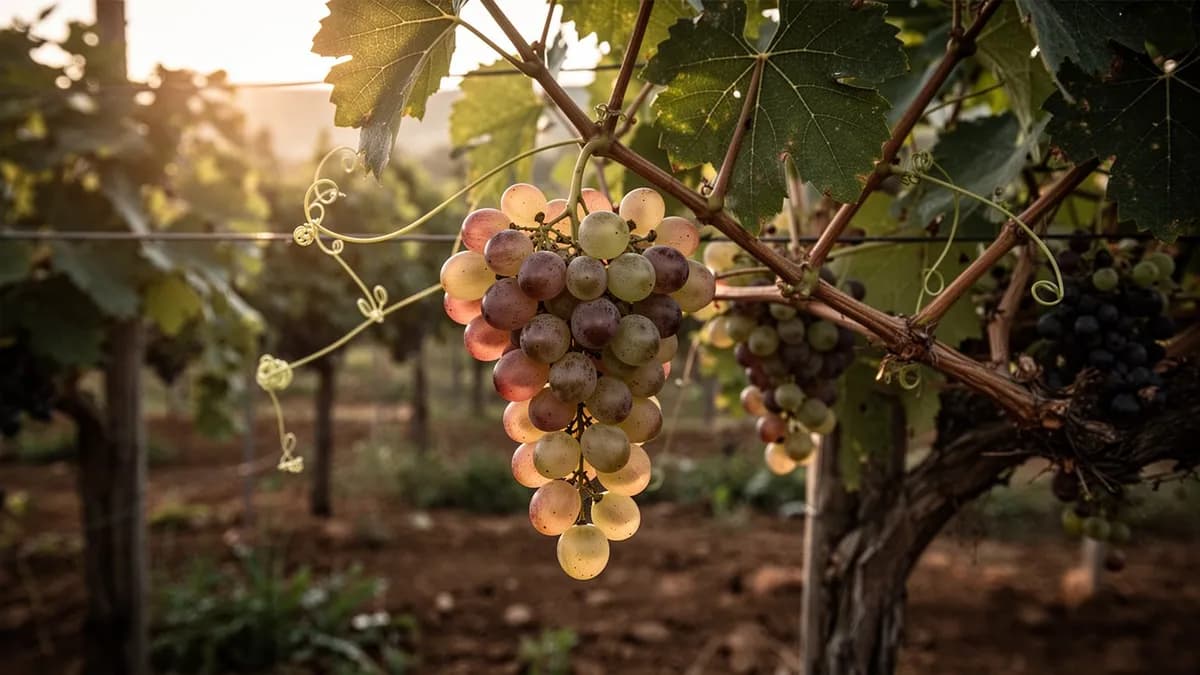
Thompson Seedless Grape
Vitis vinifera 'Thompson Seedless'
At a Glance
The world's most widely planted grape variety, used for table grapes, raisins, and wine. Thompson Seedless grapes are green, sweet, and seedless, requiring hot, dry summers to produce their best fruit. They are vigorous growers that need strong trellising and aggressive winter pruning to control vigor.
Planting & Harvest Calendar
Growth Stages
From Seed to Harvest
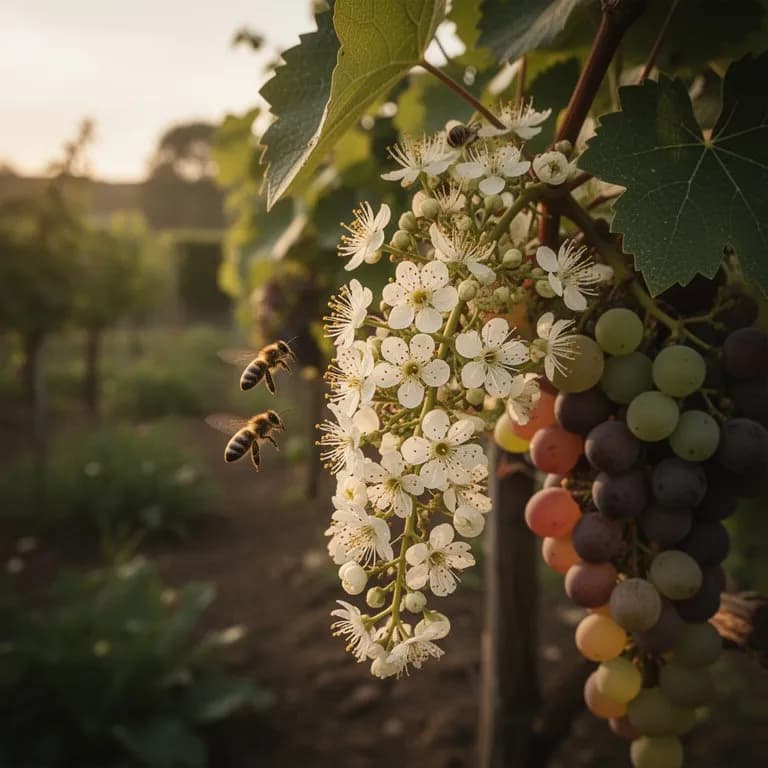
Dormancy and Late-Winter Pruning
Days 0–35
During winter dormancy the vine stands bare, its woody canes storing carbohydrates that will fuel spring growth. Sap pressure begins to build as soil temperatures creep above 7°C (45°F), signaling the end of true dormancy. This window — before buds swell — is the critical time for the season-defining dormant prune. Thompson Seedless is spur-pruned or cane-pruned depending on training system, with 90 percent or more of the previous year's growth removed to concentrate the vine's energy on high-quality fruit rather than excessive foliage.
💡 Care Tip
Prune on a dry day when air temperatures are above freezing. For cordon-spur training, cut all laterals back to 2-node spurs spaced 15-20 cm apart along the permanent arms. Remove any dead, weak, or crossing wood entirely. Apply a dormant oil and copper spray immediately after pruning to eliminate overwintering fungal spores and scale insects from the bark.
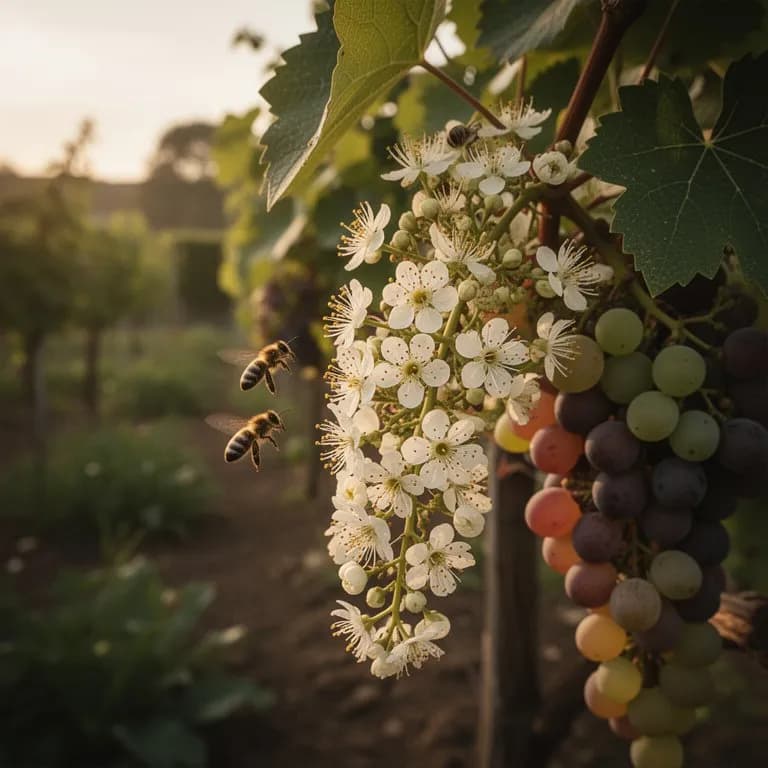
Early spring bud break on a Thompson Seedless vine as stored energy pushes tender new growth from dormant canes
Monthly Care Calendar
What to do each month for your Thompson Seedless Grape
May
You are hereShoot-position actively growing canes along trellis wires, tying loosely to avoid girdling. Remove any lateral growth from the lower trunk to maintain an open structure. Apply a preventive fungicide spray before bloom begins. Monitor closely for grape leafhoppers, mealybugs, and thrips which can cause significant damage to young tissue and developing flower clusters.
Did You Know?
Fascinating facts about Thompson Seedless Grape
Thompson Seedless is the world's single most widely planted table grape variety, accounting for approximately half of all table grapes produced in California and a large share of global raisin production — it is the variety most consumers picture when they think of a 'supermarket green grape'.
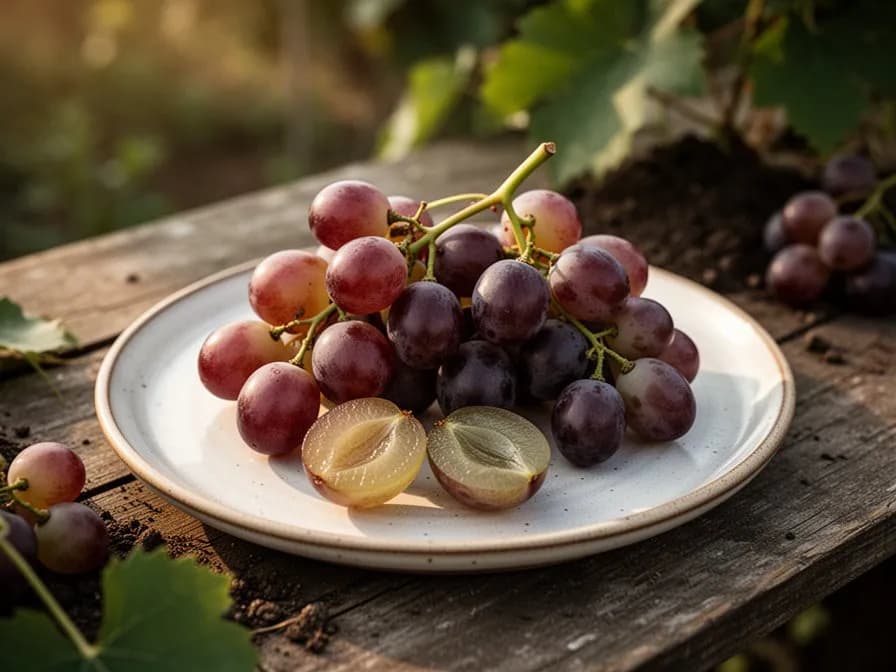
Veraison on Thompson Seedless grapes — berries shift from opaque green to translucent gold as sugars rapidly accumulate
Thompson Seedless grapes require full sun and hot, dry summers with low humidity for optimal production. Plant bare-root vines in early spring in well-drained soil amended with compost. Space vines 6 to 8 feet apart on a sturdy trellis system such as a T-trellis or overhead arbor. These vigorous vines need substantial support to handle heavy crop loads.
Prune aggressively during dormancy, as Thompson Seedless produces fruit on shoots growing from one-year-old canes. Use cane pruning, leaving 8 to 12 buds per cane with two to four fruiting canes per vine. Without heavy pruning, vines become an unproductive tangle. Shoot thinning in spring further improves fruit quality by directing energy to fewer, better clusters.
Irrigate deeply but infrequently, allowing the soil to dry between waterings. Reduce water as berries approach maturity to concentrate sugars. Apply gibberellic acid at bloom to increase berry size, a standard commercial practice. Thompson Seedless is self-fertile and does not require a pollinator. Protect ripening fruit from birds with netting, and watch for sunburn on exposed clusters during extreme heat.
Thompson Seedless, known botanically as Vitis vinifera 'Sultanina', traces its ancient lineage to the vineyards of the Middle East and Central Asia, where seedless or near-seedless grape mutations were selected and propagated by growers thousands of years ago. The variety appears in Persian and Ottoman records under the name 'Sultanina', reflecting its long cultivation across the eastern Mediterranean and into the Caucasus region. For centuries it was prized across Turkey, Iran, and Greece as a fresh eating grape and as the source of the pale sultana raisins that became a staple of European cookery. European traders carried the variety along well-established spice and commodity routes, and it was growing in southern Europe and North Africa by the early modern period.
The grape's American story begins in the 1870s when William Thompson, a Scottish-born horticulturalist who had settled in Yuba City in California's Sacramento Valley, obtained cuttings of the variety from a nursery and planted them on his farm. Thompson recognised the variety's exceptional adaptability to the hot, dry conditions of California's Central Valley and its remarkable versatility — the same vine could supply sweet, crisp fresh grapes for the table or be left to dry in the field into golden raisins. He actively promoted the variety to neighbouring farmers and distributed cuttings generously throughout the region, and by the 1880s it had spread widely across the San Joaquin Valley.
By the early 20th century, Thompson Seedless dominated California's commercial grape industry. The construction of cross-continental railways allowed California raisins and fresh grapes to reach markets across the United States for the first time, and the variety's durability in shipping, its appealing appearance, and its long shelf life made it the commercial standard. The California Raisin Growers Association, formed in the 1890s, built its entire marketing identity around the Thompson Seedless raisin.
Today Thompson Seedless remains the most planted table grape variety in the United States and is widely grown in Australia, South Africa, Chile, Turkey, and the Mediterranean. In home gardens it is cherished for its vigorous growth, heavy yields, and the exceptional satisfaction of harvesting crisp, honey-sweet grapes that require no seed-spitting — truly one of the great dual-purpose fruit plants available to the home grower.
Thompson Seedless grapes are propagated exclusively through cuttings or grafting, as they produce few to no viable seeds. Take hardwood cuttings 10 to 14 inches long from healthy one-year-old canes in late winter during dormant pruning. Include three to four nodes per cutting. Dip the basal end in rooting hormone and plant in a well-drained rooting medium. Bottom heat of 75 degrees Fahrenheit accelerates rooting. Cuttings typically root within six to ten weeks. In commercial production, Thompson Seedless is often bench-grafted onto phylloxera-resistant rootstock.
Thompson Seedless grapes perform best in deep, well-drained sandy loam to loam soil with a pH of 6.0 to 7.0. They tolerate slightly alkaline soils better than American grape varieties. Apply a balanced fertilizer in early spring, transitioning to potassium-heavy feeding after fruit set to improve berry quality. Zinc deficiency is common in alkaline soils and appears as small leaves with mottled yellowing; apply zinc sulfate foliar sprays if needed. Avoid excessive nitrogen, which promotes dense canopy growth and disease.
Check Your Zone
See if Thompson Seedless Grape is suitable for your location.
18°C – 38°C
64°F – 100°F
Thompson Seedless is a heat-loving variety that performs best in regions with long, hot, dry summers closely resembling its Central Valley California or Mediterranean homeland. Optimal ripening and maximum sugar accumulation occur when daytime temperatures consistently reach 32-38°C (90-100°F) during the fruit-maturation period. The vine requires a winter chilling period of 100-200 hours below 7°C (45°F) for proper dormancy and uniform bud break — far fewer chilling hours than most deciduous fruit trees, making it adaptable to mild-winter climates such as USDA zones 7-10. It is less cold-hardy than American hybrid grape varieties and the graft union and lower canes should be protected when winter temperatures are expected to fall below -12°C (10°F). Spring frost after bud break remains the primary temperature risk as shoots are killed at temperatures below -1°C (30°F).
Common issues affecting Thompson Seedless Grape and how to prevent and treat them organically.
The primary challenge with Thompson Seedless is their sensitivity to humid climates, where fungal diseases become unmanageable. Small berry size is common without gibberellic acid treatment or proper cluster thinning. Sunburned berries develop brown patches in extreme heat; position clusters under leaf canopy for protection. Bird damage can be severe without netting. Over-cropping leads to poor sugar development and delayed ripening. In marginal climates, berries may fail to ripen fully before fall rains.
Interplant with low-growing herbs such as basil, oregano, and thyme to repel pests and attract pollinators. Leguminous cover crops like clover or vetch between rows fix nitrogen and reduce weed competition. Avoid planting near cabbage family crops and radishes. Alyssum planted beneath vines attracts beneficial hoverflies that prey on aphids and leafhoppers. Lavender and rosemary planted nearby help deter pests with their aromatic oils.
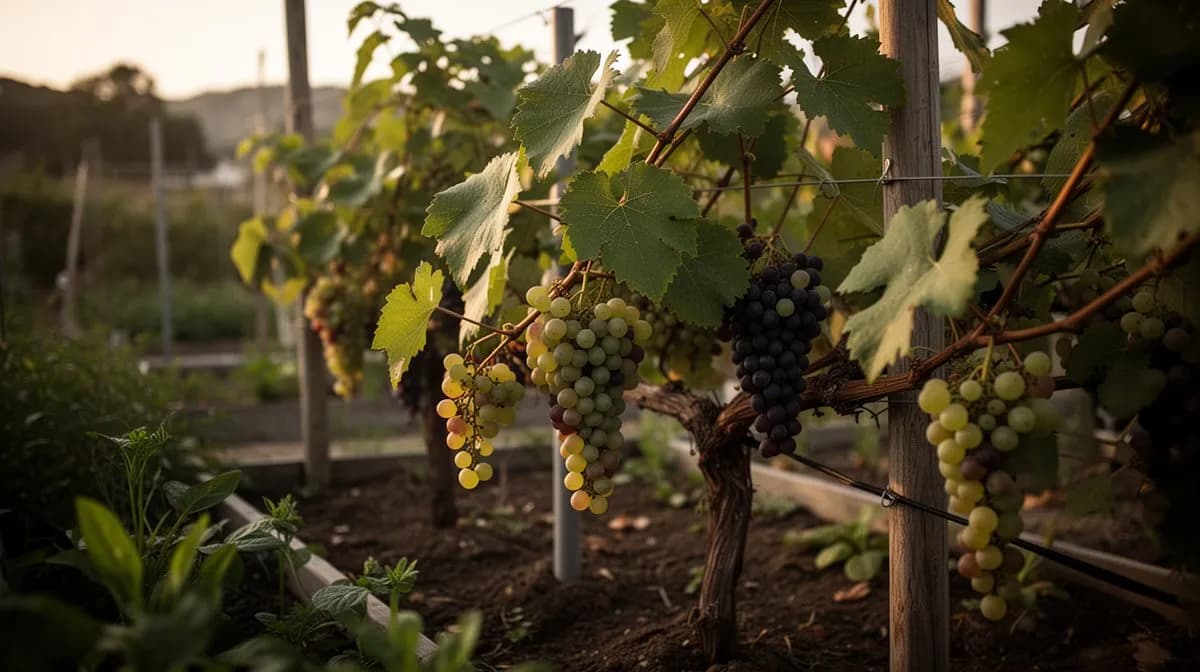
Thompson Seedless performs exceptionally well on an overhead pergola, maximising sun exposure to the fruit-bearing canopy
- 1Thompson Seedless is best adapted to USDA hardiness zones 7-10 and thrives in hot, dry summer climates with low humidity. In zones 6 and colder, protect the graft union each winter by mounding 20-25 cm of soil over the base of the vine after leaf drop, removing it again in early spring before buds swell.
- 2Choose a planting site that receives a minimum of 8 hours of direct sunlight daily — full sun from morning through afternoon is ideal. Thompson Seedless grown in partial shade will be vigorous and leafy but will produce sparse, poorly ripened fruit with low sugar content.
- 3For maximum berry size, apply a properly diluted gibberellic acid (GA3) solution to developing clusters at two stages: at fruit set (when berries are pea-sized) to thin and space berries within the cluster, and again at early berry growth to elongate individual berries. Follow label instructions precisely as over-application causes soft texture and poor shelf life.
- 4Train young vines on a double-cordon system (two permanent horizontal arms extending in opposite directions from the top of the trunk) for the most efficient and manageable spur-pruned framework. Establish the trunk and cordons over the first two to three years before allowing any crop to set.
- 5Drip irrigation positioned at the base of the vine trunk delivers water efficiently to the root zone while keeping the canopy and soil surface dry — a critical advantage for reducing powdery mildew pressure and preventing the shallow roots that result from frequent light surface irrigation.
- 6Thompson Seedless produces better-quality fruit when the soil is allowed to dry slightly between irrigations during the berry sizing phase rather than being kept continuously moist. A deep weekly soaking is far preferable to daily shallow watering, as it encourages roots to grow deeply and the vine to develop drought resilience.
- 7Avoid applying high-nitrogen fertilisers after early spring as excessive nitrogen stimulates canopy growth at the direct expense of fruit production and ripening. Use a balanced fertiliser in early spring and switch to a low-nitrogen, high-potassium blend after fruit set to support sugar accumulation in the developing berries.
- 8The natural waxy bloom on the surface of ripe Thompson Seedless berries is a sign of quality and gentle handling — do not wash grapes until just before eating, as washing removes this protective coating and significantly shortens storage life in the refrigerator.
- 9Propagate Thompson Seedless from hardwood cuttings taken during the dormant pruning season in late winter. Select healthy, pencil-thick canes from the previous season's growth, cut them into 30 cm sections with three to four nodes, and callus them in a cool, slightly moist medium for two to three weeks before planting in nursery beds with the top bud just above the soil surface.
- 10In regions with persistent powdery mildew pressure, a preventive spray programme beginning at bud break and continuing on a 10-14 day schedule through veraison is far more effective than attempting to cure established infections. Sulfur-based fungicides applied in the morning before temperatures exceed 32°C (90°F) are the most reliable organic option.
Thompson Seedless grapes ripen in late August through September. Berries should be light green to golden yellow, translucent, and sweet when tasted. Use a refractometer to measure sugar content; harvest when Brix reaches 19 to 22 degrees for table grapes or higher for raisins. Cut clusters with sharp shears and handle gently to preserve the waxy bloom. For raisin production, lay clusters on paper trays between vine rows to dry in the sun for two to three weeks.
Fresh Thompson Seedless grapes store for two to four weeks in the refrigerator at 30 to 32 degrees Fahrenheit with high humidity. Pack loosely in ventilated containers. These grapes are the world's primary raisin variety; sun-dry or use a dehydrator at 135 degrees for 24 to 48 hours. They also freeze well for use in smoothies and cooking. Thompson Seedless makes excellent white grape juice, light wines, and grape seed oil from the rare seeds that occasionally develop.
Plan your garden with ease
Love growing Thompson Seedless Grape? Use our free garden planner to design your beds, track planting dates, and get personalized care reminders.
Nutritional Info
Per 100g serving
67
Calories
Health Benefits
- Excellent natural source of easily digestible sugars — primarily glucose and fructose — providing rapid, sustained energy ideal for active gardeners and athletes
- Contains resveratrol concentrated in the skin, a polyphenol antioxidant widely studied for its cardiovascular protective effects and potential anti-inflammatory properties
- Rich in vitamin K (14.6 mcg per 100g, approximately 18% DV), an essential fat-soluble vitamin that supports healthy blood clotting and bone mineral density
- Provides copper (0.127 mg per 100g, around 14% DV), a trace mineral critical for iron metabolism, connective tissue formation, and antioxidant enzyme function
- Contains quercetin, kaempferol, and other flavonoid antioxidants with documented anti-inflammatory and immune-modulating activity in laboratory and clinical research
- The thin edible skin of Thompson Seedless delivers a meaningful portion of the fruit's total antioxidant content and dietary fibre, making it important to eat the skin rather than discarding it
💰 Why Grow Your Own?
A single bare-root Thompson Seedless grapevine typically costs $12-25 from a nursery and, once established by its third or fourth year, will reliably produce 10-25 kg of fresh grapes annually — the equivalent of $50-150 worth of organic seedless green grapes at typical retail prices of $5-7 per kg. Over a vine's productive life of 30-50 years the cumulative savings are exceptional. The variety's dual-purpose nature multiplies this value further: surplus fruit not eaten fresh can be sun-dried into golden raisins (retail value $15-20 per kg) at zero additional cost beyond the patience to leave them on drying racks in the sun. Home-made grape juice and fresh-squeezed grape concentrate add further savings compared to premium store-bought equivalents.
Quick Recipes
Simple recipes using fresh Thompson Seedless Grape
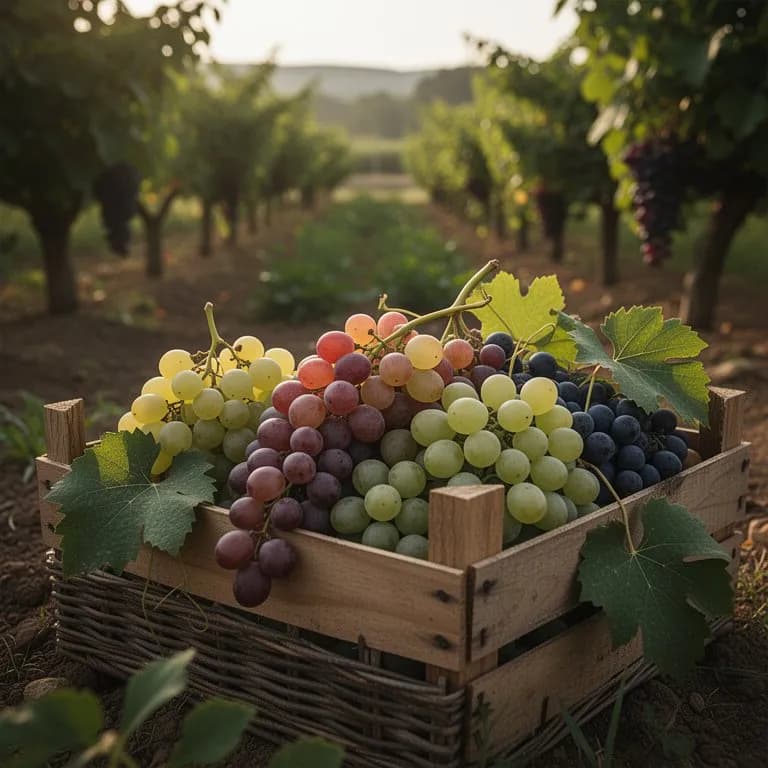
Honey-Roasted Thompson Seedless Grape Flatbread
25 minutesA simple yet stunning flatbread that transforms fresh Thompson Seedless grapes into a deeply caramelised topping through high-heat roasting. The grapes burst and concentrate into jammy, intensely sweet-tart morsels that contrast beautifully with creamy whipped ricotta, salty crumbled feta, and fragrant fresh thyme on a crispy base.
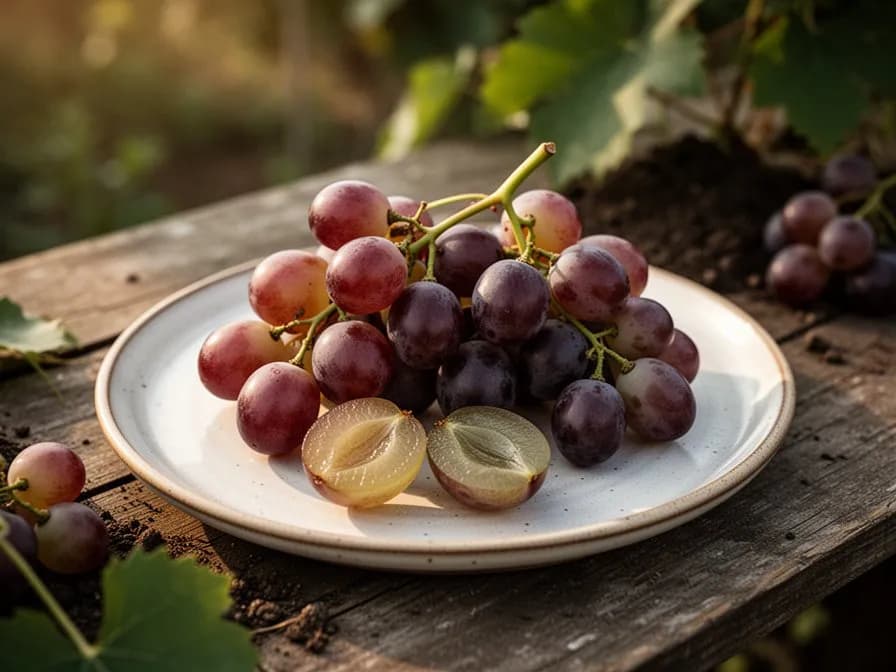
Thompson Seedless Sun-Dried Raisins
15 minutes active, 14-21 days dryingThe most satisfying way to preserve a bumper Thompson Seedless harvest is to dry them into golden raisins, exactly as California's Central Valley farmers have done for over a century. Sun-drying requires nothing more than the grapes themselves and a few weeks of warm, dry weather. The result is a product far superior in flavour to anything available in shops.
Frozen Thompson Seedless Grape Sorbet
10 minutes active, 4 hours freezingA completely natural, no-added-sugar frozen treat that showcases the pure honey-sweet flavour of home-grown Thompson Seedless grapes. Blended from nothing but frozen grapes and a splash of lemon juice, this minimalist sorbet has an astonishingly clean, bright flavour and a smooth texture that rivals any commercial frozen dessert.
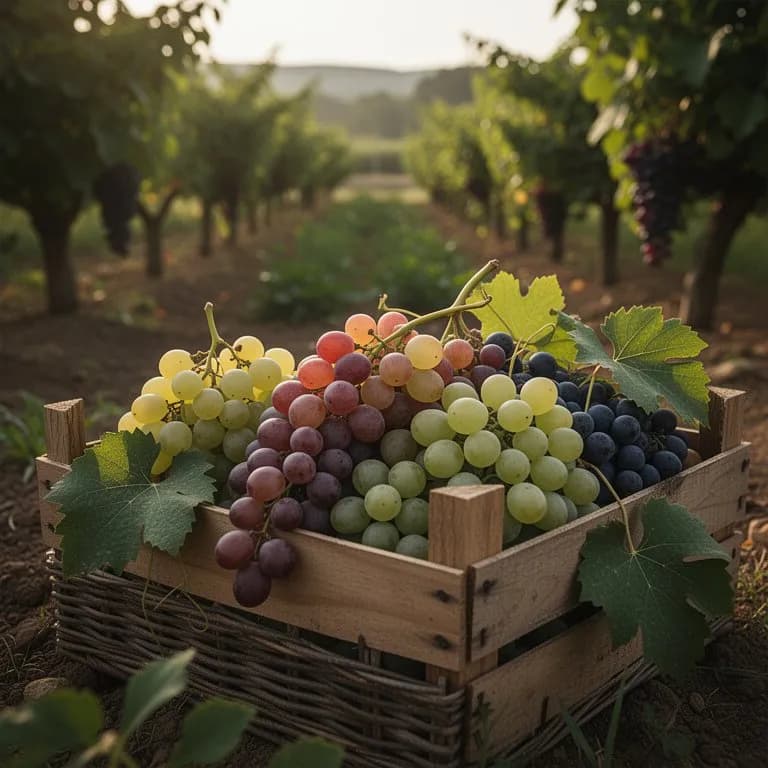
Harvesting ripe Thompson Seedless clusters at peak sweetness — the standard for California table grapes and sun-dried raisins
Yield & Spacing Calculator
See how many Thompson Seedless Grape plants fit in your garden bed based on the recommended 240cm spacing.
0
Thompson Seedless Grape plants in a 4×4 ft bed
0 columns × 0 rows at 240cm spacing
Popular Varieties
Some of the most popular thompson seedless grape varieties for home gardeners, each with unique characteristics.
Thompson Seedless
The standard green seedless grape, extremely versatile for fresh eating, raisins, and wine. Requires hot dry climate for best production.
Flame Seedless
A red seedless table grape with crisp texture and sweet flavor, ripening earlier than Thompson and with better cold tolerance.
Crimson Seedless
A late-season red seedless grape with excellent storage qualities, firm berries, and a neutral sweet flavor popular in commercial production.
Princess
A large-berried white seedless grape with muscat flavor, vigorous growth, and good heat tolerance for desert regions.
Thompson Seedless grapes are the standard fresh snacking grape worldwide. They are the primary raisin grape, used in baking, cereals, and trail mixes. Fresh grapes are excellent in salads, chicken salad, and fruit platters. They produce light, crisp white wines and delicate grape juice. Frozen grapes make a popular healthy snack alternative to candy.
When should I plant Thompson Seedless Grape?
Plant Thompson Seedless Grape in March, April. It takes approximately 730 days to reach maturity, with harvest typically in August, September.
What are good companion plants for Thompson Seedless Grape?
Thompson Seedless Grape grows well alongside Basil, Oregano. Companion planting can improve growth, flavor, and natural pest control.
What hardiness zones can Thompson Seedless Grape grow in?
Thompson Seedless Grape thrives in USDA hardiness zones 6 through 10. With greenhouse protection, it may be grown in zones 4 through 11.
How much sun does Thompson Seedless Grape need?
Thompson Seedless Grape requires Full Sun (6-8h+). This means at least 6-8 hours of direct sunlight daily.
How far apart should I space Thompson Seedless Grape?
Space Thompson Seedless Grape plants 240cm (94 inches) apart for optimal growth and air circulation.
What pests and diseases affect Thompson Seedless Grape?
Common issues include Powdery Mildew, Grape Leafhopper, Botrytis Bunch Rot, Grape Mealybug. Prevention through good garden practices like crop rotation, proper spacing, and companion planting is the best approach. See the detailed pests and diseases section above for symptoms, prevention, and treatment for each.
How do I store Thompson Seedless Grape after harvest?
Fresh Thompson Seedless grapes store for two to four weeks in the refrigerator at 30 to 32 degrees Fahrenheit with high humidity. Pack loosely in ventilated containers. These grapes are the world's primary raisin variety; sun-dry or use a dehydrator at 135 degrees for 24 to 48 hours. They also freez...
What are the best Thompson Seedless Grape varieties to grow?
Popular varieties include Thompson Seedless, Flame Seedless, Crimson Seedless, Princess. Each has unique characteristics suited to different growing conditions and culinary preferences. See the varieties section above for detailed descriptions.
What soil does Thompson Seedless Grape need?
Thompson Seedless grapes perform best in deep, well-drained sandy loam to loam soil with a pH of 6.0 to 7.0. They tolerate slightly alkaline soils better than American grape varieties. Apply a balanced fertilizer in early spring, transitioning to potassium-heavy feeding after fruit set to improve be...
Can I grow Thompson Seedless grapes outside California and the Mediterranean?
Yes, but Thompson Seedless is strongly heat-adapted and performs best in USDA zones 7-10 with long, hot, dry summers. It will grow and fruit in zone 6 with winter protection and a warm microclimate (south-facing wall, urban heat island), but berry sugar levels and the quality of the harvest will be lower than in warmer regions. In cool, humid climates the variety is more susceptible to downy and powdery mildew and the fruit often fails to ripen fully before autumn frosts. In zones 5 and below it is generally not recommended without a greenhouse or heated cold frame for winter protection.
Why does my Thompson Seedless have small, irregular berries in the cluster?
Small, poorly developed berries scattered through an otherwise normal cluster are called 'shot berries' or 'hens and chicks' and result from incomplete pollination or irregular fruit set during bloom. Thompson Seedless is prone to this under cool, wet, or windy conditions at bloom time that impede the natural pollination process. Ensuring the vine is not stressed during bloom and avoiding overhead irrigation during that window significantly reduces shot berry incidence. Commercial growers routinely apply gibberellic acid at fruit set to thin and size berries more uniformly — home gardeners can do the same with careful label-rate applications.
How long does it take Thompson Seedless grapes to ripen from bud break to harvest?
Thompson Seedless is a mid-season to late-season variety that typically requires 145-165 days from bud break to harvest. In California's Central Valley, where the variety is best adapted, bud break occurs in late February to early March and harvest falls in late July through August. In cooler climates with later bud break, harvest may push into September or even October. Heat accumulation (growing degree days) is a better predictor of ripeness timing than the calendar — the variety performs best in climates accumulating 1,800-2,200 growing degree days (base 10°C) between bud break and harvest.
What is the best way to make home-dried raisins from Thompson Seedless grapes?
Sun-drying is the traditional and most flavourful method. Harvest mature clusters at full ripeness (18-22° Brix), lay them in a single layer on clean wooden or food-safe plastic trays, and place them in a sunny, well-ventilated location. Cover loosely with cheesecloth or fine mesh to protect from insects without blocking airflow. Drying takes 2-4 weeks depending on temperature and humidity — ideal conditions are sustained temperatures above 35°C (95°F) with low humidity. Berries are ready when they are plump, chewy, and no longer feel wet at the centre. For faster drying, briefly dip clusters in near-boiling water for 30 seconds before placing on trays — this cracks the skin's waxy surface and accelerates moisture loss significantly.
Does Thompson Seedless need another grape variety for cross-pollination?
No. Thompson Seedless is self-fertile and does not require a second variety for pollination. Its flowers produce viable pollen and the vine pollinates itself without any assistance. This makes it ideal for small gardens where only one vine is desired. That said, planting a second variety nearby causes no harm and increases overall biodiversity and insect activity in the garden, which can modestly improve fruit set during bloom periods when weather conditions are less than ideal.
How should I prune Thompson Seedless to get the best harvest each year?
Thompson Seedless is most commonly managed on a two-arm bilateral cordon spur-pruning system. The permanent cordon arms extend horizontally along trellis wires from the top of the trunk, and all laterals growing from the cordons are cut back each winter to 2-node spurs spaced 15-20 cm apart. Each spur produces 1-2 fruiting shoots the following season, and only the strongest replacement shoot is retained at the next winter's pruning. Remove approximately 85-90 percent of the previous year's growth annually. This severe-seeming pruning is essential because Thompson Seedless fruits only on new growth arising from one-year-old wood — vines that are under-pruned produce excessive foliage, poor fruit sizing, and eventually decline in yield quality.
Ready to Grow Thompson Seedless Grape?
Add Thompson Seedless Grape to your garden plan and start designing your perfect layout.

Vladimir Kusnezow
Gardener and Software Developer
Zone 6b gardener. Growing vegetables and fruits in soil and hydroponics for 6 years. I built PlotMyGarden to plan my own gardens.
Jump to Section