
Queen Anne's Lace
Daucus carota
At a Glance
It's planting season for Queen Anne's Lace! Start planning your garden now.
A graceful biennial wildflower with flat, lacy umbels of tiny white flowers that resemble delicate doilies, common in meadows and roadsides. Queen Anne's lace is the wild ancestor of the garden carrot and an important host plant for swallowtail butterfly larvae. It self-sows readily and adds an airy, natural charm to wildflower meadows.
Planting & Harvest Calendar
Growth Stages
From Seed to Harvest
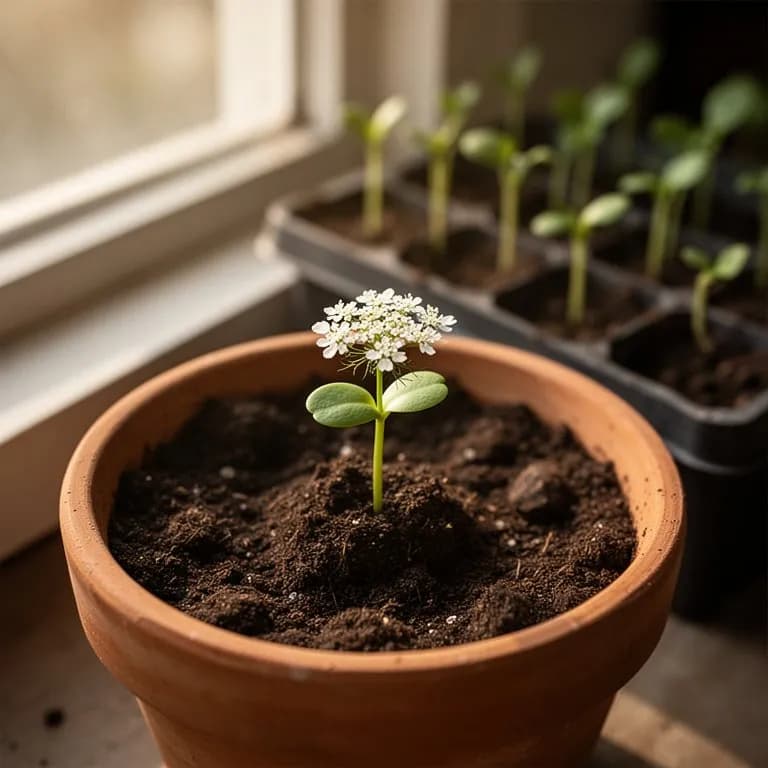
Seed Germination
Days 0–21
Seeds require light to germinate and benefit from cold stratification. Surface-sow on moist soil and keep consistently damp. Germination can take 1 to 3 weeks depending on temperature, with optimal germination occurring between 15 and 20 degrees Celsius.
💡 Care Tip
Do not cover seeds with soil — they need light exposure. Mist gently to keep the surface moist without washing seeds away.
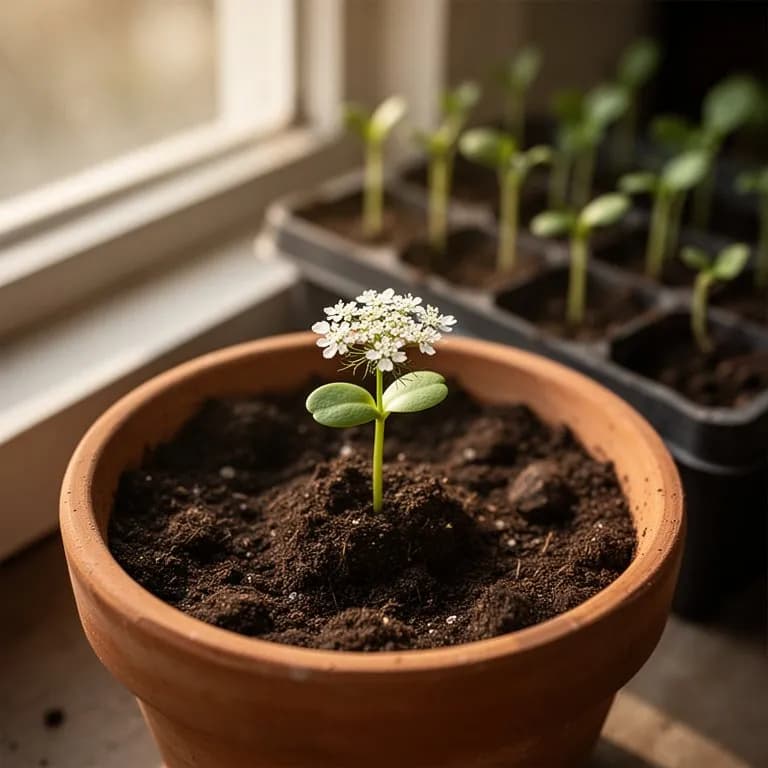
Early seedlings display the characteristic finely divided leaves that resemble their cultivated carrot relatives
Monthly Care Calendar
What to do each month for your Queen Anne's Lace
May
You are hereSecond-year plants begin bolting. Stake tall stems if necessary. Mulch around plants to retain moisture and suppress competing weeds. First-year rosettes are now well established.
Did You Know?
Fascinating facts about Queen Anne's Lace
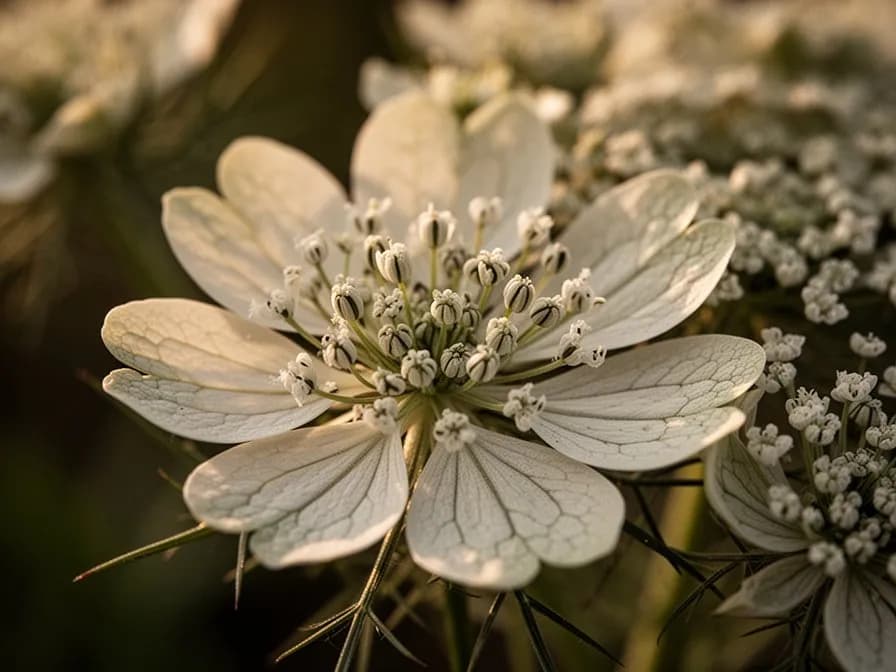
The tiny dark purple or red floret at the center of many Queen Anne's lace umbels is thought to mimic an insect, attracting pollinators to the flower cluster — though not every umbel produces this distinctive central floret.
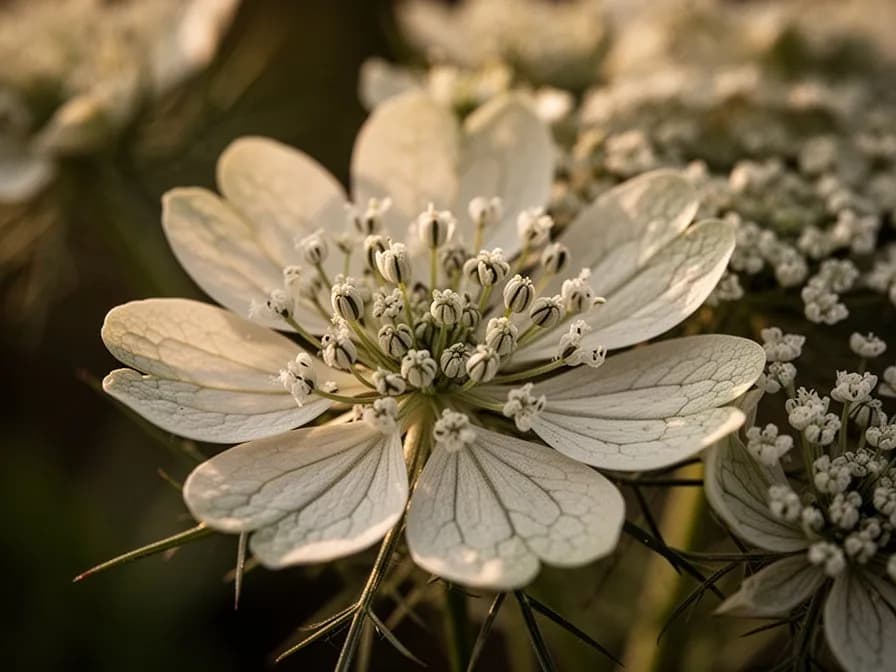
WARNING: Always confirm identification by checking for hairy stems and a carrot scent — poison hemlock has smooth, purple-spotted stems and is deadly toxic
Direct sow Queen Anne's lace seeds in autumn or early spring on bare ground in full sun. As a biennial, it produces a ferny rosette of carrot-like foliage the first year and tall flower stems with lacy white umbels the second year before dying. The plant self-sows prolifically and once introduced to a site, it will maintain itself indefinitely without any further input.
Queen Anne's lace requires absolutely no care once established. It thrives in poor, dry, disturbed soil and is commonly found along roadsides, in abandoned fields, and on waste ground. Do not water, feed, or amend the soil. Rich conditions produce lush foliage but fewer flowers. The plant's tap root, which is the wild ancestor of the cultivated carrot, allows it to extract moisture from deep in the soil.
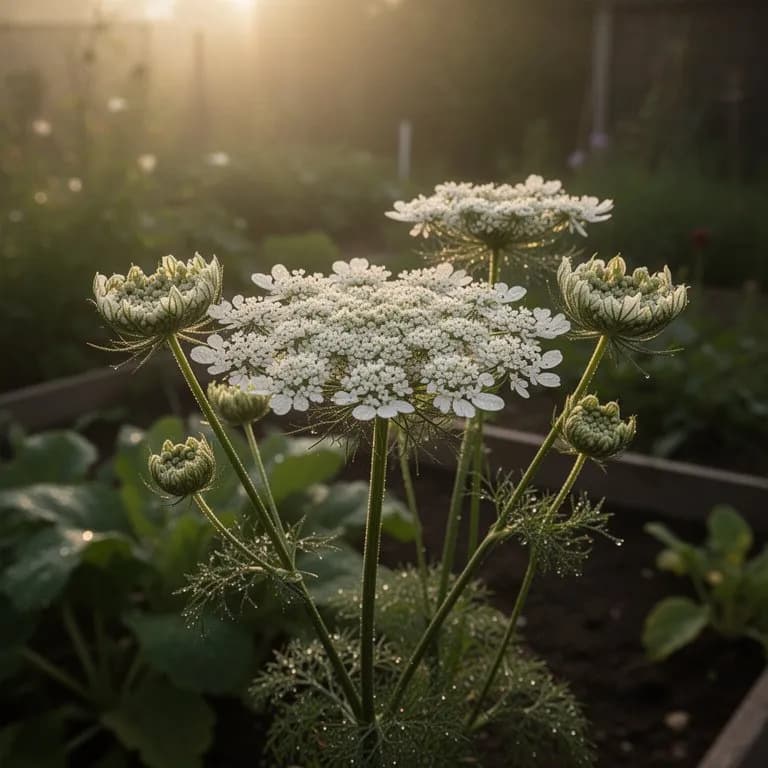
The flat-topped, lacy white flower clusters appear in early to midsummer and attract an impressive array of beneficial insects. As the flowers age, the umbels curl inward to form a distinctive bird's nest shape that holds the seeds. CAUTION: Queen Anne's lace closely resembles the deadly poisonous poison hemlock (Conium maculatum) and water hemlock. Always verify identification by the single dark floret in the center of the flower cluster and the hairy stems that distinguish it from the smooth, purple-spotted stems of poison hemlock.
Queen Anne's lace (Daucus carota) is native to temperate regions of Europe, southwestern Asia, and North Africa. As the wild progenitor of the domesticated carrot, it holds a central place in agricultural history. Archaeological evidence from sites in Switzerland and southern Germany suggests that humans have gathered and consumed wild carrot roots for at least 5000 years. The earliest cultivated carrots, selected for larger and less woody roots, appeared in Persia and Afghanistan around the 10th century CE. These early cultivated forms were purple and yellow rather than orange. The familiar orange carrot was developed in the Netherlands during the 16th and 17th centuries, possibly in honor of William of Orange, though this origin story remains debated by historians. Queen Anne's lace was introduced to North America by European colonists in the 17th century, likely arriving as a contaminant in crop seed or in ship ballast soil. It naturalized rapidly across the continent and is now found in all 50 US states and throughout southern Canada. In many regions it is classified as an invasive or noxious weed due to its prolific seed production and ability to dominate meadows and roadsides. Despite its weedy reputation, the plant plays a valuable ecological role as a nectar source for hundreds of pollinator species and as a host plant for the black swallowtail butterfly. In traditional European herbalism, the roots, seeds, and leaves were used to treat kidney and bladder ailments, digestive complaints, and as a diuretic. The plant remains an important component of wildflower meadow seed mixes in ecological restoration projects across Europe and North America.
Queen Anne's lace seeds germinate readily when scattered on bare soil in autumn or early spring. The seeds have small barbs that help them adhere to soil surfaces. No pretreatment is needed for autumn-sown seed. For spring sowing, cold-stratify in moist sand for four weeks to improve germination rates. Seeds germinate in fourteen to twenty-one days at 55 to 65 degrees Fahrenheit. The biennial growth pattern means flowers appear in the second year from seed.
Queen Anne's lace thrives in poor, dry, well-drained soil with a pH of 5.5 to 8.0. It requires no soil amendment, fertilization, or any other input. The plant naturally colonizes roadsides, waste ground, and abandoned fields where soil is compacted and nutrient-poor. Rich garden soil promotes excessive foliage growth and can reduce flowering. Its deep taproot accesses moisture and nutrients from well below the surface.
Check Your Zone
See if Queen Anne's Lace is suitable for your location.
-5°C – 30°C
23°F – 86°F
Queen Anne's lace is extremely cold-hardy and thrives across USDA zones 3 through 9. Established rosettes can survive winter temperatures down to minus 30 degrees Celsius with snow cover. Seeds germinate best between 15 and 20 degrees Celsius. The plant grows actively in the 10 to 25 degree Celsius range and tolerates summer heat up to 35 degrees Celsius when moisture is adequate. Flowering is triggered by the vernalization period of sustained cold in winter followed by lengthening days in spring.
Common issues affecting Queen Anne's Lace and how to prevent and treat them organically.
The primary concern is that Queen Anne's lace can become invasive through prolific self-seeding, and in some regions it is classified as a noxious weed. Control spread by removing flower heads before seeds mature. The critical safety issue is its resemblance to deadly poison hemlock, which has killed people who misidentified it. Always confirm identification before any culinary use. The plant can also harbor carrot rust fly which may spread to cultivated carrots nearby.
Queen Anne's lace is an important host plant for swallowtail butterfly caterpillars and attracts numerous beneficial insects including parasitic wasps, lacewings, and hoverflies that prey on garden pests. Plant near vegetable gardens to attract beneficial predators, but at a safe distance to avoid harboring carrot rust fly. It combines beautifully with other meadow wildflowers including cornflowers, poppies, and ox-eye daisies for a cottage meadow effect.
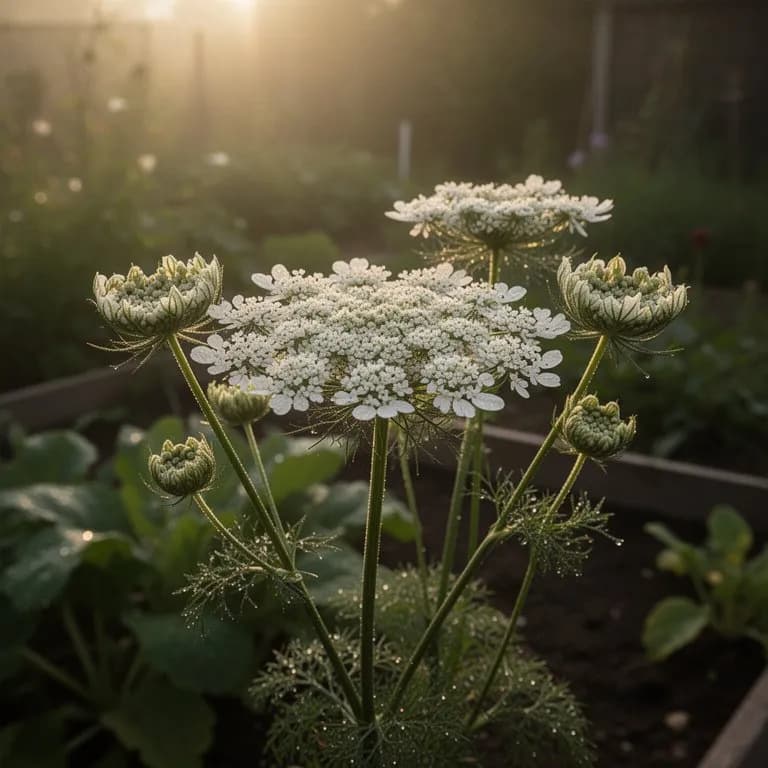
A naturalized stand of wild carrot in peak summer bloom attracts a wide array of beneficial insects
- 1Surface-sow seeds and press gently into the soil without covering them — Queen Anne's lace seeds require light exposure to trigger germination and will fail to sprout if buried.
- 2Cold-stratify seeds for 2 to 4 weeks in damp sand in the refrigerator before spring sowing to dramatically improve germination rates from roughly 50 percent to over 85 percent.
- 3Plant in full sun to partial shade in well-drained soil. Queen Anne's lace tolerates poor, rocky, and sandy soils remarkably well and actually produces more aromatic roots and seeds in lean conditions.
- 4CRITICAL SAFETY TIP: Before foraging, always crush a leaf and smell the root — Queen Anne's lace smells distinctly of carrot. If the plant lacks this scent or has smooth stems with purple blotches, it may be poison hemlock, which is deadly. When in doubt, do not consume any part of the plant.
- 5Allow plants to self-seed in a dedicated area but deadhead aggressively near vegetable beds and neighboring properties to prevent invasive spread into unwanted areas.
- 6Grow Queen Anne's lace near vegetable gardens as a trap crop for pests like carrot rust fly and as a nursery for beneficial predatory insects such as lacewings, parasitic wasps, and ladybugs.
- 7Harvest first-year roots in late autumn after the first frost but before the ground freezes hard — cold exposure converts some starches to sugars and improves the flavor considerably.
- 8To create a continuous supply, sow seeds in successive patches each spring so that you always have both first-year plants for root harvest and second-year plants for flowers and seeds.
- 9Avoid planting directly adjacent to cultivated carrots, parsley, or celery as these related Apiaceae family members share pests and diseases and may cross-pollinate.
- 10Dried seed heads make excellent additions to winter flower arrangements and wreaths. Harvest stems when the bird's nest is fully formed but still greenish-brown for the best structural integrity.
Cut Queen Anne's lace stems for elegant, airy arrangements when the flat umbels are fully open. The delicate white flowers create a beautiful lacy filler in mixed bouquets, complementing roses, delphiniums, and other summer flowers. Stems last five to seven days in water. For dried arrangements, pick when fully open and press between heavy books or dry in silica gel. The curled bird's nest seed heads are also attractive in dried displays.
As seeds ripen, the umbel curls inward to form the distinctive 'bird's nest' that aids seed dispersal
Queen Anne's lace self-sows so freely that seed storage is rarely necessary. If desired, collect the curled seed heads when dry and shake out the small, barbed seeds. Store in paper envelopes in a cool, dry location. The flowers can be pressed flat for botanical art and crafts. Dried seed heads maintain their bird's nest shape and make interesting additions to winter arrangements. The first-year roots can be stored like carrots in damp sand.
Plan your garden with ease
Love growing Queen Anne's Lace? Use our free garden planner to design your beds, track planting dates, and get personalized care reminders.
Nutritional Info
Per 100g serving
41
Calories
Health Benefits
- Young first-year roots contain beta-carotene, though less than cultivated carrots, giving them a pale cream color
- Leaves are rich in chlorophyll and contain notable amounts of vitamin K and folate
- Seeds contain volatile oils including geraniol, pinene, and carotol with potential antioxidant activity
- The root provides more fiber per gram than cultivated carrots due to its denser, less watery texture
- Flowers contain flavonoids including luteolin and apigenin, which have documented anti-inflammatory properties
- WARNING: Only consume after positive identification by an experienced forager — confusion with poison hemlock is potentially fatal
💰 Why Grow Your Own?
Queen Anne's lace is a freely available wild plant that self-seeds abundantly once established, eliminating any ongoing seed or plant purchase costs. A single planting can provide an indefinite supply of roots, flowers, and seeds for culinary and herbal use. As a pollinator magnet, it reduces the need for purchased beneficial insect attractants and can improve yields of nearby vegetable crops through enhanced pollination. Its deep taproot also breaks up compacted subsoil, functioning as a free natural soil aerator. However, always factor in the time investment needed to learn proper identification skills to safely distinguish it from toxic look-alikes.
Quick Recipes
Simple recipes using fresh Queen Anne's Lace
Wild Carrot Root Soup with Thyme
40 minutesA rustic, earthy soup made from first-year wild carrot roots. The roots have a more intense and slightly bitter flavor compared to cultivated carrots, producing a deeply aromatic soup that pairs beautifully with fresh thyme and a swirl of cream. Only use roots that have been positively identified by an experienced forager.
Queen Anne's Lace Flower Fritters
25 minutesDelicate and crispy fritters made from fresh flower umbels dipped in a light tempura-style batter and fried until golden. The flowers have a mild, slightly sweet flavor with subtle herbal notes. A beautiful and unusual appetizer that showcases edible wild flowers at their best. Harvest only fully identified blooms from unsprayed areas.
Wild Carrot Seed Spice Blend
10 minutesThe seeds of Queen Anne's lace have a warm, aromatic flavor profile reminiscent of a cross between caraway and dill with subtle citrus undertones. Lightly toasted and ground, they make an exceptional spice for breads, root vegetable dishes, and seasoning blends. This versatile condiment keeps for months in an airtight jar.
The slender white taproot of wild carrot is edible when young and has a strong carrot-like flavor
Yield & Spacing Calculator
See how many Queen Anne's Lace plants fit in your garden bed based on the recommended 30cm spacing.
16
Queen Anne's Lace plants in a 4×4 ft bed
4 columns × 4 rows at 30cm spacing
Popular Varieties
Some of the most popular queen anne's lace varieties for home gardeners, each with unique characteristics.
Dara
A cultivated selection in a mix of white, pink, and deep burgundy flower colors, bred specifically for cut flower use. Stunning in arrangements.
Wild Species
The common wild form with pure white lacy umbels featuring a single dark floret at the center, the ancestor of all cultivated carrots.
Queen Anne's lace is the wild ancestor of the cultivated carrot, and its first-year taproot is edible when young and tender, tasting like a woody, concentrated carrot. The flowers can be dipped in batter and fried as fritters, or used as an edible garnish. The seeds have a caraway-like flavor and can be used as a spice. CRITICAL WARNING: Never harvest from the wild without expert identification, as confusion with deadly poison hemlock has caused fatalities.
When should I plant Queen Anne's Lace?
Plant Queen Anne's Lace in March, April, May. It takes approximately 365 days to reach maturity, with harvest typically in June, July, August.
What are good companion plants for Queen Anne's Lace?
Queen Anne's Lace grows well alongside Bachelor's Button, Cosmos, Coneflower. Companion planting can improve growth, flavor, and natural pest control.
What hardiness zones can Queen Anne's Lace grow in?
Queen Anne's Lace thrives in USDA hardiness zones 3 through 10. With greenhouse protection, it may be grown in zones 1 through 11.
How much sun does Queen Anne's Lace need?
Queen Anne's Lace requires Full Sun (6-8h+). This means at least 6-8 hours of direct sunlight daily.
How far apart should I space Queen Anne's Lace?
Space Queen Anne's Lace plants 30cm (12 inches) apart for optimal growth and air circulation.
What pests and diseases affect Queen Anne's Lace?
Common issues include Carrot Rust Fly, Aster Yellows. Prevention through good garden practices like crop rotation, proper spacing, and companion planting is the best approach. See the detailed pests and diseases section above for symptoms, prevention, and treatment for each.
How do I store Queen Anne's Lace after harvest?
Queen Anne's lace self-sows so freely that seed storage is rarely necessary. If desired, collect the curled seed heads when dry and shake out the small, barbed seeds. Store in paper envelopes in a cool, dry location. The flowers can be pressed flat for botanical art and crafts. Dried seed heads main...
What are the best Queen Anne's Lace varieties to grow?
Popular varieties include Dara, Wild Species. Each has unique characteristics suited to different growing conditions and culinary preferences. See the varieties section above for detailed descriptions.
What soil does Queen Anne's Lace need?
Queen Anne's lace thrives in poor, dry, well-drained soil with a pH of 5.5 to 8.0. It requires no soil amendment, fertilization, or any other input. The plant naturally colonizes roadsides, waste ground, and abandoned fields where soil is compacted and nutrient-poor. Rich garden soil promotes excess...
How do I tell Queen Anne's lace apart from poison hemlock?
There are several reliable differences. Queen Anne's lace has hairy stems, while poison hemlock has smooth stems with distinctive purple or reddish blotches. Crush a Queen Anne's lace leaf and it smells like carrot; poison hemlock has an unpleasant musty odor. Queen Anne's lace typically grows 60 to 120 cm tall, while poison hemlock can reach 180 to 300 cm. Queen Anne's lace often has a single dark purple floret at the center of its umbel, which poison hemlock lacks. The root of Queen Anne's lace is slender and white with a strong carrot scent. If you cannot confirm all of these features with certainty, do not touch or consume the plant. Poison hemlock is lethal even in small amounts.
Is Queen Anne's lace considered invasive?
Yes, in many parts of North America, Queen Anne's lace is classified as an invasive or noxious weed. It is listed as a noxious weed in at least 12 US states including Iowa, Michigan, Ohio, and Washington. A single plant can produce thousands of seeds that remain viable in soil for up to 5 years. If you choose to grow it, contain its spread by deadheading most flower heads before seeds mature, growing it in a bordered area, or mowing adjacent areas regularly to prevent establishment beyond your intended planting zone.
Can I eat the root of Queen Anne's lace like a regular carrot?
Yes, the first-year taproot is edible and tastes like a strong, slightly bitter carrot. It is best harvested in late autumn of the first year when it is still tender. By the second year, the root becomes extremely woody and fibrous as the plant channels its energy into flowering, making it inedible. Young roots can be eaten raw, roasted, sauteed, or added to soups. Always confirm identification with absolute certainty before consuming any part of the plant.
Does Queen Anne's lace attract beneficial insects?
Queen Anne's lace is one of the most effective native pollinator plants available. Its flat, open umbel structure provides easy access to nectar for a huge range of insects including parasitic wasps, hoverflies, lacewings, ladybugs, native bees, and butterflies. It is a larval host plant for the black swallowtail butterfly. Many organic farmers intentionally maintain patches of Queen Anne's lace near crop fields as insectary strips to boost populations of natural pest predators.
How do I prevent Queen Anne's lace from taking over my garden?
The most effective strategy is to remove flower heads before seeds mature. Cut the umbels as soon as the bird's nest shape begins to form and before the seeds turn brown. Mow or cut second-year plants at ground level before flowering if you do not want them to set seed at all. Maintain a 2 to 3 meter mowed buffer zone around your planting area. In garden beds, hand-pull first-year rosettes that appear outside the desired growing area. Consistent management for 2 to 3 seasons will significantly reduce unwanted spread.
Can I grow Queen Anne's lace in a container or raised bed?
Yes, containers and raised beds are actually an excellent way to enjoy Queen Anne's lace while controlling its spread. Use a container at least 30 cm deep to accommodate the taproot. A well-drained potting mix with minimal fertilizer works well, as rich soil produces lush foliage but weaker flavor and fewer flowers. Place in full sun and water when the top few centimeters of soil are dry. Growing in containers eliminates the risk of unwanted self-seeding in your garden, making it a practical choice for smaller spaces.
Ready to Grow Queen Anne's Lace?
Add Queen Anne's Lace to your garden plan and start designing your perfect layout.

Vladimir Kusnezow
Gardener and Software Developer
Zone 6b gardener. Growing vegetables and fruits in soil and hydroponics for 6 years. I built PlotMyGarden to plan my own gardens.
Jump to Section