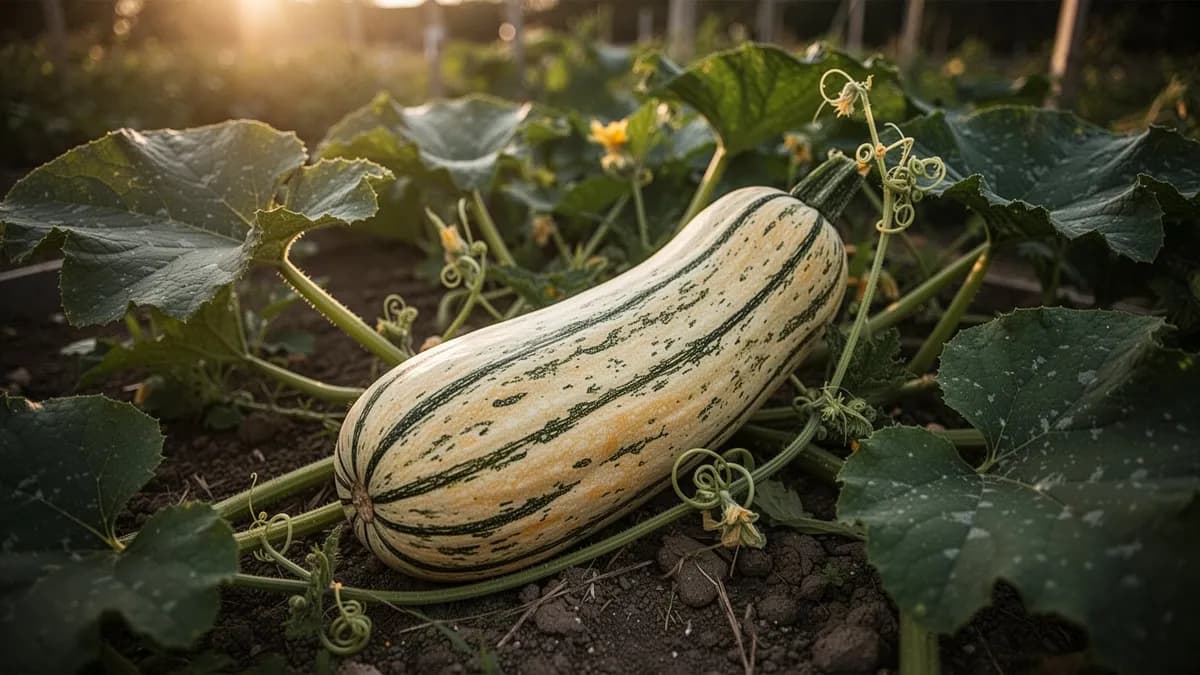
Tromboncino Squash
Cucurbita moschata
At a Glance
It's planting season for Tromboncino Squash! Start planning your garden now.
An Italian climbing squash with long, curved trombone-shaped fruits that are eaten young like zucchini or left to mature as a winter squash. Vigorous vines produce prolifically when grown on a sturdy trellis, which also keeps the long fruits straight. Young fruits have a sweet, nutty flavor superior to standard zucchini and are virtually immune to squash vine borer. Mature fruits develop a hard tan shell and dense orange flesh similar to butternut squash.
Planting & Harvest Calendar
Growth Stages
From Seed to Harvest
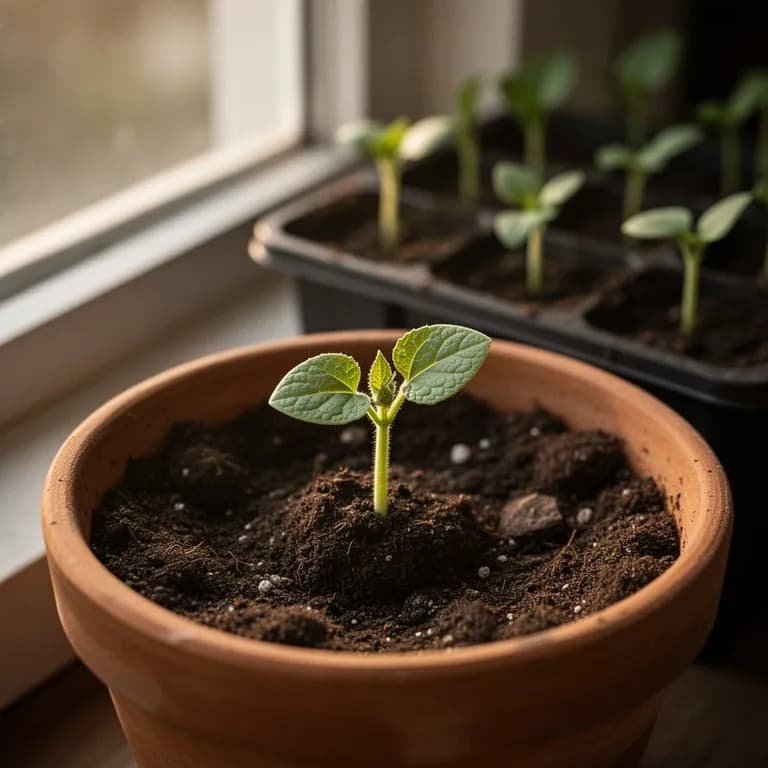
Seed Starting
Days 0–12
Seeds germinate in warm soil, pushing up thick hypocotyls that lift large, rounded cotyledon leaves above the surface. Tromboncino is a Cucurbita moschata species, so seeds require genuinely warm soil of at least 21°C (70°F) for reliable germination. Emergence typically occurs in 7-12 days under ideal conditions.
💡 Care Tip
Direct sow seeds 2.5 cm deep after all frost danger has passed and soil is warm. If starting indoors, use large biodegradable pots 3-4 weeks before transplanting to avoid disturbing the sensitive taproot.
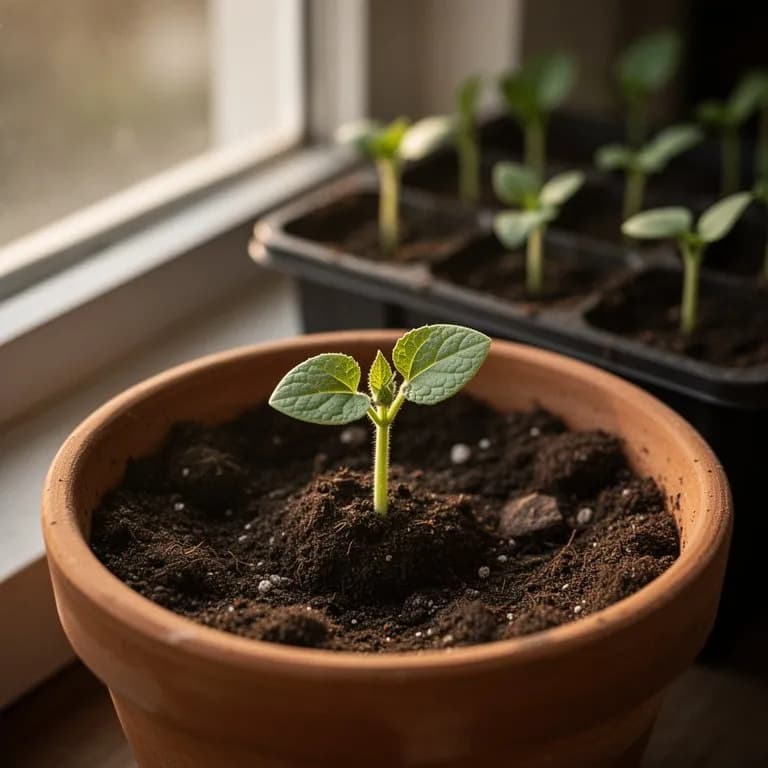
Tromboncino seedlings emerge vigorously in warm soil, ready to climb within weeks
Monthly Care Calendar
What to do each month for your Tromboncino Squash
May
You are herePrimary planting month for most zones. Direct sow or transplant after all frost danger has passed and nights stay above 13°C (55°F). Plant at the base of your trellis, spacing plants 90-120 cm apart. Water deeply at planting.
Did You Know?
Fascinating facts about Tromboncino Squash
Tromboncino squash gets its name from the Italian word for trombone — the long, curved fruit resembles the slide of the brass instrument. In Italy it is also called 'zucchetta' (little squash) or 'zucchino rampicante' (climbing zucchini), reflecting its vigorous vining habit.
Tromboncino squash is a vigorous Italian heirloom that thrives when grown vertically on a strong trellis, arbor, or sturdy fence. Start seeds indoors three to four weeks before the last frost, sowing 2 cm deep in individual pots. Transplant to the garden after all frost danger has passed, spacing plants 90 cm apart at the base of a support structure. Alternatively, direct sow after soil warms to 18 degrees Celsius. Provide a trellis at least 2 meters tall and very robust, as mature vines are heavy and produce large fruits.
Growing vertically offers major advantages: fruits hang straight instead of curving on the ground, air circulation reduces disease, and the substantial garden footprint is minimized. Train vines up the trellis by gently tying them as they grow. Provide consistent deep watering, especially during flowering and fruit development. Apply a thick organic mulch around the base to retain moisture and suppress weeds. Feed generously with compost tea or balanced liquid fertilizer every two to three weeks, as these vigorous vines are heavy feeders.
One of the great advantages of tromboncino is its resistance to squash vine borer, the devastating pest that destroys many summer squash crops. The hard stems of Cucurbita moschata species are less attractive to the borer moth for egg laying. Plants also show good resistance to powdery mildew compared to other summer squash types. Harvest young fruits at 30 to 40 cm long for use as a superior summer squash, or allow fruits to mature fully on the vine for use as a butternut-type winter squash.
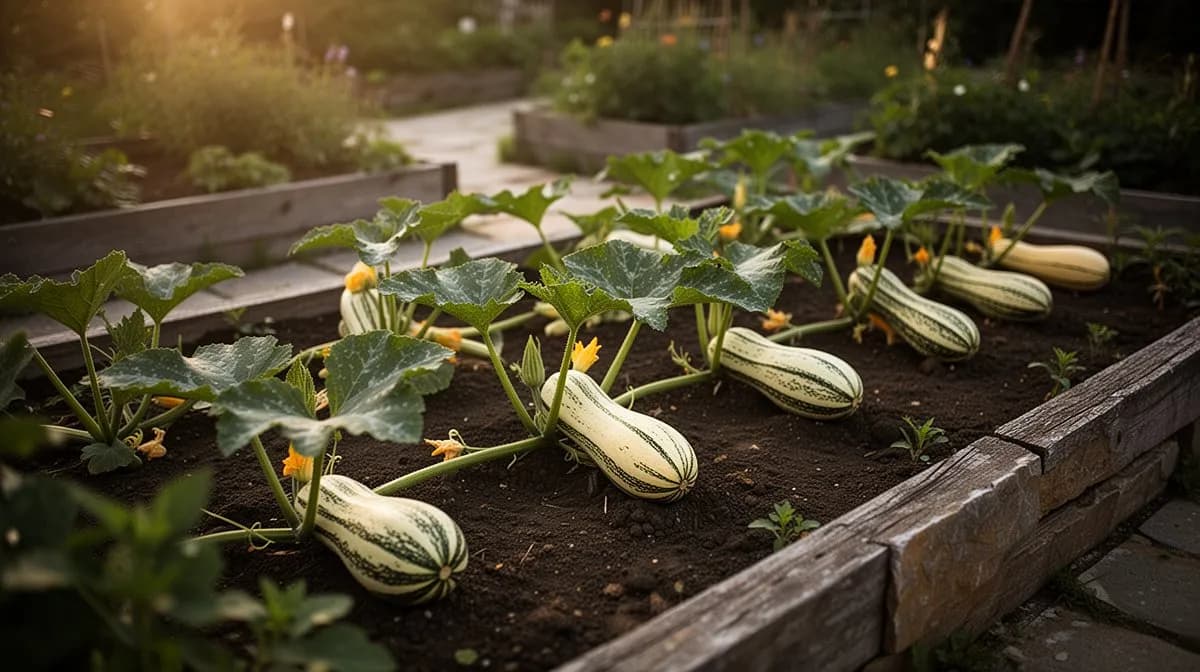
Growing vertically on a trellis produces the straightest fruit and saves valuable garden space
Tromboncino squash (Cucurbita moschata) traces its origins to the tropical lowlands of Central and South America, where the moschata species was first domesticated thousands of years ago. Archaeological evidence suggests Cucurbita moschata cultivation began in coastal Peru and southern Mexico as early as 4,000-5,000 BCE, making it one of the oldest domesticated crops in the Americas. Spanish and Portuguese explorers brought moschata squash back to Europe in the 16th century, where it quickly adapted to Mediterranean growing conditions and became integrated into local agricultural traditions.
Italy became a particularly important center of tromboncino cultivation, where generations of farmers selected for the distinctive elongated fruit shape, climbing habit, and firm flesh that characterizes modern varieties. The squash became deeply embedded in the summer cuisine of Italian regions including Liguria, Campania, Puglia, and Sicily, where the long growing season and warm climate allowed the vigorous vines to reach their full potential. Italian gardeners developed the practice of growing tromboncino on trellises and arbors, discovering that vertical cultivation produced straighter, more uniform fruit and saved valuable garden space.
In recent decades, tromboncino has experienced a remarkable revival among home gardeners worldwide, driven by its exceptional resistance to squash vine borers and powdery mildew — the two most destructive problems facing summer squash growers. Organic gardeners in particular have embraced tromboncino as a reliable, productive alternative to disease-prone zucchini and yellow squash. The dual-purpose nature of the fruit, usable as both a tender summer squash and a hard-shelled winter keeper, adds to its appeal for gardeners seeking maximum versatility from limited space. Today, tromboncino is widely available from heirloom and specialty seed companies and is increasingly found at farmers markets across North America and Europe.
Start seeds indoors three to four weeks before the last frost, sowing one seed 2 cm deep in individual 9 cm pots of rich seed-starting mix. Seeds germinate in five to eight days at 21 to 27 degrees Celsius. Grow on in bright light and transplant after all frost danger has passed, taking care not to disturb the root ball. For direct sowing, wait until soil is at least 18 degrees Celsius and plant two to three seeds per position, thinning to the strongest seedling. Ensure the trellis or support structure is installed before planting to avoid root damage from later installation.
Tromboncino squash is a heavy feeder that thrives in rich, well-drained soil with a pH of 6.0 to 7.0. Prepare planting sites by working in generous amounts of well-rotted compost or aged manure to a depth of 30 cm. Apply a balanced granular fertilizer at planting time and supplement with compost tea or liquid feed every two to three weeks throughout the growing season. The vigorous vines demand consistent nutrients and moisture. Switch to a high-potassium feed once fruits begin developing to support quality and flavor. Maintain even soil moisture with deep watering and organic mulch.
Check Your Zone
See if Tromboncino Squash is suitable for your location.
21°C – 32°C
70°F – 90°F
Tromboncino squash is a warm-season crop that thrives in steady summer heat. As a Cucurbita moschata, it requires warmer soil for germination than pepo-type squash — at least 21°C (70°F), with 24-30°C (75-85°F) being optimal. Plants grow most vigorously between 21-32°C (70-90°F) and tolerate heat well up to 35°C (95°F) with adequate moisture. Growth stalls below 15°C (60°F) and frost is instantly fatal. Compared to zucchini, tromboncino handles hot, humid conditions better and maintains production longer into the season.
Common issues affecting Tromboncino Squash and how to prevent and treat them organically.
Inadequate support is the most common mistake, as vigorous vines can collapse weak trellises under the weight of multiple large fruits. Build very sturdy structures before planting. Poor fruit set results from insufficient pollination; hand-pollinate by transferring pollen from male to female flowers early in the morning if bee activity is low. Curved or misshapen fruits occur when fruits grow on the ground instead of hanging from a trellis. Bitter fruits are rare with this species but can result from heat stress or cross-pollination with ornamental gourds. Monitor for squash bugs, which are the primary pest for this vine borer-resistant variety.
Tromboncino squash pairs well with the Three Sisters planting of corn and beans, though its climbing habit means it can use the trellis instead of sprawling on the ground. Plant corn and beans in front of the trellis where they benefit from reflected warmth. Marigolds and nasturtiums planted nearby repel squash bugs and attract pollinators. Radishes serve as trap crops for flea beetles. Avoid planting near potatoes, which may share disease susceptibility. The large leaves provide excellent shade for heat-sensitive understory crops like lettuce planted at the base of the trellis.
- 1Provide a sturdy trellis or support structure at least 2 meters tall — this is essential for tromboncino. Vertical growing produces straighter fruit, saves space, improves air circulation, and keeps fruit clean and slug-free. A cattle panel, sturdy fence, or wooden arbor all work well.
- 2Be patient with soil temperature. As a moschata species, tromboncino requires warmer soil than zucchini for germination — wait until soil is at least 21°C (70°F). Planting in cold soil leads to seed rot and poor stands. Use black plastic mulch to warm beds 2-3 weeks early.
- 3Plant in the richest soil available. Work in generous amounts of compost and well-rotted manure before planting. Side-dress with balanced fertilizer every 2-3 weeks throughout the growing season — the vigorous vines are heavy feeders that respond dramatically to fertility.
- 4Water deeply and consistently at the base of the plant, providing 2.5-5 cm per week. Avoid overhead watering that wets the foliage. Drip irrigation is ideal. Consistent moisture is especially important during flowering and fruit development.
- 5Harvest young fruit at 25-40 cm for the best summer squash texture and flavor. At this size the skin is tender, the flesh is firm and nutty, and the entire fruit is usable. Unlike zucchini, tromboncino remains tender at somewhat larger sizes, giving you a more forgiving harvest window.
- 6Take advantage of the dual-purpose nature. Let a few late-season fruit mature fully on the vine until the skin hardens and turns tan. These cured squash store for 3-6 months and can be used exactly like butternut squash — roasted, pureed for soup, or baked into pies.
- 7Train vines deliberately by guiding growing tips onto the trellis and loosely tying stems with soft fabric strips. Tromboncino has strong tendrils but the heavy fruit can pull stems free from supports. Check ties weekly and add new ones as the vine extends.
- 8Embrace tromboncino's natural squash vine borer resistance. As a Cucurbita moschata, it has solid stems that resist the borers that devastate pepo-type squash. If borers have ruined your zucchini in past years, tromboncino is the reliable alternative.
For summer squash use, harvest tromboncino fruits when they are 30 to 40 cm long and about 5 cm in diameter, while the skin is still tender enough to pierce with a fingernail. At this stage the long neck is solid flesh with no seeds, making it much more efficient than standard zucchini. Check plants every two to three days as fruits grow rapidly in warm weather. For winter squash use, leave fruits on the vine until the skin turns hard and tan, about 100 days after planting. Cut with pruning shears leaving a long stem. The solid neck portion of mature fruits is seedless butternut-quality flesh.
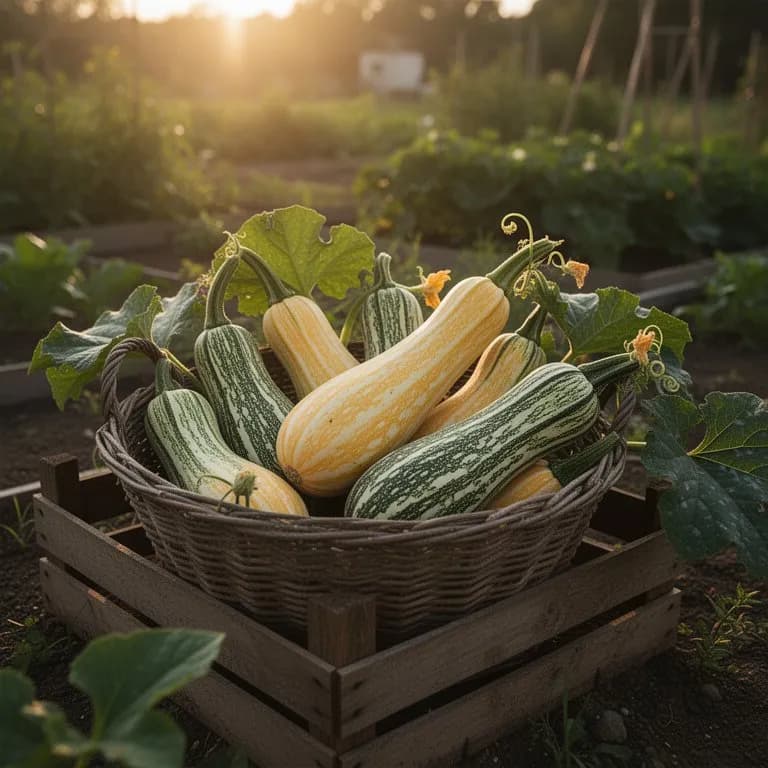
Harvest at 25-40 cm for tender summer squash or let them mature for winter storage
Young summer-stage tromboncino keeps in the refrigerator for up to a week. Mature winter squash fruits should be cured in a warm, dry location for two weeks, then stored at 10 to 15 degrees Celsius where they keep for four to six months. The seedless neck portion of mature fruits can be peeled, cubed, and frozen for convenient use in soups and stews. Young fruits freeze well when sliced, blanched for three minutes, and packed into freezer bags. Grate summer-stage fruits for zucchini bread and fritters. The dense flesh of mature fruits makes excellent winter squash soup and puree.
Plan your garden with ease
Love growing Tromboncino Squash? Use our free garden planner to design your beds, track planting dates, and get personalized care reminders.
Nutritional Info
Per 100g serving
18
Calories
Health Benefits
- Extremely low in calories at just 18 per 100g, making tromboncino squash an excellent choice for weight management without sacrificing satisfying portion sizes
- Good source of vitamin C, providing 17% of the daily value per 100g to support immune function and collagen synthesis
- Contains beta-carotene that increases significantly as the fruit matures — fully ripe tromboncino has deep orange flesh rich in provitamin A
- Provides B vitamins including folate and B6, important for energy metabolism, red blood cell formation, and nervous system health
- Rich in manganese and magnesium, trace minerals that support bone health, enzyme function, and antioxidant defense systems
- High water content of approximately 94% makes it an excellent food for hydration during the hot summer months when it is harvested fresh
💰 Why Grow Your Own?
Tromboncino squash seeds cost $3-5 per packet (enough for 10-20 plants), and a single vine can produce 15-25 summer squash plus several winter storage squash. With specialty Italian squash selling for $3-6 per pound at farmers markets, one plant can easily yield $40-80 worth of summer squash alone. The winter storage bonus — 4-6 mature squash usable as butternut substitutes worth $2-4 each — adds another $10-25 in savings, all from a single seed.
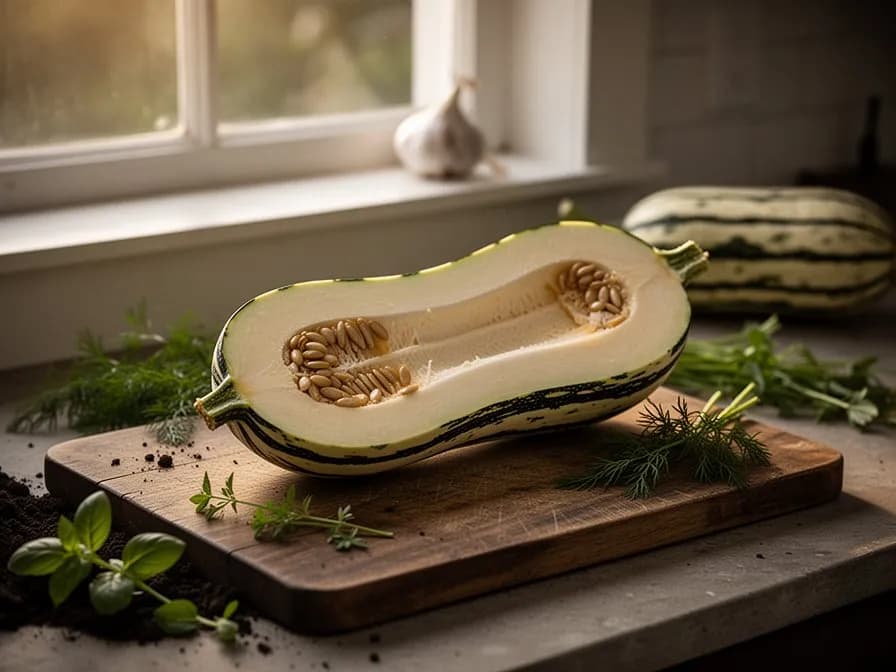
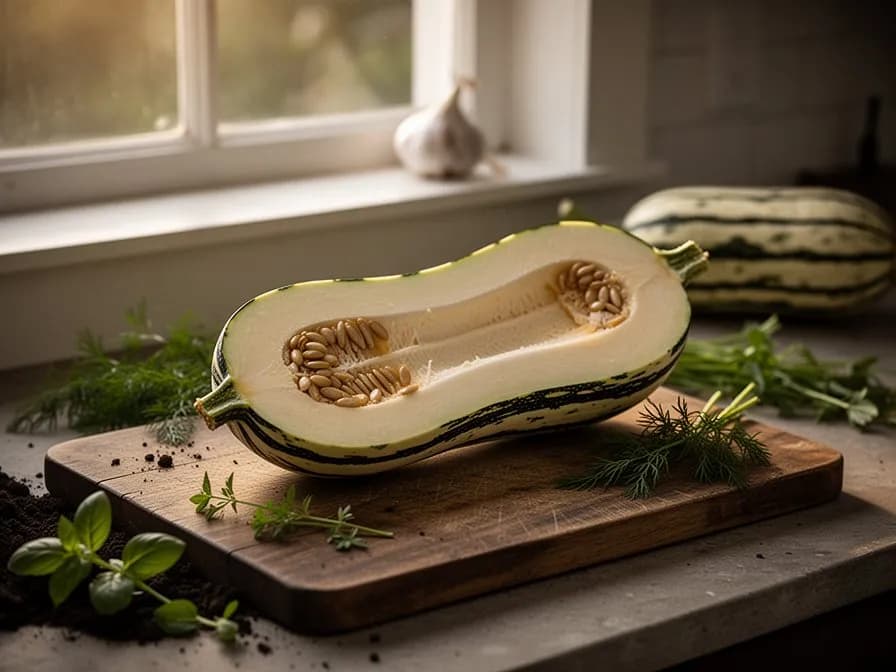
The long neck is entirely solid, seedless flesh — the seeds are confined to the small bulb at the blossom end
Quick Recipes
Simple recipes using fresh Tromboncino Squash
Tromboncino Pasta with Garlic and Basil
20 minThick half-moon slices of tromboncino sauteed in olive oil with garlic until golden, then tossed with pasta and fresh basil. The firm, nutty flesh holds its shape perfectly and absorbs the garlicky oil beautifully — a classic Italian preparation for this traditional Italian squash.
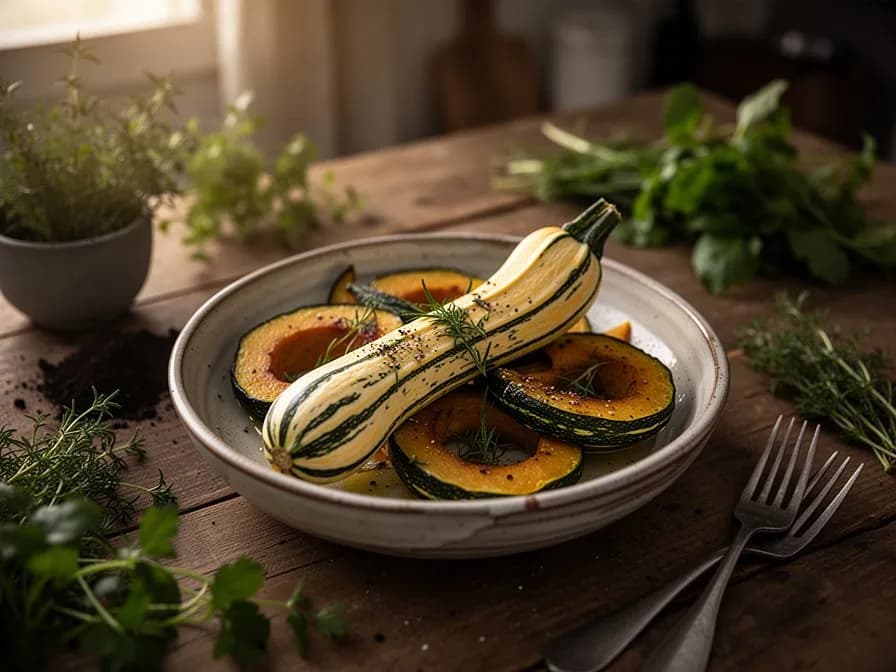
Grilled Tromboncino with Lemon and Mint
15 minThick lengthwise slices brushed with olive oil and grilled until charred and tender, then finished with a bright squeeze of lemon and torn fresh mint. The dense flesh grills beautifully without falling apart and develops a sweet, smoky caramelization.
Tromboncino Squash Fritters
25 minGrated tromboncino squash mixed with herbs, Parmesan, and a light batter, then pan-fried into crispy golden fritters. A traditional Italian way to use abundant summer squash — the firm flesh grates cleanly and holds together better than watery zucchini.
Tromboncino's firm, nutty flesh holds its shape beautifully in pasta dishes
Yield & Spacing Calculator
See how many Tromboncino Squash plants fit in your garden bed based on the recommended 120cm spacing.
1
Tromboncino Squash plants in a 4×4 ft bed
1 columns × 1 rows at 120cm spacing
Popular Varieties
Some of the most popular tromboncino squash varieties for home gardeners, each with unique characteristics.
Tromboncino
The standard Italian heirloom with long, curved fruits. Extremely vigorous vines and heavy production. Dual-purpose as summer or winter squash.
Zucchetta
Another name commonly used for the same variety in Italian seed catalogs. Identical growing characteristics and flavor.
Tromba d'Albenga
A Ligurian Italian selection with particularly long, slender fruits and excellent sweet flavor when young. Vigorous climbing habit.
Tromboncino is a dual-purpose squash with outstanding culinary versatility. Young fruits are used like superior zucchini, with a firmer, nuttier texture and sweeter flavor. The long, seedless neck offers more usable flesh per fruit than any standard summer squash. Slice into rounds for grilling, spiralize for low-carb noodles, or shred for fritters. Mature fruits have dense, orange, butternut-style flesh excellent for roasting, soups, and risotto. In Italy, young fruits are traditionally sliced thin and fried with olive oil and garlic.
When should I plant Tromboncino Squash?
Plant Tromboncino Squash in May, June. It takes approximately 60 days to reach maturity, with harvest typically in July, August, September.
What are good companion plants for Tromboncino Squash?
Tromboncino Squash grows well alongside Corn, Green Beans. Companion planting can improve growth, flavor, and natural pest control.
What hardiness zones can Tromboncino Squash grow in?
Tromboncino Squash thrives in USDA hardiness zones 4 through 11. With greenhouse protection, it may be grown in zones 2 through 12.
How much sun does Tromboncino Squash need?
Tromboncino Squash requires Full Sun (6-8h+). This means at least 6-8 hours of direct sunlight daily.
How far apart should I space Tromboncino Squash?
Space Tromboncino Squash plants 120cm (47 inches) apart for optimal growth and air circulation.
What pests and diseases affect Tromboncino Squash?
Common issues include Squash Bug, Powdery Mildew, Cucumber Beetle. Prevention through good garden practices like crop rotation, proper spacing, and companion planting is the best approach. See the detailed pests and diseases section above for symptoms, prevention, and treatment for each.
How do I store Tromboncino Squash after harvest?
Young summer-stage tromboncino keeps in the refrigerator for up to a week. Mature winter squash fruits should be cured in a warm, dry location for two weeks, then stored at 10 to 15 degrees Celsius where they keep for four to six months. The seedless neck portion of mature fruits can be peeled, cube...
What are the best Tromboncino Squash varieties to grow?
Popular varieties include Tromboncino, Zucchetta, Tromba d'Albenga. Each has unique characteristics suited to different growing conditions and culinary preferences. See the varieties section above for detailed descriptions.
What soil does Tromboncino Squash need?
Tromboncino squash is a heavy feeder that thrives in rich, well-drained soil with a pH of 6.0 to 7.0. Prepare planting sites by working in generous amounts of well-rotted compost or aged manure to a depth of 30 cm. Apply a balanced granular fertilizer at planting time and supplement with compost tea...
What is the difference between tromboncino and zucchini?
Tromboncino and zucchini are different species — tromboncino is Cucurbita moschata (like butternut squash) while zucchini is Cucurbita pepo. This means tromboncino has natural resistance to squash vine borers and powdery mildew that devastate zucchini. Tromboncino is a vigorous climbing vine (not a bush), produces long curved fruit with a seedless neck, has firmer and nuttier flesh, and can be used as both a summer and winter squash. The tradeoff is that it needs a trellis and takes longer to start producing.
Can I grow tromboncino without a trellis?
Yes, tromboncino can be grown on the ground like other vining squash, but the fruit will curl into curves and S-shapes as it follows the contours of the ground. Ground-grown fruit is also more prone to slug damage, soil rot, and discoloration on the underside. Growing on a trellis produces straighter fruit, saves significant garden space, improves air circulation to reduce disease, and makes harvesting much easier. If you lack a trellis, you can grow it along a fence, over an arbor, or up a sturdy tomato cage.
How do I use tromboncino as a winter squash?
Allow fruit to remain on the vine well past the summer squash stage until the skin becomes very hard and turns from pale green to tan or buff-colored. This typically takes 80-100 days from pollination. Harvest before frost with a 5 cm stem attached, then cure in a warm, dry spot at 27-30°C (80-85°F) for 10-14 days to harden the skin further. Once cured, store in a cool, dry location at 10-15°C (50-60°F). The mature flesh is deep orange, sweet, and dense — use it in any recipe calling for butternut squash.
Why are my tromboncino fruit curling instead of growing straight?
Curling is natural when fruit grows on the ground or on a horizontal surface — gravity cannot pull the developing fruit straight. To get long, straight fruit, grow the vines vertically on a trellis so the fruit hangs downward freely. Fruit that begins developing against the trellis structure itself may also curve around obstacles. Gently reposition young fruit so it hangs freely. Some gentle curving is normal and does not affect flavor or quality.
Is tromboncino squash really resistant to squash vine borers?
Yes, tromboncino has genuinely strong resistance to squash vine borers because it belongs to Cucurbita moschata, which has harder, more solid stems than the hollow-stemmed Cucurbita pepo species (zucchini, yellow squash, most pumpkins) that borers prefer. While not completely immune, moschata squash are rarely attacked or seriously damaged by vine borers. This resistance is the primary reason many gardeners who have given up on summer squash due to vine borers switch to tromboncino.
How long does tromboncino squash take to produce fruit?
Tromboncino takes longer to start producing than bush-type summer squash. Expect 60-80 days from planting to first harvest of young summer squash, compared to 45-55 days for zucchini. However, tromboncino compensates with a much longer production season — thanks to its disease resistance, it often continues producing for 8-12 weeks, well after zucchini plants have succumbed to powdery mildew or vine borers. The total season yield typically exceeds that of bush squash.
Ready to Grow Tromboncino Squash?
Add Tromboncino Squash to your garden plan and start designing your perfect layout.

Vladimir Kusnezow
Gardener and Software Developer
Zone 6b gardener. Growing vegetables and fruits in soil and hydroponics for 6 years. I built PlotMyGarden to plan my own gardens.
Jump to Section