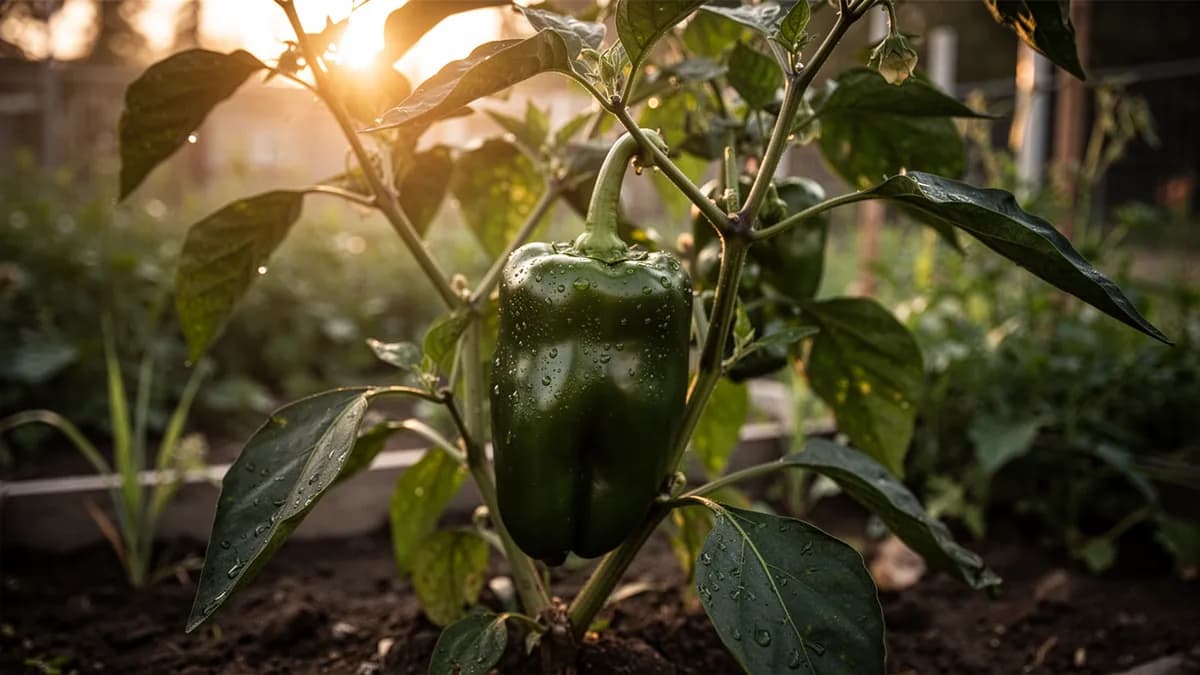
Poblano Pepper
Capsicum annuum
At a Glance
It's planting season for Poblano Pepper! Start planning your garden now.
A large, mild chile pepper with rich, earthy flavor that is the foundation of chiles rellenos and other classic Mexican dishes. When dried, poblano peppers become ancho chiles, one of the most widely used dried peppers in mole sauces. Plants are sturdy and productive, yielding heart-shaped fruits with thick walls perfect for stuffing and roasting. Harvest when dark green and glossy, or allow to ripen to deep red for a sweeter, more complex taste.
Planting & Harvest Calendar
Growth Stages
From Seed to Harvest
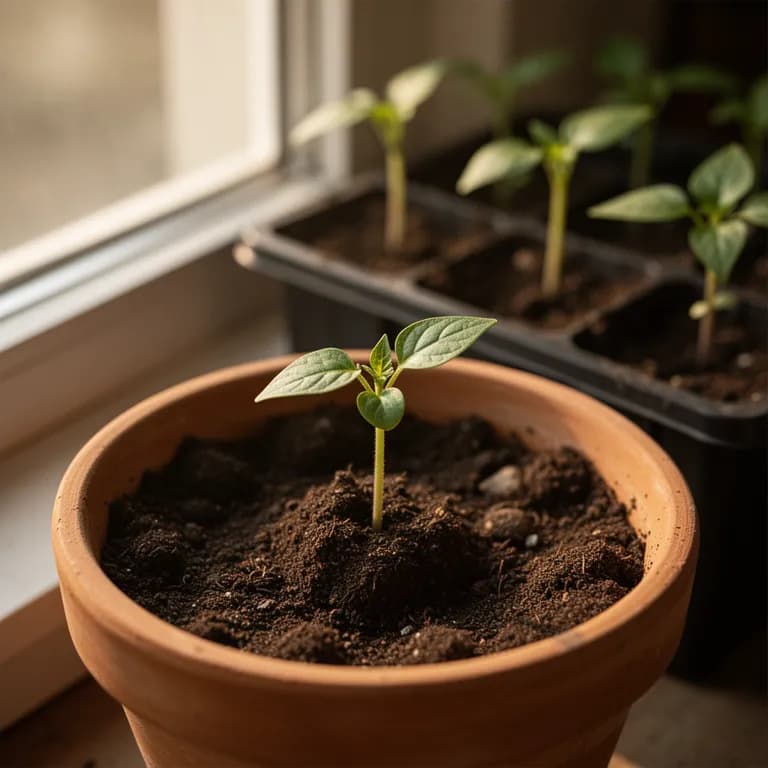
Seed Starting
Days 0–21
Poblano seeds germinate in 10 to 21 days, somewhat slower than many other pepper varieties. Seeds require consistent warmth of 27-30°C (80-85°F) for reliable germination. Small, pale cotyledon leaves emerge first, followed by the first set of narrow, pointed true leaves.
💡 Care Tip
Use a thermostat-controlled heat mat to maintain consistent soil temperature. Keep the seed-starting mix evenly moist but never waterlogged, as pepper seedlings are susceptible to damping off in soggy conditions.
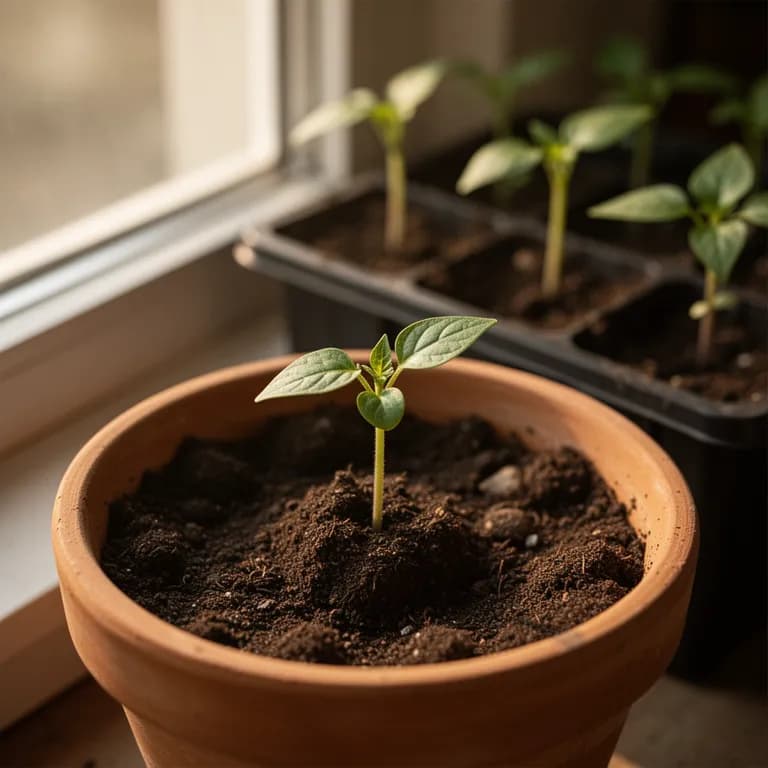
Poblano seedlings developing their first true leaves under grow lights
Monthly Care Calendar
What to do each month for your Poblano Pepper
May
You are herePrimary transplanting month for most zones. Plant in full sun, spacing 45-60 cm apart. Apply balanced slow-release fertilizer at planting. Mulch with straw or shredded leaves. Install stakes or cages for later fruit support. Water deeply after planting.
Did You Know?
Fascinating facts about Poblano Pepper
Poblano peppers are named after the city of Puebla, Mexico, where they have been cultivated for centuries and where the iconic dish chiles rellenos was perfected by nuns in colonial-era convent kitchens.
Poblano peppers require a long, warm growing season and should be started indoors 8 to 10 weeks before the last frost. Seeds germinate best at soil temperatures between 80°F and 85°F, so using a heat mat is highly recommended. Transplant seedlings outdoors once nighttime temperatures consistently stay above 60°F and the soil has warmed thoroughly.
Plant poblanos in full sun with rich, well-drained soil amended with plenty of compost. Space plants 18 to 24 inches apart to accommodate their sturdy, bushy growth habit. These peppers develop large, heavy fruits that may require staking or caging as the season progresses. Water deeply and consistently, providing about 1 to 2 inches per week, and mulch heavily to conserve moisture.
Poblano plants respond well to moderate feeding throughout the season. Apply a balanced fertilizer at transplanting, then switch to a phosphorus-rich formula once flowering begins. Pinching off early blossoms can encourage a stronger root system before the plant begins channeling energy into fruit production. In hot climates above 95°F, consider providing afternoon shade to prevent blossom drop.
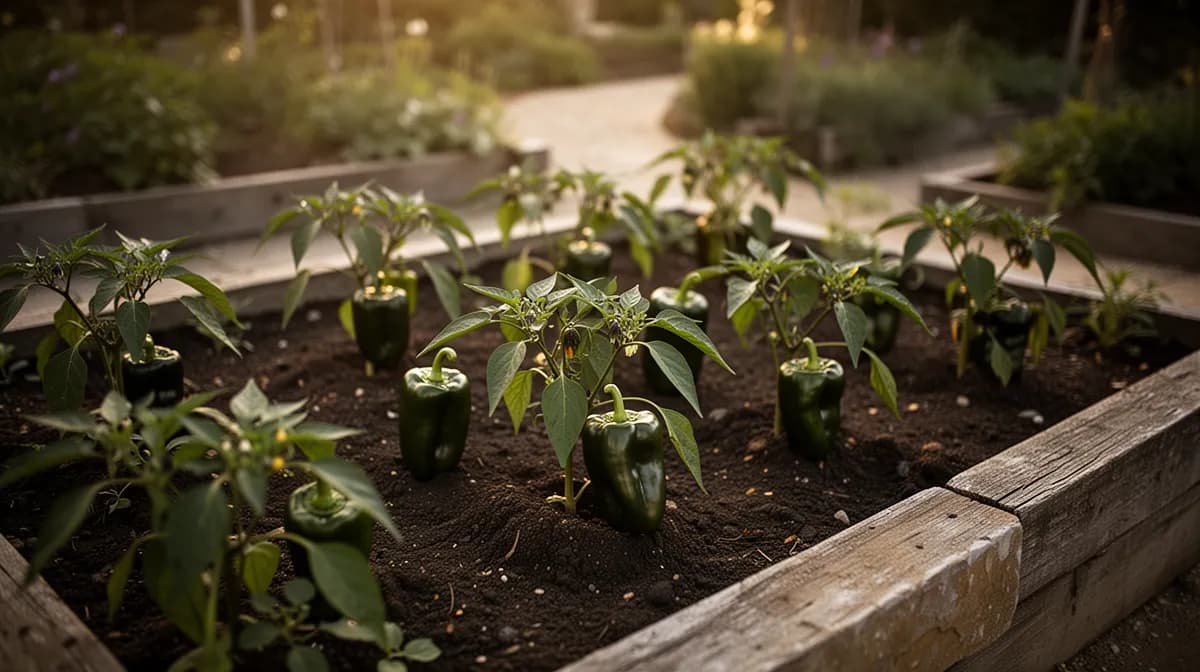
Healthy poblano plants loaded with fruit in a well-mulched raised bed
The poblano pepper (Capsicum annuum) originated in the state of Puebla, Mexico, from which it takes its name. Archaeological evidence suggests that wild ancestors of Capsicum annuum were consumed in Mesoamerica as early as 7,000 BCE, and deliberate cultivation of chile peppers began around 3,500 BCE, making them one of the oldest cultivated crops in the Americas. The poblano variety was selected and refined over centuries by indigenous peoples of central Mexico who valued its large size, thick walls, and mild heat that could be used in quantity without overwhelming dishes.
Puebla, a city founded by Spanish colonists in 1531 in the central Mexican highlands, became the culinary epicenter for poblano pepper cuisine. The convent kitchens of colonial Puebla are credited with creating many of Mexico's most iconic dishes, including chiles rellenos and mole poblano, both of which feature the poblano as a central ingredient. The nuns blended indigenous ingredients like chiles, chocolate, and tomatoes with European cooking techniques, creating a syncretic cuisine that remains the heart of Mexican gastronomy. The ancho chile — the dried form of the red-ripe poblano — became so essential to Mexican cooking that it earned the nickname 'the sweetest of dried chiles' and forms the flavor base of countless sauces, stews, and moles.
Today, Mexico remains the primary producer of poblano peppers, with cultivation concentrated in the states of Puebla, Guanajuato, Zacatecas, and San Luis Potosi. The pepper has spread throughout the Americas and is now widely grown in home gardens and commercially across the United States, particularly in California, New Mexico, and Texas. In the U.S., poblanos have become one of the most popular specialty peppers, driven by the growing popularity of Mexican cuisine. Modern breeding programs have developed improved varieties with better disease resistance, more uniform fruit size, and enhanced yields, but the essential character of the poblano — its earthy, slightly smoky flavor, thick walls, and versatile mild heat — remains unchanged from the peppers cultivated in Puebla centuries ago.
Start poblano seeds indoors 8 to 10 weeks before your last frost date. Sow seeds one-quarter inch deep in warm, moist seed-starting mix. Use a heat mat set to 80-85°F for consistent germination, which takes 10 to 21 days. Poblano seeds can be slower to germinate than other peppers, so be patient. Provide strong light for 14 to 16 hours daily after emergence. Pot up seedlings when they develop 2 to 3 sets of true leaves. Harden off gradually over 10 days before transplanting to the garden.
Poblano peppers need fertile, well-drained soil with a pH of 6.0 to 7.0. Incorporate 2 to 3 inches of aged compost before planting to improve soil structure and nutrient content. Apply a balanced slow-release fertilizer at transplanting time. Once plants begin setting fruit, side-dress with a low-nitrogen fertilizer or compost tea every 3 to 4 weeks. Excessive nitrogen creates vigorous foliage at the expense of fruit production. Add bone meal for extra phosphorus to support strong flowering.
Check Your Zone
See if Poblano Pepper is suitable for your location.
21°C – 32°C
70°F – 90°F
Poblano peppers thrive in warm conditions between 21-32°C (70-90°F). Growth stalls below 15°C (60°F) and plants suffer damage below 5°C (41°F). Blossom drop occurs when daytime temperatures exceed 35°C (95°F) or nighttime temperatures fall below 13°C (55°F). The optimal range for fruit set is 21-29°C (70-85°F) during the day and 16-21°C (60-70°F) at night. Soil temperature must be at least 18°C (65°F) for transplanting and 27°C (80°F) for seed germination.
Common issues affecting Poblano Pepper and how to prevent and treat them organically.
Poblanos are prone to blossom drop when temperatures exceed 95°F or fall below 58°F at night. Thick-walled fruits can crack if watering is inconsistent, alternating between dry and saturated conditions. Sunscald affects exposed fruits, so maintain healthy foliage canopy. Poor fruit set may result from inadequate pollination during hot or humid weather. Plants stressed by drought may produce smaller, hotter peppers than expected.
Poblano peppers benefit from being planted near tomatoes and basil, which can help repel aphids and improve overall garden health. Onions and garlic deter many common pepper pests. Avoid planting near fennel, which releases compounds that can inhibit pepper growth. Low-growing herbs like oregano and thyme make excellent ground cover companions, helping retain soil moisture while attracting pollinators. Corn or sunflowers planted to the west provide beneficial afternoon shade.
- 1Start seeds early and be patient. Poblano seeds germinate more slowly than many other peppers, often taking 14-21 days. A consistent heat mat temperature of 27-30°C (80-85°F) is the single most important factor for reliable germination.
- 2Harden off transplants gradually over 10 full days before planting outdoors. Poblanos are sensitive to transplant shock, and rushing this process leads to stunted growth and delayed fruiting that costs weeks of potential harvest.
- 3Mulch heavily with 7-10 cm of straw or shredded leaves once the soil has warmed. Poblanos have relatively shallow root systems that benefit greatly from consistent soil moisture and temperature moderation provided by a thick mulch layer.
- 4Stake or cage plants before fruits develop. Poblano fruits are large and heavy, often reaching 100-150g each, and a plant loaded with 8-10 developing peppers can snap branches if unsupported. Install supports early rather than trying to retrofit them around a mature plant.
- 5Maintain rock-steady watering consistency. Poblanos are particularly sensitive to fluctuations between wet and dry soil. Irregular watering causes blossom end rot, fruit cracking, and blossom drop more readily than in many other pepper types. Drip irrigation on a timer is ideal.
- 6Roast peppers directly over a gas flame or under a broiler until the skin is uniformly charred and blistered, then steam in a covered bowl for 15 minutes. The skin peels away easily, revealing the smoky, silky flesh beneath — this technique transforms the flavor entirely.
- 7Allow some peppers to ripen fully to deep red on the plant if you want to make your own ancho chiles. Red-ripe poblanos develop a sweeter, more complex flavor that intensifies dramatically when dried. This requires patience, as full ripening takes 2-3 weeks beyond the green stage.
- 8Grow poblanos in large containers (minimum 19 liters / 5 gallons) if garden space is limited. Use a high-quality potting mix with perlite for drainage, and feed weekly with liquid fertilizer during the growing season. Container plants produce fewer but still worthwhile peppers.
Harvest poblano peppers when they are 4 to 6 inches long, dark green, and glossy. The thick walls should feel firm when gently squeezed. For dried ancho chiles, leave fruits on the plant until they turn deep red, then harvest and dry them in a well-ventilated area. Cut peppers from the plant with pruning shears rather than pulling. Poblanos are mildly hot at 1,000 to 2,000 Scoville units, but heat can increase with plant stress or hot growing conditions.
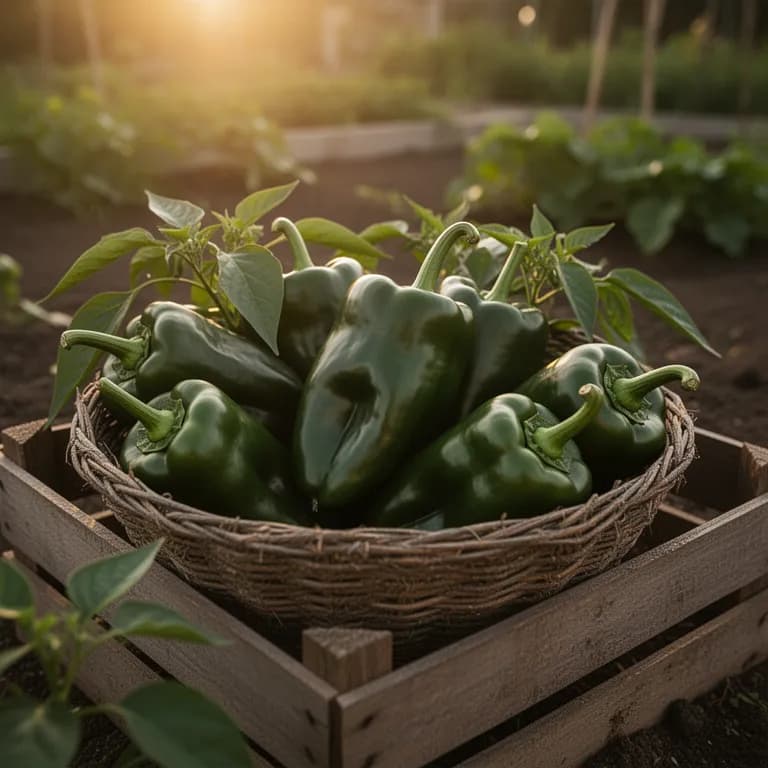
A harvest of glossy, dark green poblanos at ideal size for stuffing and roasting
Fresh poblanos keep for up to 2 weeks in the refrigerator. Roasting and peeling poblanos before freezing is the most popular preservation method, yielding ready-to-use peppers for chiles rellenos and sauces year-round. To make ancho chiles, dry fully ripe red poblanos in a dehydrator at 135°F for 12 to 24 hours or string them into ristras for air drying. Dried anchos stored in airtight containers last over a year and develop deep, complex flavor.
Plan your garden with ease
Love growing Poblano Pepper? Use our free garden planner to design your beds, track planting dates, and get personalized care reminders.
Nutritional Info
Per 100g serving
20
Calories
Health Benefits
- Exceptionally rich in vitamin C, providing roughly 90% of the daily value per 100g — more than many citrus fruits and essential for immune function and collagen production
- Good source of vitamin A from beta-carotene, supporting eye health, skin integrity, and immune defense — red-ripe poblanos contain significantly more than green ones
- Contains capsaicin at mild levels (1,000-2,000 Scoville units), which has been shown to boost metabolism, reduce inflammation, and provide natural pain relief
- Provides vitamin B6, important for brain development, neurotransmitter production, and energy metabolism
- Low calorie density at only 20 calories per 100g with good fiber content, making poblanos an excellent addition to weight-conscious diets
- Contains iron, magnesium, and antioxidant compounds including quercetin and luteolin that help combat oxidative stress
💰 Why Grow Your Own?
A single poblano plant grown from a $2-3 seed packet or $3-5 transplant can produce 15-25 large peppers over a season. Fresh poblanos sell for $3-6 per pound at grocery stores, and specialty items like roasted poblanos or dried ancho chiles command $8-15 per pound. Growing just 3-4 plants can save $50-100 per season on fresh peppers, and the savings increase dramatically if you make your own ancho chiles, which retail for $10-20 per 4-ounce bag. Roasting, peeling, and freezing your harvest provides premium-quality peppers year-round at a fraction of store cost.
Quick Recipes
Simple recipes using fresh Poblano Pepper
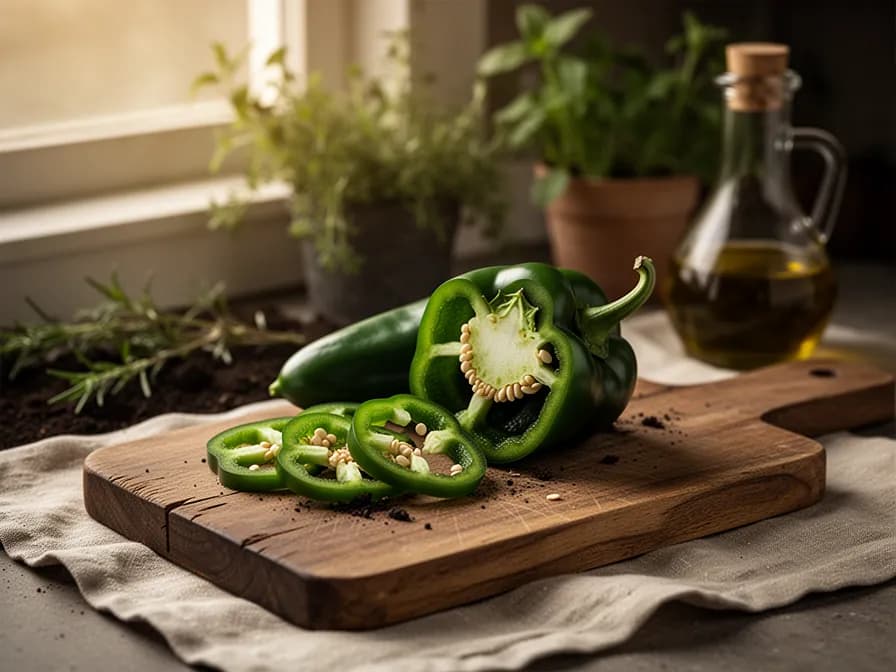
Classic Chiles Rellenos
45 minThe iconic Mexican dish — whole poblano peppers roasted, peeled, stuffed with melting cheese, dipped in fluffy egg batter, and fried to golden perfection. Served with a warm tomato-chile sauce, this is the dish that poblanos were born for.
Creamy Rajas con Crema
30 minRoasted poblano strips simmered in a luscious Mexican cream sauce with sweet onions and corn. This versatile side dish is equally delicious served over rice, folded into tacos, or alongside grilled meats. The smoky sweetness of roasted poblanos is the star.
Poblano and Black Bean Soup
40 minA hearty, smoky soup combining fire-roasted poblanos with creamy black beans, cumin, and a squeeze of lime. Pureed to velvety smoothness and topped with crumbled queso fresco and tortilla strips, this is deeply satisfying comfort food.
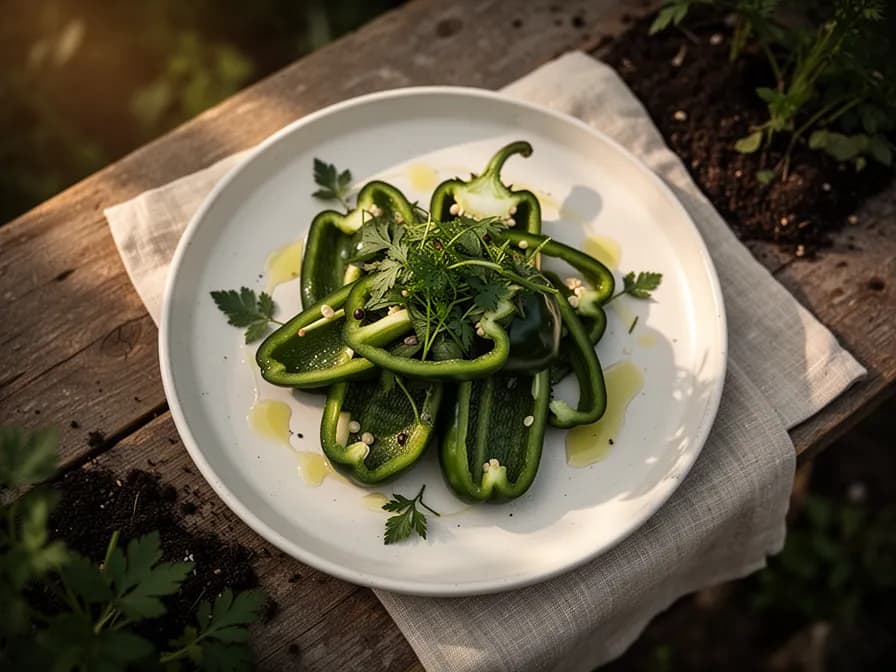
Fire-roasted poblanos ready for peeling — the essential first step for chiles rellenos
Yield & Spacing Calculator
See how many Poblano Pepper plants fit in your garden bed based on the recommended 45cm spacing.
4
Poblano Pepper plants in a 4×4 ft bed
2 columns × 2 rows at 45cm spacing
Popular Varieties
Some of the most popular poblano pepper varieties for home gardeners, each with unique characteristics.
Ancho 101
A reliable, high-yielding variety producing large, heart-shaped fruits with thick walls ideal for stuffing and drying into ancho chiles.
Tiburon
A hybrid poblano with excellent disease resistance, producing extra-large fruits with very thick walls and consistent mild heat.
Ancho Magnifico
An early-maturing hybrid that sets fruit well even in cooler conditions. Compact plant habit makes it suitable for containers.
Mulato Isleno
A distinct brown-skinned poblano type with chocolate-toned dried flesh, offering a richer, sweeter flavor profile than standard green poblanos.
Poblanos are indispensable in Mexican cuisine. They are the traditional pepper for chiles rellenos, stuffed with cheese and fried in egg batter. Roasted and peeled, they enrich enchilada sauces, cream-based rajas, and soups. Dried ancho chiles are ground into rich mole sauces. Their mild heat and earthy complexity make them ideal for adding depth to virtually any savory dish without overwhelming spiciness.
When should I plant Poblano Pepper?
Plant Poblano Pepper in March, April, May. It takes approximately 75 days to reach maturity, with harvest typically in July, August, September.
What are good companion plants for Poblano Pepper?
Poblano Pepper grows well alongside Tomato, Basil, Onion. Companion planting can improve growth, flavor, and natural pest control.
What hardiness zones can Poblano Pepper grow in?
Poblano Pepper thrives in USDA hardiness zones 4 through 12. With greenhouse protection, it may be grown in zones 2 through 13.
How much sun does Poblano Pepper need?
Poblano Pepper requires Full Sun (6-8h+). This means at least 6-8 hours of direct sunlight daily.
How far apart should I space Poblano Pepper?
Space Poblano Pepper plants 45cm (18 inches) apart for optimal growth and air circulation.
What pests and diseases affect Poblano Pepper?
Common issues include Pepper Weevil, Phytophthora Blight, Hornworms. Prevention through good garden practices like crop rotation, proper spacing, and companion planting is the best approach. See the detailed pests and diseases section above for symptoms, prevention, and treatment for each.
How do I store Poblano Pepper after harvest?
Fresh poblanos keep for up to 2 weeks in the refrigerator. Roasting and peeling poblanos before freezing is the most popular preservation method, yielding ready-to-use peppers for chiles rellenos and sauces year-round. To make ancho chiles, dry fully ripe red poblanos in a dehydrator at 135°F for 12...
What are the best Poblano Pepper varieties to grow?
Popular varieties include Ancho 101, Tiburon, Ancho Magnifico, Mulato Isleno. Each has unique characteristics suited to different growing conditions and culinary preferences. See the varieties section above for detailed descriptions.
What soil does Poblano Pepper need?
Poblano peppers need fertile, well-drained soil with a pH of 6.0 to 7.0. Incorporate 2 to 3 inches of aged compost before planting to improve soil structure and nutrient content. Apply a balanced slow-release fertilizer at transplanting time. Once plants begin setting fruit, side-dress with a low-ni...
What is the difference between a poblano pepper and an ancho chile?
They are the same pepper at different stages. A poblano is the fresh, green (or red-ripe) pepper harvested from the plant. An ancho chile is a fully red-ripe poblano that has been dried. The drying process concentrates and transforms the flavor, producing a sweet, smoky, mildly fruity dried chile with notes of raisin and chocolate. Ancho chiles are the foundation of mole sauces and many other Mexican dishes. You cannot make a true ancho from a green poblano — the pepper must ripen to deep red on the plant first.
Why are some of my poblano peppers much hotter than others?
Poblano heat levels are notoriously inconsistent, ranging from 1,000 to 2,000 Scoville units, with occasional outliers reaching higher. Heat increases when plants experience stress — drought, extreme heat, nutrient deficiency, or root disturbance all trigger the plant to produce more capsaicin. Peppers from the same plant can vary, and peppers from stressed plants are consistently hotter. Consistent watering, adequate fertilization, and moderate temperatures produce the mildest, most predictable fruit.
How do I roast and peel poblano peppers?
Place whole poblanos directly over a gas burner flame, under a broiler set to high, or on a very hot grill. Turn frequently with tongs until the skin is uniformly charred, blistered, and blackened on all sides — this takes 5 to 8 minutes. Immediately transfer the charred peppers to a bowl, cover tightly with plastic wrap or a lid, and let them steam for 15 minutes. The steam loosens the skin, which then peels away easily by hand. Avoid rinsing under water, which washes away the smoky flavor. Make a small slit to remove seeds and membranes.
Can I overwinter poblano pepper plants indoors?
Yes, poblanos can be overwintered indoors in a sunny window or under grow lights. Before the first frost, cut the plant back by about half, carefully dig it up or bring the container inside, and place it in a bright location with temperatures above 15°C (60°F). Water sparingly through winter — just enough to prevent complete wilting. The plant will go semi-dormant and may lose most of its leaves. In spring, increase watering and feeding as new growth appears, then harden off and move back outdoors after the last frost. Overwintered plants produce fruit earlier the following season.
Why are my poblano plants dropping their flowers without setting fruit?
Blossom drop in poblanos is most commonly caused by temperature extremes. Nighttime temperatures below 13°C (55°F) or daytime temperatures above 35°C (95°F) prevent proper pollination and cause flowers to abort. Other causes include inconsistent watering, excessive nitrogen fertilization that promotes foliage over fruit, and insufficient pollinator activity. To improve fruit set, ensure consistent moisture, use a balanced or phosphorus-rich fertilizer during flowering, and gently shake plants to help distribute pollen if bee activity is low.
How long does it take for poblano peppers to turn red for making ancho chiles?
After reaching full green size, poblanos take an additional 2 to 4 weeks to ripen fully to deep red on the plant. The transition is gradual — peppers first develop dark patches, then shift to a chocolate-red, and finally deepen to a rich, dark red. Patience is essential, as picking too early produces an inferior dried chile. Once fully red, harvest and dry in a dehydrator at 57°C (135°F) for 12-24 hours, or string into ristras and air-dry in a warm, well-ventilated area for 3-4 weeks. Properly dried anchos are flexible, not brittle, and store for over a year.
Ready to Grow Poblano Pepper?
Add Poblano Pepper to your garden plan and start designing your perfect layout.

Vladimir Kusnezow
Gardener and Software Developer
Zone 6b gardener. Growing vegetables and fruits in soil and hydroponics for 6 years. I built PlotMyGarden to plan my own gardens.
Jump to Section