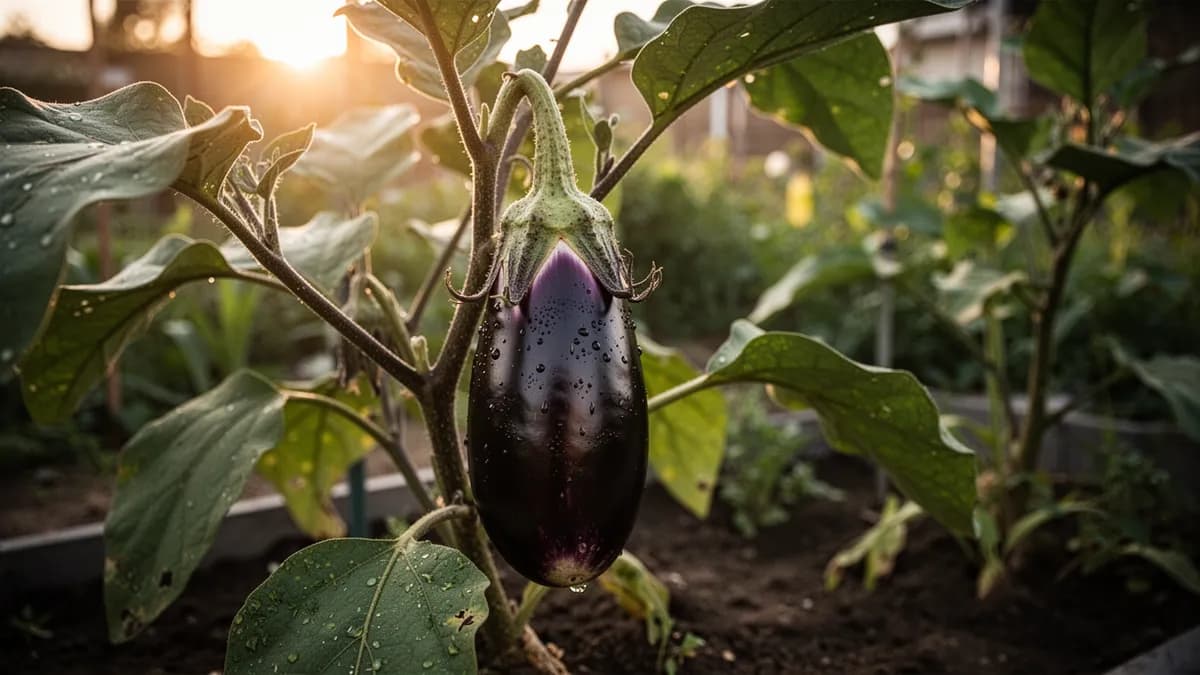
Eggplant
Solanum melongena
At a Glance
It's planting season for Eggplant! Start planning your garden now.
A heat-loving nightshade producing glossy, purple fruits that require a long warm season to mature properly. Start seeds indoors eight to ten weeks before the last frost and transplant only when nighttime temperatures stay above 60 degrees Fahrenheit. Eggplant pairs beautifully with Mediterranean and Asian cuisines, and smaller varieties work especially well in containers. Harvest when skin is glossy and firm, pressing gently to check that flesh springs back rather than remaining indented.
Planting & Harvest Calendar
Growth Stages
From Seed to Harvest
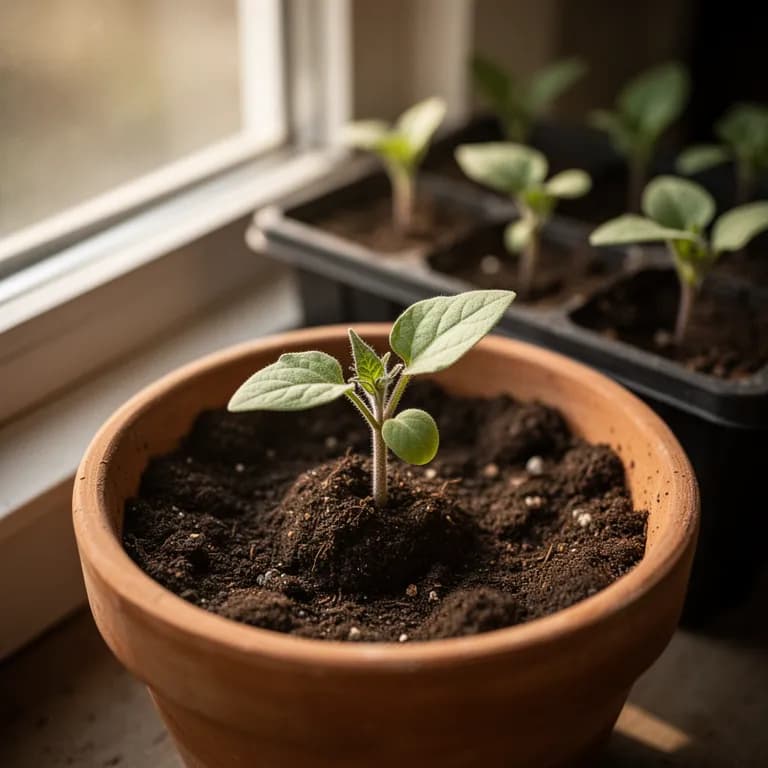
Seed Starting
Days 0–14
Seeds germinate slowly in warm, moist conditions. A tiny white radicle emerges first, followed by a pair of round cotyledons pushing through the surface. Eggplant germination is slower and more erratic than tomato or pepper.
💡 Care Tip
Maintain 27-32°C (80-90°F) with a heat mat — germination is very poor below 24°C. Cover trays with a humidity dome until sprouts appear. Provide 14-16 hours of grow light immediately upon emergence.
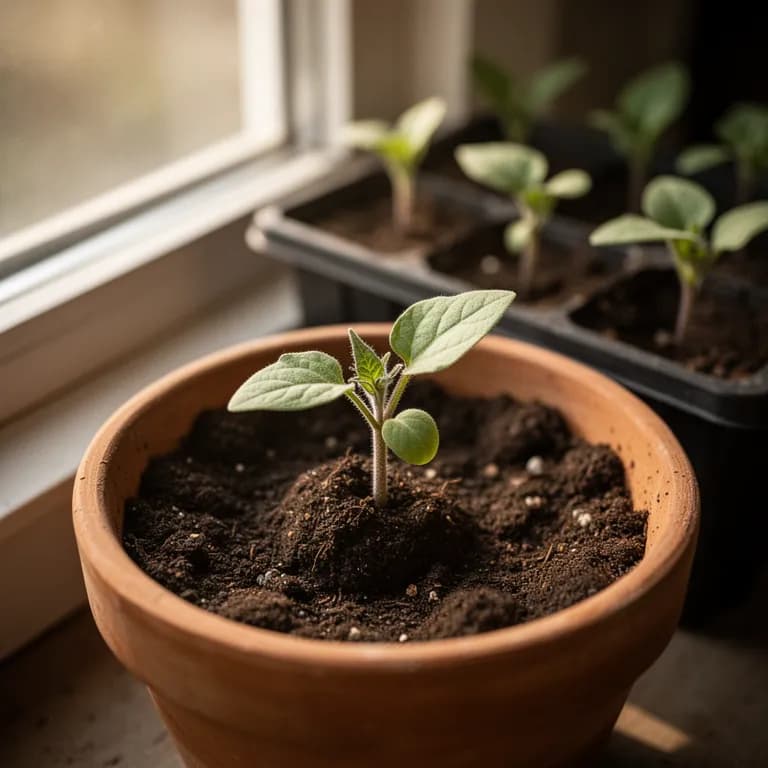
Eggplant seedlings ready for potting up
Monthly Care Calendar
What to do each month for your Eggplant
May
You are hereTransplant outdoors only after soil reaches 21°C (70°F) and nighttime air temperatures stay above 15°C (60°F). Install stakes at planting time. Apply organic mulch after soil is warm. Use row covers if flea beetles are a concern.
Did You Know?
Fascinating facts about Eggplant
Eggplant gets its English name from early European varieties that produced small, white, egg-shaped fruits — they literally looked like eggs hanging from the plant before the large purple cultivars became dominant.
Eggplant is one of the most heat-demanding vegetables, requiring warm soil, hot days, and warm nights to produce well. Start seeds indoors 8-10 weeks before the last frost date, sowing 6mm deep in warm (27-32°C / 80-90°F) seed-starting mix. Eggplant germinates slowly compared to other nightshades — use a heat mat for consistent warmth and expect 7-14 days to emergence. Transplant outdoors only after nighttime temperatures reliably stay above 15°C (60°F) and soil has warmed to at least 21°C (70°F). Use black plastic mulch to pre-warm soil in cooler climates.
Space transplants 45-60 cm apart in a location receiving at least 8 hours of full, direct sunlight. Prepare beds with generous compost and a balanced fertilizer. Eggplant has shallow roots that benefit from 5-8 cm of organic mulch once soil is thoroughly warm. Stake or cage plants as they grow heavy with fruit — branches laden with large fruits can snap easily.
Water consistently with 2.5-5 cm per week using drip irrigation to keep foliage dry — eggplant is susceptible to fungal diseases when leaves stay wet. Side-dress with compost or a balanced fertilizer when the first fruits begin to set. In very hot climates, fruit set may pause when temperatures exceed 35°C (95°F) — plants resume production as temperatures moderate. Pinch off the first few flowers on young transplants to encourage stronger root establishment before allowing fruit development.
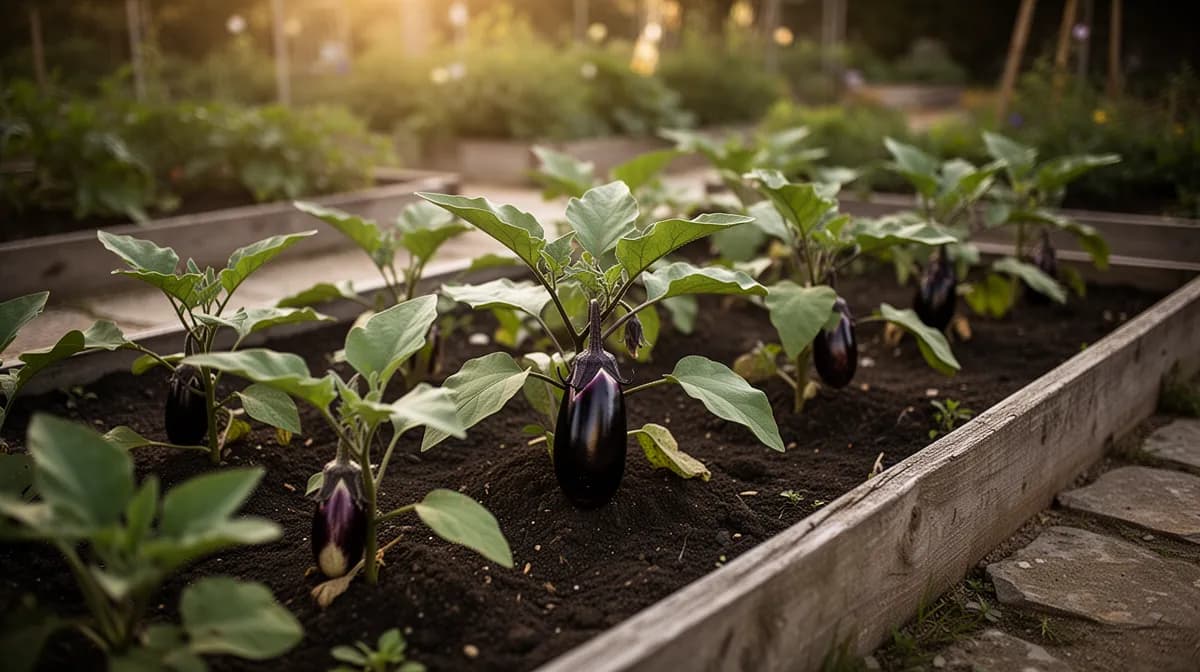
Eggplant thriving in a warm, sunny raised bed
Eggplant has one of the longest and most fascinating domestication stories among common vegetables. Wild eggplant species originated in Africa, but the plant was first cultivated in the Indian subcontinent over 4,000 years ago, where it was prized in Ayurvedic medicine and developed into the diverse range of shapes and colors seen today. Ancient Sanskrit texts reference eggplant cultivation, and archaeological evidence from Indian sites confirms its importance as a food crop long before recorded history. From India, eggplant spread eastward along trade routes to China by the 5th century CE, where it became a staple vegetable and was further bred into the long, slender varieties characteristic of East Asian cuisine.
Arab traders and merchants carried eggplant westward across the Islamic world during the 7th and 8th centuries, introducing it to Persia, North Africa, and eventually the Iberian Peninsula. The Moors brought eggplant to Spain during their occupation, and from there it spread throughout the Mediterranean. However, European acceptance was slow and suspicious — the plant's membership in the nightshade family led many to believe it was poisonous or caused madness. Italian names like 'mala insana' (mad apple) and 'melanzana' reflect this deep mistrust that persisted for centuries.
It was not until the 18th and 19th centuries that eggplant gained widespread culinary acceptance in Europe, eventually becoming a cornerstone ingredient in Mediterranean cooking. Dishes like moussaka in Greece, ratatouille in France, parmigiana di melanzane in Italy, and escalivada in Spain all emerged during this period. Thomas Jefferson grew eggplant as an ornamental at Monticello in 1806, though Americans would not widely embrace it as food until the 20th century with the influx of Mediterranean and Asian immigrants who brought their recipes and food traditions.
Start eggplant seeds indoors 8-10 weeks before the last frost date — they need a longer indoor growing period than tomatoes or peppers. Sow seeds 6mm (1/4 inch) deep in sterile seed-starting mix kept consistently warm at 27-32°C (80-90°F) using a heat mat. Germination takes 7-14 days and is erratic at temperatures below 24°C (75°F). Provide 14-16 hours of strong light daily once seedlings emerge. Transplant into larger individual pots when the first true leaves appear. Harden off gradually over 10-14 days before transplanting outdoors — eggplant is very sensitive to cold and even a light chill can stunt growth. Transplant only when nighttime temperatures reliably exceed 15°C (60°F).
Eggplant seedlings are slower-growing and more temperamental than their nightshade cousins. Bottom heat is critical — without a heat mat, germination rates drop dramatically and can take three weeks or longer. Once seedlings emerge, lower the temperature slightly to 21-24°C (70-75°F) to prevent leggy growth, but never below 18°C (65°F). Pot up seedlings into 10 cm (4 inch) containers when the first set of true leaves is fully expanded, handling them gently by the leaves rather than the delicate stems. Feed weekly with quarter-strength liquid fertilizer from the two-leaf stage onward.
Hardening off eggplant requires more patience than other vegetables because it is extremely cold-sensitive. Begin 10-14 days before your planned transplant date by placing seedlings outdoors in a sheltered, shaded spot for just one hour the first day, increasing exposure by 30-60 minutes daily. Introduce direct sunlight gradually starting on day four or five. Bring plants indoors if nighttime temperatures will drop below 13°C (55°F). By transplant day, seedlings should tolerate full sun and gentle wind for a full day. Transplant on a cloudy afternoon and water deeply with a dilute seaweed solution to reduce transplant shock.
Eggplant demands rich, well-drained soil with a pH of 5.5-6.8. Work in 8-10 cm of compost and a balanced slow-release fertilizer before transplanting. Black plastic mulch warms soil and conserves moisture while suppressing weeds. Once fruits begin setting, switch to a fertilizer higher in phosphorus and potassium (such as 5-10-10) to support fruit development rather than foliage growth. Side-dress with compost or liquid fish emulsion every 3-4 weeks during the growing season. Calcium is important for preventing blossom end rot — add gypsum or crushed eggshells to soil if calcium levels are low. Avoid excessive nitrogen which promotes lush leaves but delays fruiting.
Eggplant is a heavy feeder that benefits from rich, biologically active soil. Before planting, incorporate 5-8 cm of well-aged compost into the top 30 cm of soil along with a handful of bone meal per planting hole for phosphorus. If your soil is heavy clay, raise beds at least 15-20 cm and mix in perlite or coarse sand to improve drainage — eggplant roots rot quickly in waterlogged soil. A soil temperature of at least 21°C (70°F) at transplanting is essential; cold soil stunts root development and delays fruiting by weeks.
Magnesium deficiency is common in eggplant and shows as yellowing between leaf veins on older leaves. Prevent this by mixing a tablespoon of Epsom salts into the planting hole at transplant time. Monitor soil pH throughout the season, as eggplant performs poorly in alkaline conditions above 7.0. Foliar feeding with dilute seaweed extract every two weeks provides trace minerals and growth-stimulating hormones that boost fruit set and plant vigor, particularly during the heavy fruiting period of midsummer.
Check Your Zone
See if Eggplant is suitable for your location.
21°C – 32°C
70°F – 90°F
Eggplant is the most heat-loving of the common garden vegetables. Below 15°C (60°F), growth stalls and flowers drop without setting fruit. Above 35°C (95°F), pollen viability decreases and fruit set may temporarily pause. The ideal range is 24-30°C (75-86°F) daytime with 18-24°C (65-75°F) nights for optimal flowering and fruit development.
Common issues affecting Eggplant and how to prevent and treat them organically.
Flowers dropping without setting fruit is the most common frustration — this is usually caused by temperatures below 15°C (60°F) at night or above 35°C (95°F) during the day, low humidity, or insufficient pollinator activity. Gently tap open flowers to assist self-pollination. Small, bitter fruits result from water stress or overmaturity — harvest promptly when glossy and maintain consistent watering. Sunscald appears as pale, papery patches on fruit surfaces exposed to intense direct sun — maintain good foliage cover. Blossom end rot (dark, sunken spots on the fruit bottom) is caused by calcium deficiency linked to inconsistent watering.
Flea beetle damage is almost universal on eggplant and can be devastating to young transplants. The tiny shotgun-hole pattern they create weakens plants and opens wounds for bacterial infection. Row covers are the most effective organic defense — install them immediately after transplanting and remove only when flowering begins so pollinators can access the blossoms. If flea beetles are a perennial problem in your garden, consider growing eggplant under permanent row cover and hand-pollinating flowers with a small paintbrush.
Poor fruit size and misshapen fruits often result from inadequate pollination rather than nutrient deficiency. Eggplant flowers are self-fertile but require vibration to release pollen — in greenhouses or under row covers, manually shake plants or use an electric toothbrush on flower clusters to simulate bee buzz pollination. Cool nighttime temperatures below 15°C (60°F) also cause pollination failure and misshaped fruits. If your climate has cool summers, choose fast-maturing varieties and use black plastic mulch and row covers to create a warmer microclimate.
Basil is the premier eggplant companion — its volatile aromatic oils repel aphids, spider mites, and whiteflies that commonly attack eggplant. Marigolds deter nematodes and whiteflies with their root exudates and pungent foliage. Thyme and oregano provide ground cover that conserves moisture while their scent confuses pests seeking eggplant. Bell peppers and eggplant have similar cultural requirements and grow well side by side. Avoid planting near fennel, which releases growth-inhibiting substances, and rotate away from other nightshades to prevent disease buildup.
- 1Eggplant needs more heat than any other common garden vegetable. Do not rush transplanting — wait until nighttime temperatures reliably stay above 15°C (60°F) and soil has reached at least 21°C (70°F). Cold soil and cool nights permanently stunt growth.
- 2Black plastic mulch is the eggplant grower's secret weapon. It warms the soil 3-5°C above ambient temperature, conserves moisture, and suppresses weeds. Lay it two weeks before transplanting to pre-warm beds, especially in cooler climates.
- 3Full sun is absolutely essential — 8 or more hours of direct, unfiltered sunlight daily. Southern exposure against a heat-reflecting wall or fence is ideal. Eggplant grown in partial shade produces few if any fruits.
- 4Water deeply and consistently with 2.5-5 cm (1-2 inches) per week using drip irrigation. Eggplant is particularly sensitive to water stress during flowering and fruit set — inconsistent moisture causes blossom drop and bitter, pithy fruits.
- 5Stake or cage every plant at transplanting time, before it needs support. Eggplant branches are brittle and snap easily under the weight of large fruits. Use soft ties to attach main stems and fruit-laden branches to supports.
- 6Flea beetles are eggplant enemy number one. Install lightweight floating row covers immediately after transplanting and leave them in place until plants begin flowering. This single measure prevents more damage than any spray.
- 7Pinch off the first two or three flowers on newly transplanted eggplant. This feels counterintuitive, but it redirects the plant's energy into root and stem development, resulting in a stronger plant that ultimately produces more and larger fruits.
- 8Rotate eggplant away from all nightshade family crops (tomatoes, peppers, potatoes) on a 3-4 year cycle. These crops share diseases like Verticillium wilt and Phytophthora that persist in the soil for years. Never plant eggplant where any nightshade grew in the previous three seasons.
Harvest eggplant when fruits are glossy, firm, and have reached their expected size for the variety — typically 15-20 cm for standard types and 8-12 cm for Asian varieties. Press the skin gently with your thumb; if it springs back, the fruit is at peak quality, but if the indentation remains, the fruit is overripe with tough seeds and bitter flesh. Dull, matte skin also indicates overmaturity. Cut fruits from the plant with pruning shears, leaving 2-3 cm of stem attached — the calyx has small spines on some varieties, so wear gloves. Harvest regularly every few days to encourage continued production, as leaving mature fruits on the plant signals it to slow down flowering.
Timing your harvest correctly makes a significant difference in eating quality. Eggplant develops bitterness as it matures past its prime — seeds darken from white to tan to brown, and the flesh becomes spongy and develops off-flavors. For the mildest, creamiest flesh, harvest on the younger side when seeds are still pale and the interior is uniformly white or cream-colored. Morning harvesting, after the dew has dried, yields the firmest fruits with the longest shelf life. In peak summer, check plants every one to two days, as warm temperatures can push a fruit from perfect to overripe in just 48 hours.
Different varieties have different harvest cues. Standard globe types like Black Beauty should be deep, uniformly purple-black and 15-20 cm long. Long Asian types like Ichiban are best at 20-25 cm when still slender — they become seedy if allowed to fatten. Small Italian types like Rosa Bianca are harvested when they reach softball size and the lavender color is vivid. White varieties should be pure white without yellowing. Regardless of type, a glossy sheen is the universal indicator of prime harvest readiness — once the shine fades to matte, the window has passed.
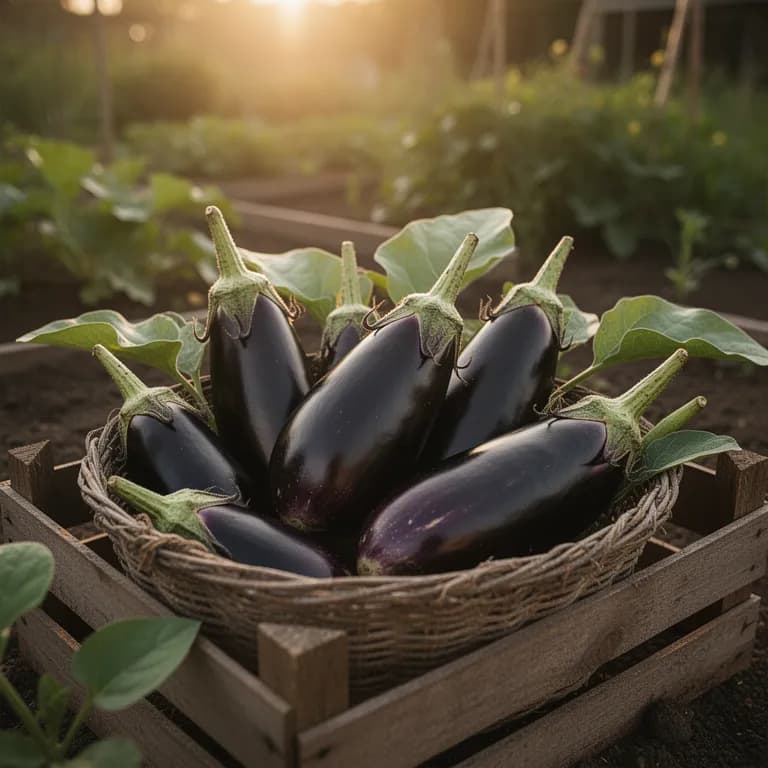
Harvest when the skin is glossy and springs back when pressed
Eggplant is best used within 2-3 days of harvest, as it does not store well long-term. Keep at room temperature if using within a day, or in the refrigerator crisper for up to a week — temperatures below 10°C (50°F) cause chilling injury and brown spots. For freezing, slice and roast or grill first, then freeze in a single layer on sheets before transferring to bags for up to 6 months — do not freeze raw eggplant as it becomes mushy. Pickled eggplant in oil and vinegar is an excellent Mediterranean preservation method. Dehydrate thin slices at 52°C (125°F) for 8-12 hours for eggplant chips.
For longer preservation, eggplant caponata — a Sicilian sweet-and-sour relish of diced eggplant cooked with tomatoes, celery, capers, olives, and vinegar — can be water-bath canned and stored for up to a year. Eggplant parmesan also freezes exceptionally well: assemble the dish, cool completely, wrap tightly in plastic and foil, and freeze for up to three months. Thaw overnight in the refrigerator before reheating. Grilled eggplant slices can be preserved in olive oil with garlic and herbs in sterilized jars, stored in the refrigerator for up to two weeks.
Smoked eggplant is another excellent preservation approach — halve fruits, grill or broil until the flesh is completely soft and the skin is charred, then scoop out the smoky flesh and freeze in portions for instant baba ghanoush or smoky dips year-round. For eggplant powder, dehydrate thin slices until completely brittle, then grind into a fine powder that adds rich umami depth to soups, stews, and spice blends. Store the powder in airtight containers away from light for up to six months.
Plan your garden with ease
Love growing Eggplant? Use our free garden planner to design your beds, track planting dates, and get personalized care reminders.
Nutritional Info
Per 100g serving
25
Calories
Health Benefits
- Rich in nasunin, a potent anthocyanin antioxidant found in the purple skin that may help protect brain cell membranes from free radical damage
- Excellent source of dietary fiber — 3g per 100g supports digestive health, blood sugar regulation, and cholesterol reduction
- Very low calorie (only 25 calories per 100g) making it ideal for weight management and calorie-conscious diets
- Contains chlorogenic acid, one of the most powerful free-radical scavengers found in plant tissue, with anti-inflammatory and antimicrobial properties
- Good source of manganese and potassium, supporting bone health and blood pressure regulation respectively
- Provides B vitamins including folate and thiamine, important for energy metabolism and cell function
💰 Why Grow Your Own?
A single eggplant transplant costing $3-5 can produce $15-30 worth of organic eggplant over a season. Specialty varieties like Rosa Bianca or Japanese types that command $4-6 per pound at farmers markets offer especially strong returns. A small planting of 3-4 plants provides more than enough eggplant for a family, with surplus for grilling, freezing, and sharing with neighbors.
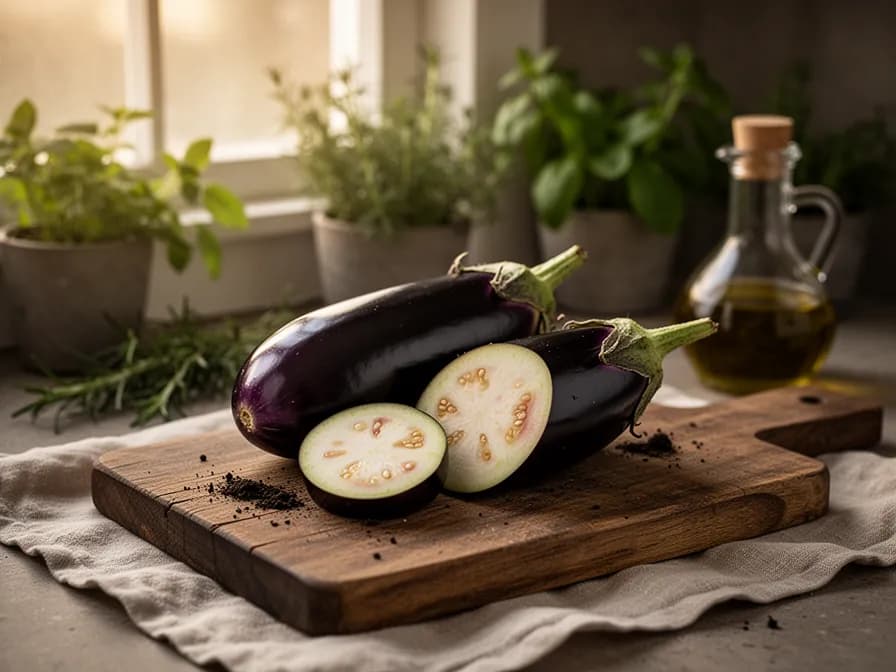
Fresh eggplant with pale seeds indicates perfect maturity
Quick Recipes
Simple recipes using fresh Eggplant
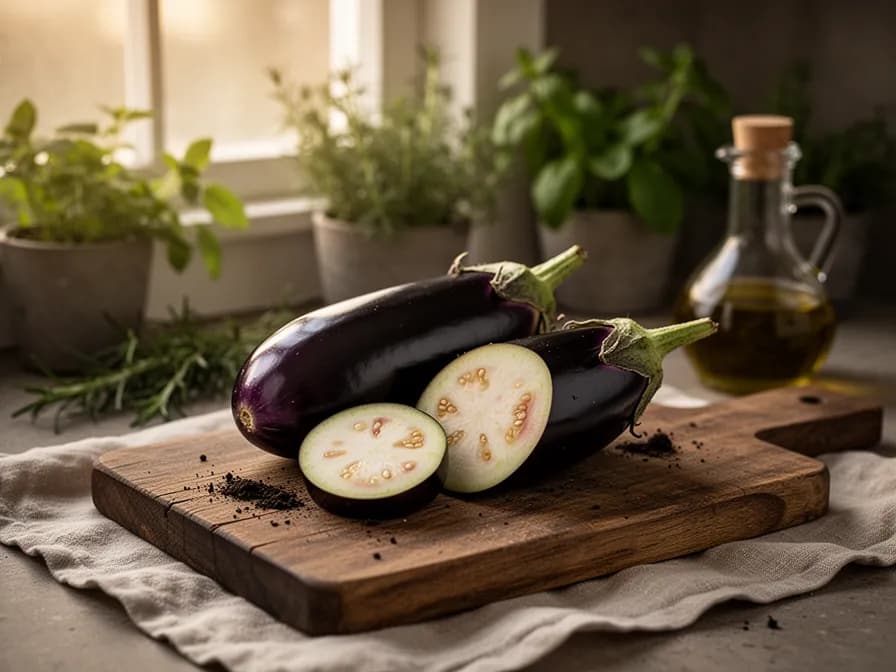
Classic Baba Ghanoush
30 minThe quintessential eggplant dip from the Middle East. Whole eggplant is charred over an open flame or under a broiler until the flesh is completely soft and smoky, then blended with tahini, lemon, and garlic into a silky, addictive spread.
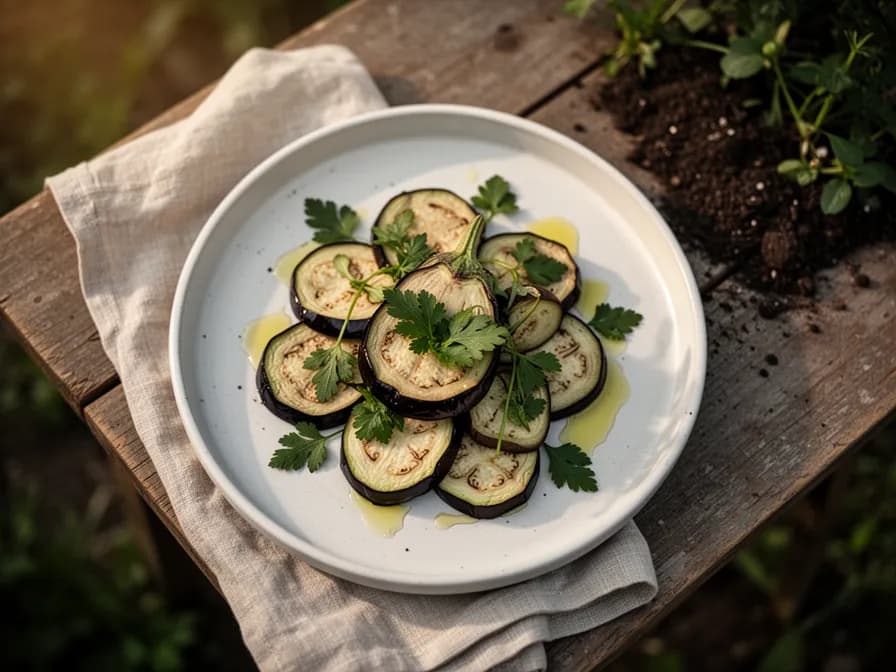
Grilled Eggplant Steaks
20 minThick eggplant slices brushed with a garlic-herb marinade and grilled until tender with beautiful char marks. A satisfying vegetarian main that holds its own alongside any grilled meat. Best with eggplant freshly picked from the garden.
Japanese Miso-Glazed Eggplant (Nasu Dengaku)
25 minHalved eggplant scored in a crosshatch pattern, pan-fried until golden, then topped with a sweet white miso glaze and broiled until bubbling and caramelized. A beloved Japanese side dish that showcases eggplant at its silky best.
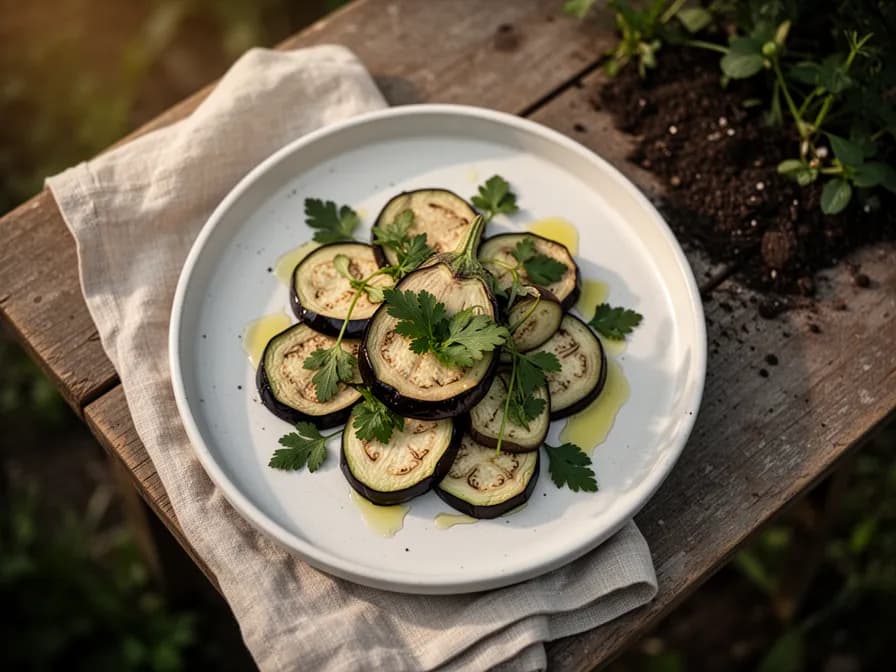
Grilled eggplant develops a rich, smoky sweetness
Yield & Spacing Calculator
See how many Eggplant plants fit in your garden bed based on the recommended 60cm spacing.
4
Eggplant plants in a 4×4 ft bed
2 columns × 2 rows at 60cm spacing
Popular Varieties
Some of the most popular eggplant varieties for home gardeners, each with unique characteristics.
Black Beauty
The classic large, glossy, deep-purple eggplant that is the standard variety for home gardens. Produces 3-6 large, tear-drop shaped fruits per plant. 80 days to maturity. Excellent for grilling, baking, and breading.
Ichiban
A long, slender Japanese variety with thin, tender skin that does not need peeling. Dark purple fruits 25-30 cm long with mild, sweet flavor and few seeds. 70 days. Prolific producer perfect for stir-fries.
Rosa Bianca
A beautiful Italian heirloom with round, lavender-pink fruits streaked with white. Creamy, mild flesh with no bitterness — considered one of the finest eating eggplants. 88 days. Best in warm climates.
Fairy Tale
A miniature variety producing clusters of small, striped purple-and-white fruits with exceptionally sweet, tender flesh. 50 days. Perfect for containers. No bitterness or need for salting before cooking.
Thai Green
A compact variety producing round, lime-green fruits 5-8 cm in diameter. Essential in Thai and Southeast Asian curries. Firm texture holds up well in long cooking. 65 days. Highly productive.
Eggplant is a culinary chameleon absorbing flavors beautifully — grill, roast, fry, or bake it for Mediterranean dishes like moussaka, ratatouille, and baba ghanoush. It is essential in Asian stir-fries, curries, and tempura. Salt and drain slices before cooking to reduce moisture and bitterness in older varieties. Eggplant pairs well with olive oil, garlic, tomatoes, basil, miso, sesame, and cumin. It provides fiber, potassium, folate, and nasunin, a potent antioxidant in the purple skin.
The spongy flesh of eggplant makes it an exceptional vehicle for absorbing sauces and marinades. For the richest flavor, roast or grill eggplant until deeply caramelized — high heat transforms its texture from spongy to silky and develops complex, smoky sweetness. Sliced and grilled eggplant makes an excellent meat substitute in sandwiches, wraps, and lasagna. In Middle Eastern cuisine, charring whole eggplant over an open flame produces the incomparable smoky flesh used in baba ghanoush and mutabal. Japanese cuisine features nasu dengaku — halved eggplant glazed with sweet miso and broiled until bubbling.
For the crispiest fried eggplant, salt slices for 30 minutes to draw out moisture, pat dry thoroughly, then dredge in seasoned flour, egg, and breadcrumbs before frying in hot oil. This technique prevents the flesh from absorbing excessive oil — a common complaint when frying unsalted eggplant. Eggplant is naturally low in calories (only 25 per 100g) and provides significant dietary fiber, making it an excellent component of heart-healthy and weight-management diets. The deep purple skin contains nasunin, an anthocyanin antioxidant that research suggests may help protect cell membranes from oxidative damage.
When should I plant Eggplant?
Plant Eggplant in April, May, June. It takes approximately 70 days to reach maturity, with harvest typically in July, August, September.
What are good companion plants for Eggplant?
Eggplant grows well alongside Basil, Marigold, Thyme, Bell Pepper. Companion planting can improve growth, flavor, and natural pest control.
What hardiness zones can Eggplant grow in?
Eggplant thrives in USDA hardiness zones 9 through 12. With greenhouse protection, it may be grown in zones 7 through 13.
How much sun does Eggplant need?
Eggplant requires Full Sun (6-8h+). This means at least 6-8 hours of direct sunlight daily.
How far apart should I space Eggplant?
Space Eggplant plants 60cm (24 inches) apart for optimal growth and air circulation.
What pests and diseases affect Eggplant?
Common issues include Flea Beetle, Verticillium Wilt, Spider Mites, Phytophthora Blight. Prevention through good garden practices like crop rotation, proper spacing, and companion planting is the best approach. See the detailed pests and diseases section above for symptoms, prevention, and treatment for each.
How do I store Eggplant after harvest?
Eggplant is best used within 2-3 days of harvest, as it does not store well long-term. Keep at room temperature if using within a day, or in the refrigerator crisper for up to a week — temperatures below 10°C (50°F) cause chilling injury and brown spots. For freezing, slice and roast or grill first,...
What are the best Eggplant varieties to grow?
Popular varieties include Black Beauty, Ichiban, Rosa Bianca, Fairy Tale, Thai Green. Each has unique characteristics suited to different growing conditions and culinary preferences. See the varieties section above for detailed descriptions.
What soil does Eggplant need?
Eggplant demands rich, well-drained soil with a pH of 5.5-6.8. Work in 8-10 cm of compost and a balanced slow-release fertilizer before transplanting. Black plastic mulch warms soil and conserves moisture while suppressing weeds. Once fruits begin setting, switch to a fertilizer higher in phosphorus...
Why are my eggplant flowers falling off without producing fruit?
Blossom drop is almost always caused by temperature extremes. Eggplant flowers fail to set fruit when nighttime temperatures drop below 15°C (60°F) or daytime temperatures exceed 35°C (95°F). Low humidity and poor pollination are secondary causes. Gently tap or shake flowering branches to help release pollen. If cool nights are the issue, use row covers to trap daytime warmth overnight.
Do I need to salt eggplant before cooking?
Modern eggplant varieties bred for home gardens have much less bitterness than older cultivars, so salting is often unnecessary. However, salting and draining for 30 minutes before frying is still worthwhile because it draws out moisture, resulting in crispier, less oil-absorbent fried eggplant. For grilling, roasting, or stewing, salting is generally not needed with fresh garden eggplant picked at the glossy stage.
Can I grow eggplant in containers?
Yes, eggplant does well in containers with at least 20 liters (5 gallons) of capacity. Choose compact or dwarf varieties like Fairy Tale, Patio Baby, or Hansel for best results. Use quality potting mix with added compost, place in the sunniest spot available (8+ hours of direct sun), water daily in hot weather, and feed weekly with liquid tomato fertilizer. Container eggplant may need staking as fruits develop.
How do I know when an eggplant is overripe?
An overripe eggplant has dull, matte skin instead of a glossy sheen, and pressing the flesh leaves a permanent indentation rather than springing back. When you cut it open, the seeds will be large, dark brown, and surrounded by tan-colored flesh instead of small, pale seeds in creamy white flesh. Overripe eggplant tastes bitter and has a spongy, unpleasant texture. Harvest promptly when skin is shiny.
What causes small, misshapen eggplant fruits?
Small or deformed fruits usually result from poor pollination, often caused by cool temperatures, low humidity, or lack of pollinator vibration. Eggplant pollen must be physically shaken loose from the flower — buzz-pollinating bees do this naturally, but in their absence you can hand-pollinate by tapping flowers or using an electric toothbrush on the base of each flower. Insufficient water and nutrient deficiencies can also limit fruit size.
How long does it take for eggplant to produce fruit from transplanting?
Most eggplant varieties take 60-80 days from transplanting to first harvest, depending on variety, temperature, and growing conditions. Fast-maturing varieties like Fairy Tale can produce in as few as 50 days, while large-fruited types like Black Beauty may need 75-80 days. Consistent warmth accelerates development — cool weather can delay harvest by two weeks or more. From seed, total time is typically 100-140 days.
Ready to Grow Eggplant?
Add Eggplant to your garden plan and start designing your perfect layout.

Vladimir Kusnezow
Gardener and Software Developer
Zone 6b gardener. Growing vegetables and fruits in soil and hydroponics for 6 years. I built PlotMyGarden to plan my own gardens.
Jump to Section