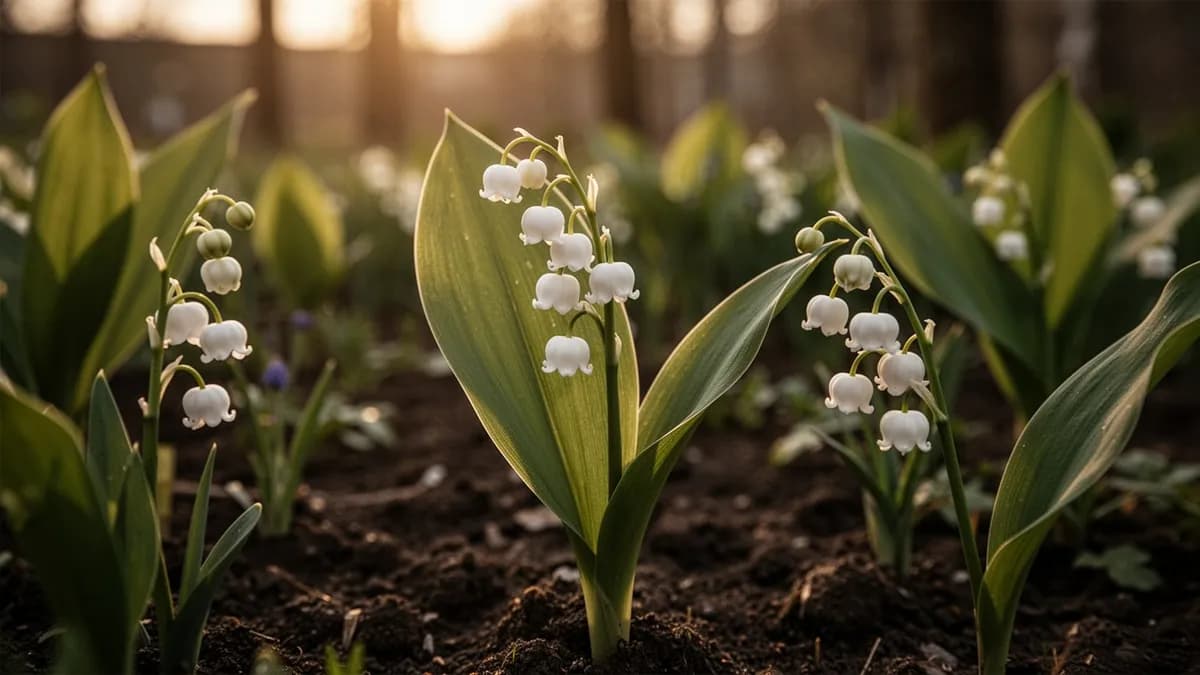
Lily of the Valley
Convallaria majalis
At a Glance
A beloved woodland groundcover with arching stems of intensely fragrant, tiny white bell flowers above pairs of smooth green leaves. Lily of the valley spreads aggressively by rhizomes and is best planted where it can naturalize freely in shade. All parts are poisonous, but the heavenly spring scent makes it a timeless garden classic.
Planting & Harvest Calendar
Growth Stages
From Seed to Harvest
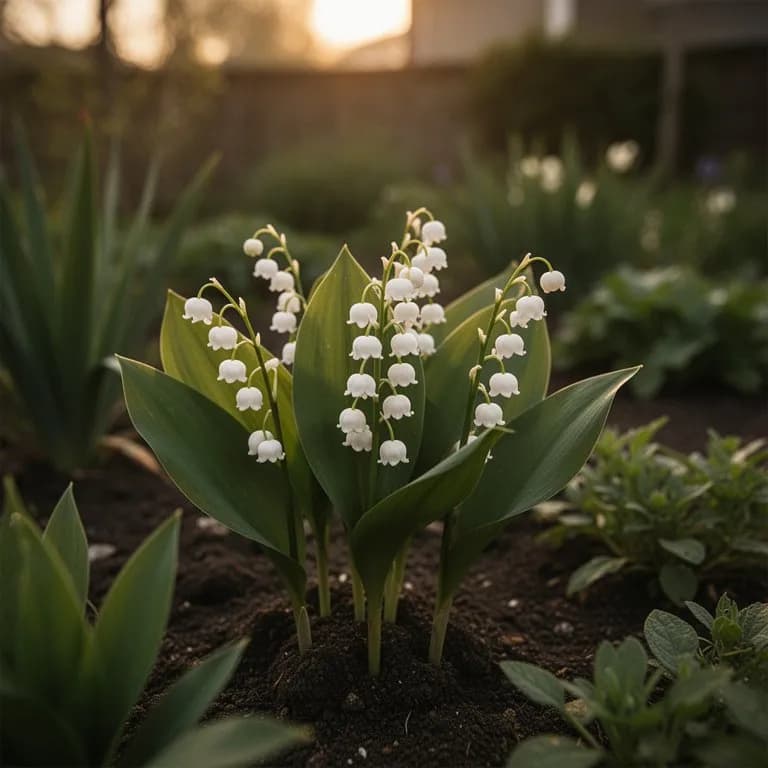
Dormant Pip
Days 0–30
Rhizome pips rest underground through winter, requiring a cold stratification period of at least 8-10 weeks below 5°C (41°F) to break dormancy. The chilling requirement is essential for proper flower bud initiation in the following spring season.
💡 Care Tip
Ensure pips remain in moist but not waterlogged soil during dormancy. Apply a 5-8cm layer of organic mulch such as shredded leaves to insulate rhizomes and maintain consistent soil moisture throughout the cold months.
Monthly Care Calendar
What to do each month for your Lily of the Valley
May
You are hereEnjoy peak flowering season; cut stems for indoor arrangements wearing gloves. Keep soil evenly moist to prolong the flowering period as long as possible. Remove spent flower stems after blooming finishes unless you wish to observe berry development
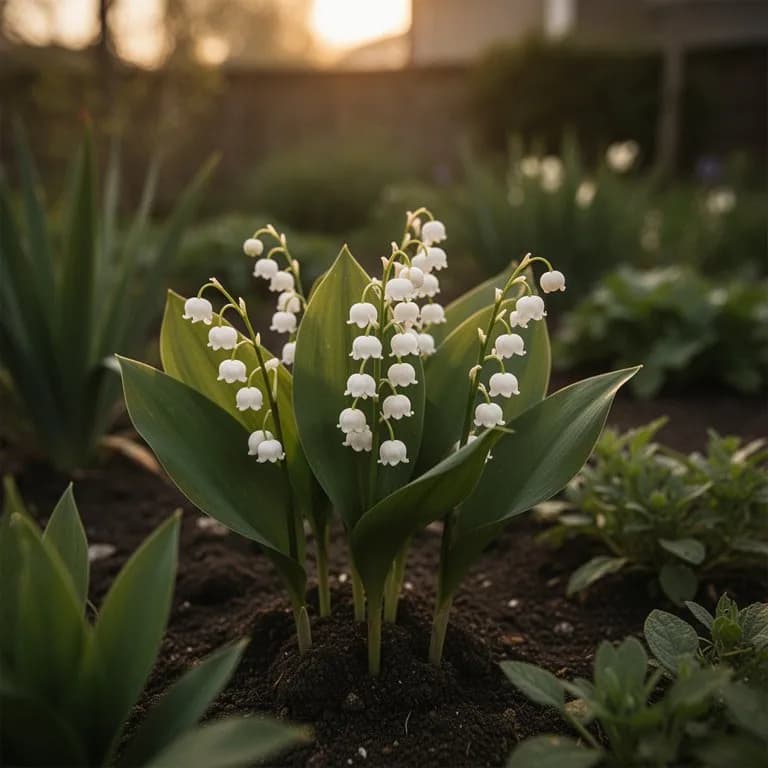
Plants die back completely in autumn; a layer of leaf mulch protects the rhizomes through winter
Did You Know?
Fascinating facts about Lily of the Valley
Convallaria majalis has been the national flower of Finland since 1967, symbolizing purity and the return of happiness with spring, despite being one of the most toxic garden plants in the Northern Hemisphere.
Plant lily of the valley pips (rhizome divisions with growth buds) in autumn or early spring, setting them just below the soil surface with the pointed tips facing up, spaced four to six inches apart. Choose a partially to fully shaded location under deciduous trees, along north-facing walls, or in woodland settings where the soil stays cool and moist. Convallaria tolerates deep shade better than almost any other flowering plant.
Water regularly during the first growing season to establish the spreading rhizome network. Once established, lily of the valley is essentially maintenance-free and will spread vigorously by underground runners to form dense, weed-suppressing carpets. In fact, its aggressive nature means you should plant it where spreading is welcome or contain it with physical root barriers sunk at least twelve inches deep.
The delicate, intensely fragrant white bells appear in mid-spring and last about three weeks. After flowering, the foliage persists as an attractive groundcover through summer before dying back in autumn. All parts of the plant are highly toxic if ingested, including the red berries that appear in late summer. Keep away from areas where children or pets play.
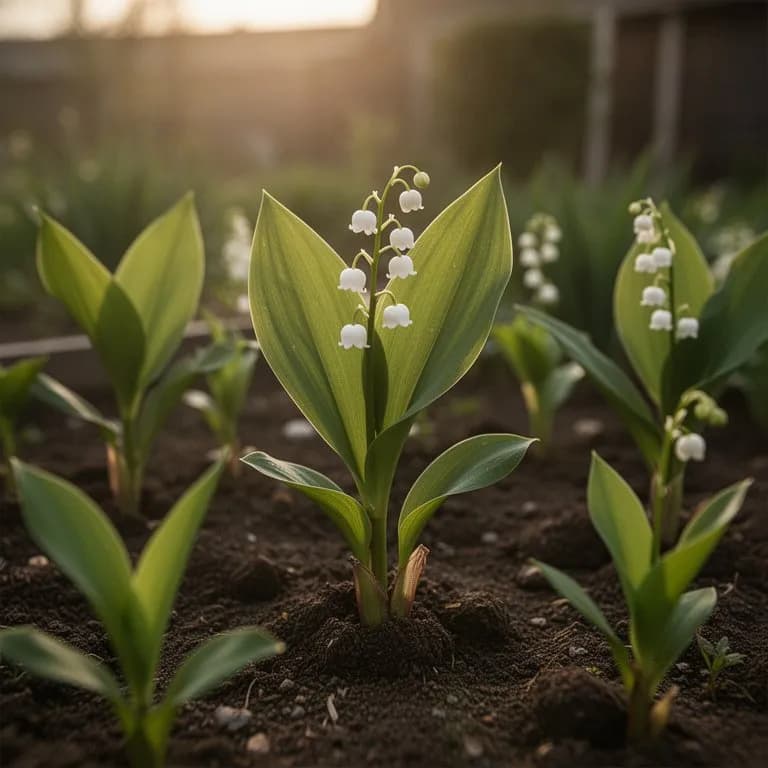
Convallaria's paired basal leaves emerge directly from underground rhizomes, forming a lush carpet
Convallaria majalis, commonly known as lily of the valley, is native to the cool temperate regions of the Northern Hemisphere, with its natural range spanning across Europe, from the British Isles and Scandinavia through Central and Eastern Europe, and extending into parts of northern Asia and eastern North America. The plant thrives in the deciduous woodland understory, where it has evolved to exploit the brief window of spring sunlight before the tree canopy fully closes overhead. Archaeological and historical records suggest that humans have cultivated and revered this plant for well over a thousand years. Ancient herbalists, including those in the Anglo-Saxon tradition, referenced the plant for its purported medicinal properties, particularly related to heart ailments, a use that modern pharmacology has validated through the identification of potent cardiac glycosides such as convallatoxin and convallamarin within its tissues. During the medieval period, lily of the valley became deeply embedded in Christian symbolism, associated with the Virgin Mary and frequently depicted in religious art as a symbol of purity, humility, and the return of happiness. The plant's cultural significance reached courtly society when King Charles IX of France established the tradition of gifting lily of the valley sprigs on the first of May in 1561, a custom that persists to this day as La Fete du Muguet. By the Victorian era, the flower had become a staple of bridal bouquets and formal gardens across Europe, prized for its intoxicating fragrance and elegant form. It was introduced widely across North America by European settlers and has since naturalized in many regions, sometimes becoming invasive in favorable conditions. Throughout its long history of cultivation, the plant's extreme toxicity has been well documented, serving as both a cautionary tale and a source of pharmaceutical interest.
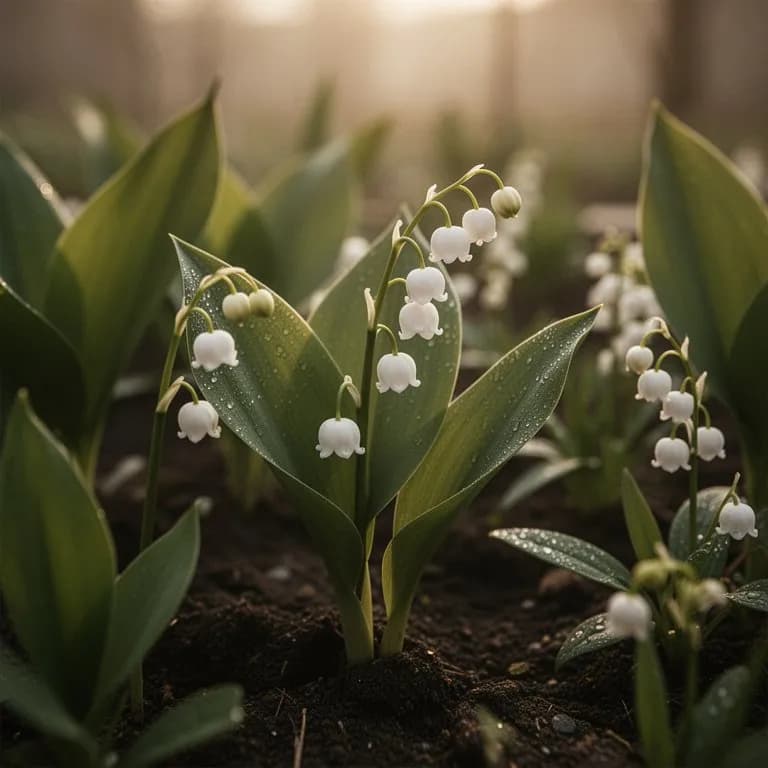
The iconic pendulous white bells of lily of the valley, each flower measuring 5-8mm across
While lily of the valley produces red berries containing seeds, propagation by seed is rarely practiced because it is extremely slow and results are unpredictable. Seeds require prolonged cold stratification and may take a year or more to germinate. The standard propagation method is division of rhizome pips in autumn or very early spring. Simply dig up sections of the spreading colony and replant immediately in prepared soil. Each pip with a healthy root system will establish and begin spreading within one season.
Lily of the valley thrives in moist, humus-rich, slightly acidic soil with a pH of 5.0 to 7.0. Amend planting areas with generous quantities of leaf mold, compost, or well-rotted manure. Apply a balanced slow-release fertilizer in early spring as growth emerges and top-dress annually with compost or leaf mold in autumn. The shallow root system benefits from a light organic mulch that retains moisture. Avoid alkaline conditions which can cause yellowing.
Check Your Zone
See if Lily of the Valley is suitable for your location.
-35°C – 25°C
-31°F – 77°F
Convallaria majalis is exceptionally cold-hardy, tolerating winter temperatures as low as -35°C (USDA Zones 2-7). The plant requires a sustained cold period below 5°C (41°F) for at least 8-10 weeks to properly vernalize and initiate flower buds. It performs best in cool spring conditions between 10-18°C (50-65°F) during active growth and flowering. Sustained summer temperatures above 25°C (77°F) cause premature foliage dieback and stress the rhizome system, making this plant poorly suited to hot climates or locations with intense afternoon sun exposure.
Common issues affecting Lily of the Valley and how to prevent and treat them organically.
The greatest challenge is controlling the aggressive spread, as lily of the valley can invade lawns, borders, and neighboring gardens via its vigorous underground rhizomes. Install root barriers at planting time to contain it. Failure to flower usually results from too much shade, overcrowding, or newly planted pips needing time to establish. Foliage can look shabby by late summer, especially in hot climates, so interplant with late-emerging perennials.
Lily of the valley excels as a groundcover beneath shade trees and tall shrubs where few other plants will grow. It pairs beautifully with ferns, hostas, brunnera, and bleeding heart in woodland garden settings. Plant along shaded pathways near seating areas where the spring fragrance can be enjoyed. Keep away from small, delicate plants that cannot compete with its vigorous spreading habit.
- 1Plant rhizome pips horizontally at a depth of only 2-3cm with the growing point (bud) facing upward, spacing them 10-15cm apart in humus-rich, consistently moist but well-drained soil for optimal establishment
- 2Select a planting location in partial to full shade; lily of the valley thrives beneath deciduous trees where it receives dappled spring sunlight but is protected from intense afternoon sun that causes leaf scorch
- 3Amend heavy clay soils with generous quantities of leaf mold, composted bark, or well-rotted garden compost to improve drainage and create the loose, organic-rich substrate that convallaria prefers
- 4Install a physical root barrier made of thick plastic or metal edging buried at least 30cm deep around convallaria beds to prevent the vigorous rhizomes from spreading into adjacent garden areas or lawn
- 5Water established colonies deeply during prolonged dry periods in summer, applying approximately 2.5cm of water per week to prevent premature foliage dieback and ensure strong rhizome development for next year
- 6Avoid fertilizing with high-nitrogen products which promote excessive leaf growth at the expense of flowering; instead, apply a top-dressing of composted leaf mold in autumn to naturally enrich the soil
- 7Always wear protective gloves when planting, dividing, weeding, or handling any part of the plant including dead foliage, as the cardiac glycosides can be absorbed through skin abrasions and cause irritation
- 8Divide overcrowded colonies every 3-4 years in early autumn after foliage has died back to maintain vigorous flowering and prevent the center of the colony from becoming sparse and unproductive
- 9Keep all parts of the plant, including cut flowers and vase water, completely away from children, pets, and food preparation areas, and educate all household members about the plant's extreme toxicity
- 10Companion plant with shade-tolerant species such as hostas, ferns, astilbe, and hellebores that share similar cultural requirements and create visually appealing textural contrasts in the woodland garden
Cut lily of the valley stems for fragrant indoor bouquets when the lowest bells on the stem have opened and the upper buds are still closed. Pull stems gently from the base rather than cutting to get the longest possible stem. Place immediately in cool water. The heavenly scent is powerful enough that a small bunch will perfume an entire room. Flowers last about a week in water. Remember to wash hands after handling, as all parts are toxic.
Prized as cut flowers for their intense fragrance; always wash hands thoroughly after handling
Lily of the valley is best preserved as dried or forced pips. To force for winter bloom, dig mature pips in late autumn, trim roots to four inches, and refrigerate in damp peat moss for three to four weeks. Pot up and bring into warmth for flowers in about three weeks. For dried arrangements, hang flower stems upside down in a dark, well-ventilated space. The scent does not persist in dried flowers. Pips for planting can be stored briefly in damp peat in the refrigerator.
Plan your garden with ease
Love growing Lily of the Valley? Use our free garden planner to design your beds, track planting dates, and get personalized care reminders.
Nutritional Info
Per 100g serving
0
Calories
Health Benefits
- CRITICAL WARNING: Convallaria majalis is HIGHLY TOXIC and must NEVER be consumed in any form
- All plant parts contain dangerous cardiac glycosides including convallatoxin, convallarin, and convallamarin
- Ingestion of any part can cause nausea, vomiting, abdominal pain, slow or irregular heartbeat, and potentially fatal cardiac arrest
- Even water from a vase containing cut lily of the valley stems can be toxic if ingested
- This plant has ZERO nutritional value as a food source and should be treated exclusively as an ornamental
- Contact your local poison control center or emergency services immediately if any part of this plant is ingested
💰 Why Grow Your Own?
Convallaria majalis is one of the most cost-effective ornamental ground covers available once established. A single purchase of 20-25 rhizome pips (typically costing $15-25 USD) can colonize an area of several square meters within 3-4 years through natural rhizome spreading, eliminating the need for additional plant purchases. The plant's aggressive spreading habit means division of existing colonies provides an essentially unlimited supply of new plants at no cost. Compared to annual bedding plants that require yearly replacement in shaded areas, established lily of the valley colonies are virtually maintenance-free perennials that return reliably for decades, representing significant long-term savings on garden planting costs. Note that this is a purely ornamental plant with no edible value whatsoever due to its extreme toxicity.
Quick Recipes
Simple recipes using fresh Lily of the Valley
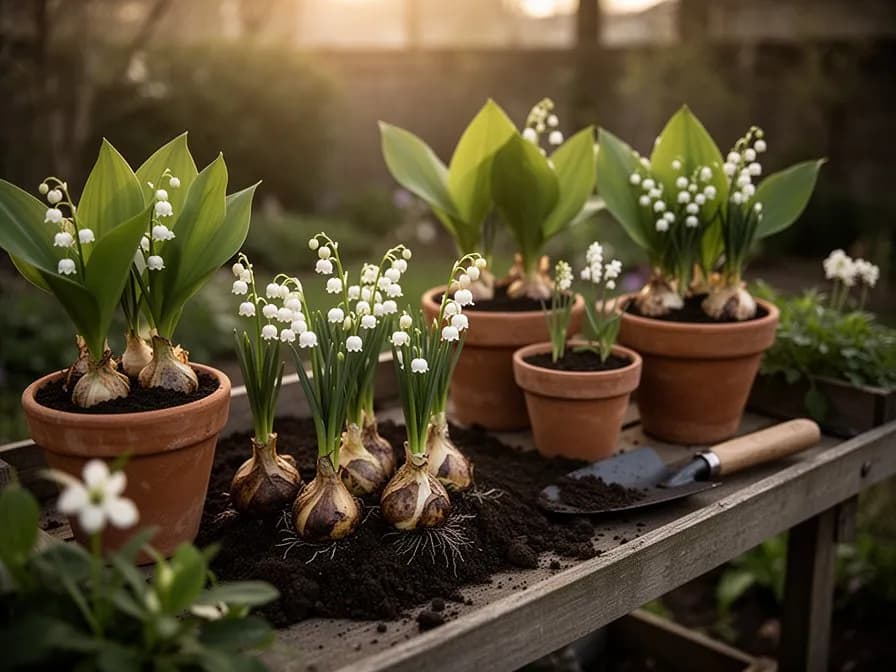
Lily of the Valley Fragrance Potpourri (Non-Edible Craft)
20 minutes plus 2-3 weeks dryingA dried flower craft project to preserve the fragrance of lily of the valley blooms. This is NOT a food recipe. Always wear gloves when handling plant material and keep the finished potpourri well away from children, pets, and food preparation areas. Wash hands thoroughly after crafting.
Pressed Lily of the Valley Botanical Art (Non-Edible Craft)
15 minutes plus 3-4 weeks pressingA botanical pressing project to create framed artwork from lily of the valley flowers and leaves. This is a decorative craft only, NOT a food recipe. Wear gloves when handling all plant parts. The pressed specimens retain their toxic properties indefinitely and should be sealed behind glass.
Lily of the Valley Forcing Arrangement (Indoor Winter Blooms)
30 minutes plus 3-4 weeks forcing periodForce pre-chilled lily of the valley pips to bloom indoors during winter months for fragrant displays. This is a horticultural technique, NOT a food recipe. Wear gloves when handling rhizomes and keep arrangements away from children, pets, and food surfaces. Dispose of water from the container safely.
Yield & Spacing Calculator
See how many Lily of the Valley plants fit in your garden bed based on the recommended 15cm spacing.
64
Lily of the Valley plants in a 4×4 ft bed
8 columns × 8 rows at 15cm spacing
Popular Varieties
Some of the most popular lily of the valley varieties for home gardeners, each with unique characteristics.
Rosea
A delicate form with pale pink-mauve bells that add a subtle warm tone to shaded areas, less vigorous than the white species.
Flore Pleno
A double-flowered form with extra petals creating fuller bells, slightly more upright and showy than the species.
Albostriata
Green leaves with elegant creamy-white longitudinal stripes that provide ornamental interest even when not in flower.
Fortin's Giant
A larger selection reaching twelve inches with bigger flowers and bolder foliage, excellent where maximum impact is desired.
When should I plant Lily of the Valley?
Plant Lily of the Valley in October, November, March. It takes approximately 365 days to reach maturity, with harvest typically in April, May.
What are good companion plants for Lily of the Valley?
Lily of the Valley grows well alongside Hosta, Siberian Bugloss, Hellebore. Companion planting can improve growth, flavor, and natural pest control.
What hardiness zones can Lily of the Valley grow in?
Lily of the Valley thrives in USDA hardiness zones 2 through 9. With greenhouse protection, it may be grown in zones 1 through 10.
How much sun does Lily of the Valley need?
Lily of the Valley requires Partial Sun (3-6h). This means 3-6 hours of sunlight, ideally morning sun with afternoon shade.
How far apart should I space Lily of the Valley?
Space Lily of the Valley plants 15cm (6 inches) apart for optimal growth and air circulation.
What pests and diseases affect Lily of the Valley?
Common issues include Anthracnose, Spider Mites, Stem Rot. Prevention through good garden practices like crop rotation, proper spacing, and companion planting is the best approach. See the detailed pests and diseases section above for symptoms, prevention, and treatment for each.
How do I store Lily of the Valley after harvest?
Lily of the valley is best preserved as dried or forced pips. To force for winter bloom, dig mature pips in late autumn, trim roots to four inches, and refrigerate in damp peat moss for three to four weeks. Pot up and bring into warmth for flowers in about three weeks. For dried arrangements, hang f...
What are the best Lily of the Valley varieties to grow?
Popular varieties include Rosea, Flore Pleno, Albostriata, Fortin's Giant. Each has unique characteristics suited to different growing conditions and culinary preferences. See the varieties section above for detailed descriptions.
What soil does Lily of the Valley need?
Lily of the valley thrives in moist, humus-rich, slightly acidic soil with a pH of 5.0 to 7.0. Amend planting areas with generous quantities of leaf mold, compost, or well-rotted manure. Apply a balanced slow-release fertilizer in early spring as growth emerges and top-dress annually with compost or...
How toxic is lily of the valley, and what should I do if someone ingests it?
Convallaria majalis is extremely toxic. All parts contain over 30 cardiac glycosides, including convallatoxin, which affects heart rhythm and can be fatal. Symptoms of ingestion include nausea, vomiting, abdominal pain, blurred vision, slow or irregular heartbeat, and in severe cases, cardiac arrest. If any part of the plant is ingested, call emergency services or your local poison control center immediately. Do not induce vomiting unless specifically instructed by medical professionals. Bring a sample of the plant to the hospital for identification.
Why is my lily of the valley producing leaves but no flowers?
The most common causes of non-flowering are insufficient winter chilling (the plant needs 8-10 weeks below 5°C), too much shade (it needs some dappled light in spring), overcrowding of the rhizome colony, or excess nitrogen fertilization that promotes leaf growth over flowering. To encourage blooming, divide overcrowded colonies in autumn, ensure the planting site receives at least 2-3 hours of filtered sunlight in spring, and avoid high-nitrogen feeds. Newly planted pips may also take 1-2 years to establish before flowering.
How do I stop lily of the valley from spreading into other parts of my garden?
The most effective method is to install a physical root barrier around the bed. Use rigid plastic or metal edging buried at least 30cm (12 inches) deep, as the rhizomes typically travel in the top 15-20cm of soil. Check the barrier annually for gaps or rhizomes growing over the top. Alternatively, plant convallaria in a contained raised bed with solid sides or in large buried containers with drainage holes. Regular edge maintenance with a sharp spade twice per year in spring and autumn can also help control spread.
Can I grow lily of the valley in containers or indoors?
Yes, convallaria grows well in containers and can be forced into bloom indoors during winter. For container growing outdoors, use a pot at least 20cm deep with drainage holes, filled with humus-rich potting mix. Place in shade and keep consistently moist. For indoor forcing, obtain pre-chilled rhizome pips (or chill your own at 1-3°C for 10-12 weeks), then plant in a shallow container with moist moss or potting mix and keep at 10-15°C in indirect light. Blooms typically appear within 3-4 weeks. Always keep containers out of reach of children and pets.
Is it safe to compost lily of the valley plant material?
It is generally not recommended to compost lily of the valley material, especially in home composting systems. The cardiac glycosides in the plant tissue break down slowly and may persist in finished compost. If this compost is then used on vegetable gardens or areas accessible to children and pets, there is a potential risk of contamination. Instead, dispose of all plant material including dead foliage, spent flowers, and removed berries in sealed bags with your regular household waste. If you must compost it, use only a dedicated ornamental garden compost bin and never apply the resulting compost to edible crop areas.
What pests and diseases commonly affect Convallaria majalis?
Lily of the valley is relatively pest-resistant, likely due to its toxic chemistry. However, it can be affected by Botrytis (gray mold) in humid conditions, which appears as gray fuzzy growth on leaves and flowers. Improve air circulation and avoid overhead watering to prevent this. Leaf spot fungal diseases may cause brown patches on foliage in wet seasons. Vine weevils can notch leaf margins, and their larvae may damage rhizomes underground. Slugs and snails may feed on young emerging shoots in early spring. Spider mites can occasionally affect plants in dry, sheltered locations. Stem nematodes are a less common but serious problem that causes distorted, stunted growth.
Ready to Grow Lily of the Valley?
Add Lily of the Valley to your garden plan and start designing your perfect layout.

Vladimir Kusnezow
Gardener and Software Developer
Zone 6b gardener. Growing vegetables and fruits in soil and hydroponics for 6 years. I built PlotMyGarden to plan my own gardens.
Jump to Section