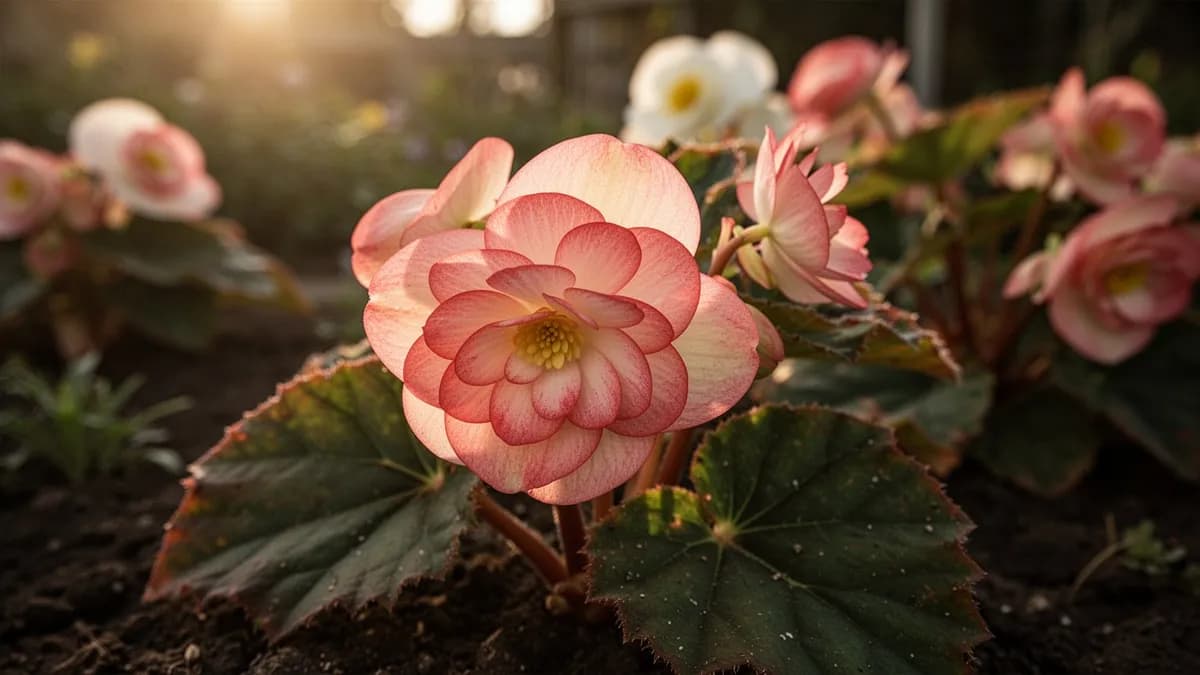
Begonia
Begonia x semperflorens
At a Glance
It's planting season for Begonia! Start planning your garden now.
A shade-tolerant annual with waxy leaves and continuous blooms, ideal for brightening dim garden spots and containers. Begonias thrive in rich, moist soil with good drainage and prefer morning sun with afternoon shade to prevent leaf scorch. Wax begonias are the most commonly grown type, but tuberous varieties offer larger, showier flowers in a wider color range. Avoid overhead watering to prevent powdery mildew and remove spent blooms occasionally, though many modern varieties are self-cleaning.
Planting & Harvest Calendar
Growth Stages
From Seed to Harvest
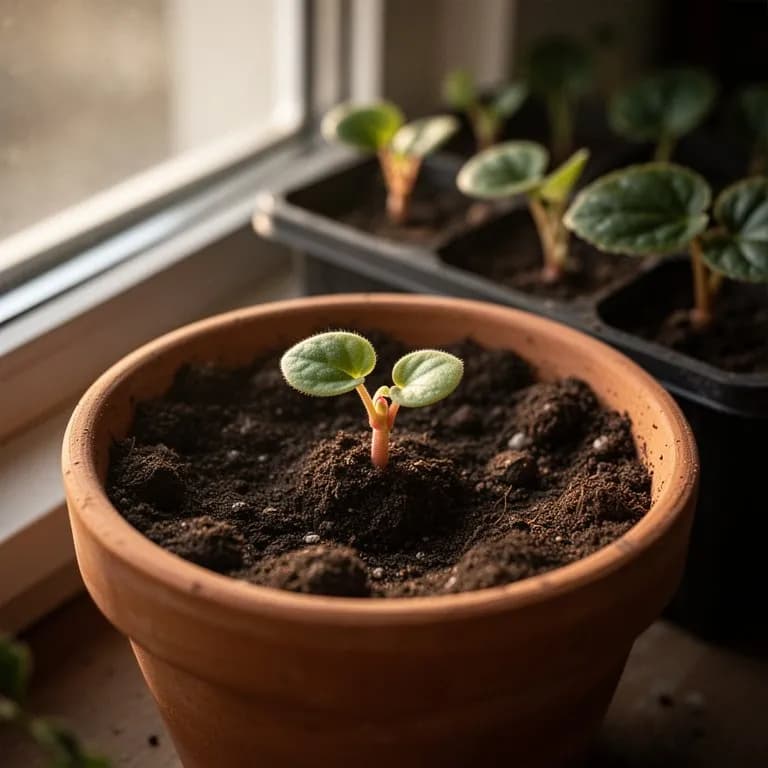
Seed Germination
Days 0–21
Begonia seeds are among the smallest of all cultivated plants, resembling fine dust. They require light to germinate and should be surface-sown on moist, sterile seed-starting mix without any covering. Germination is slow and requires consistently warm temperatures between 21-25°C (70-77°F) with high humidity. A clear plastic dome or wrap helps maintain the necessary moisture levels.
💡 Care Tip
Never cover begonia seeds with soil as they need light to germinate. Mist the surface gently with a spray bottle to avoid displacing the tiny seeds. Use a heat mat set to 23°C and maintain near-100% humidity with a clear cover. Bottom watering is preferred to prevent disturbing the delicate seedlings.
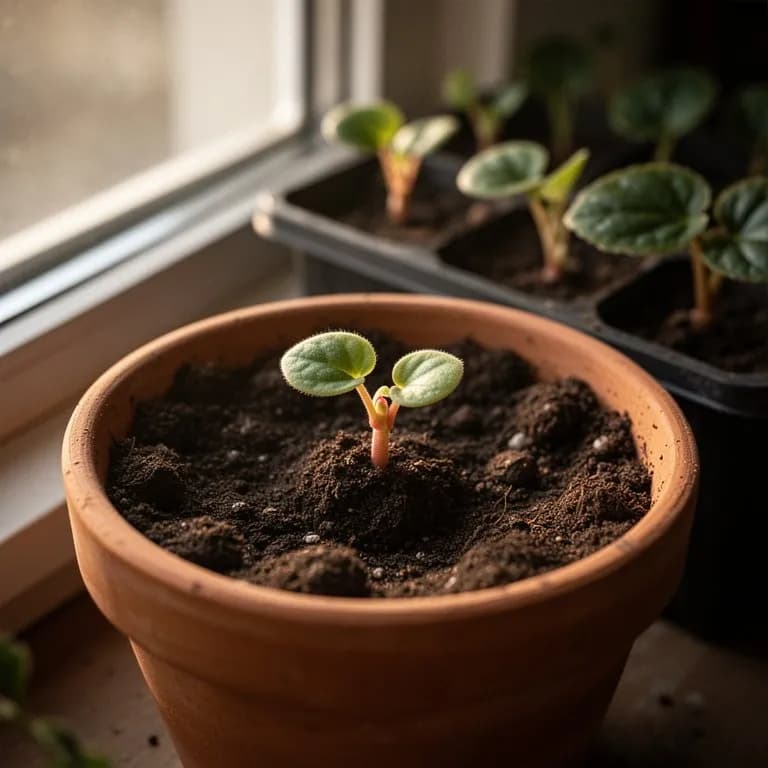
Begonia seedlings are extremely small and require careful moisture management during early growth
Monthly Care Calendar
What to do each month for your Begonia
May
You are hereTransplant begonias outdoors after all danger of frost has passed and nighttime temperatures remain consistently above 10°C (50°F). Choose a location with filtered light or morning sun with afternoon shade. Mulch around plants to conserve moisture and regulate soil temperature.
Did You Know?
Fascinating facts about Begonia
The begonia genus is one of the largest flowering plant genera, containing over 2,000 recognized species found primarily in tropical and subtropical regions around the world, making it the fifth-largest genus of flowering plants.
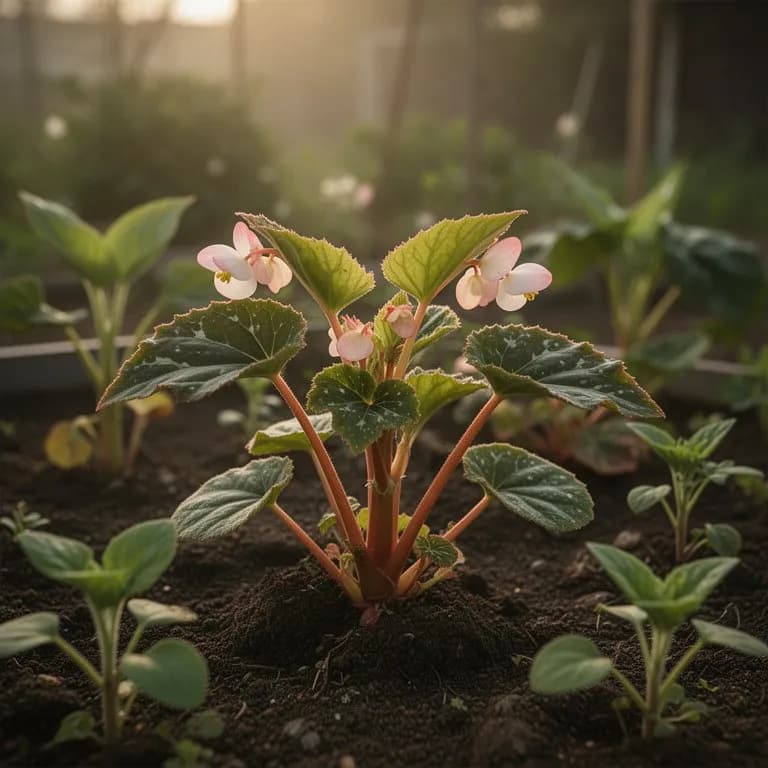
Begonia foliage is prized for its unique asymmetrical leaf shape and ornamental texture
Begonias are warm-season plants that should not be set outdoors until nighttime temperatures consistently remain above 50 degrees Fahrenheit. Choose a location with morning sun and afternoon shade, or dappled light throughout the day. Prepare beds with rich, well-drained soil amended with compost and peat moss to provide the moist, humus-rich conditions begonias prefer. Space wax begonias eight to twelve inches apart and tuberous types twelve to fifteen inches apart.
Water begonias consistently, keeping the soil evenly moist but never waterlogged. Water at the base of plants to keep foliage dry, as wet leaves are prone to powdery mildew and botrytis. Apply a balanced liquid fertilizer every two to three weeks during the growing season, or use a slow-release granular fertilizer at planting time.
Wax begonias are largely self-cleaning and require minimal deadheading. Tuberous begonias benefit from removing spent flowers and pinching off the two smaller female blooms flanking each large male flower to direct energy into the showiest blooms. In fall before frost, dig tuberous begonia tubers, dry them for a few days, and store in dry peat moss at 50 degrees Fahrenheit over winter.
Begonias belong to the family Begoniaceae and are native to tropical and subtropical regions across Central and South America, Africa, and southern Asia. The genus was first formally described in 1690 by the French botanist Charles Plumier, who encountered these plants during an expedition to the Caribbean islands, particularly in modern-day Haiti and the Dominican Republic. Plumier named the genus in honor of his patron Michel Begon, who had sponsored the botanical expedition as part of his broader efforts to catalog the natural resources of France's colonial territories.
The first begonia species to reach European gardens was Begonia nitida, which arrived in England around 1777. However, it was the discovery of the tuberous begonias of the Andes in the mid-19th century that truly ignited begonia mania among horticulturists. Plant hunters such as Richard Pearce collected Begonia boliviensis, B. pearcei, and B. veitchii from the cloud forests of Bolivia and Peru between 1864 and 1868, sending them back to the Veitch Nurseries in England. These Andean species became the foundation of the modern tuberous begonia hybrids that are grown worldwide today.
In the late 1800s, breeders in Belgium and England crossed these wild species to create the large-flowered, double-petaled tuberous hybrids that resemble roses and camellias. Belgium, particularly the city of Ghent, became the global center of begonia breeding, a tradition that continues to this day. Rex begonias, prized for their spectacular foliage, were developed from Begonia rex, discovered in Assam, India, in 1856. Meanwhile, wax begonias (Begonia semperflorens) became popular bedding plants due to their heat tolerance and continuous flowering. Today, begonias remain among the most popular ornamental plants worldwide, cultivated as houseplants, bedding plants, and container specimens across every inhabited continent.
Begonia seeds are exceptionally tiny, even smaller than petunia seeds. Start twelve to sixteen weeks before the last frost by sprinkling seeds on the surface of finely sifted, moist seed-starting mix. Do not cover, as seeds need light to germinate. Cover trays with clear plastic and maintain 70 to 75 degrees Fahrenheit. Germination takes fourteen to twenty-one days. Growth is slow initially. Transplant seedlings into individual pots when large enough to handle. Tuberous begonias are more commonly started from dormant tubers, set hollow side up in trays of moist peat moss six to eight weeks before the last frost.
Begonias require rich, well-drained soil with a pH of 5.5 to 6.5. They prefer soil high in organic matter, so amend beds generously with compost, peat moss, or leaf mold. In containers, use a premium peat-based potting mix with added perlite for drainage. Feed with a balanced liquid fertilizer every two to three weeks during the growing season. Tuberous begonias are heavier feeders than wax types and benefit from a high-potassium fertilizer as flowering begins to promote larger blooms.
Check Your Zone
See if Begonia is suitable for your location.
13°C – 27°C
55°F – 81°F
Begonias prefer moderate warmth and are sensitive to temperature extremes. Most varieties thrive between 16-24°C (60-75°F) during the day with slightly cooler nighttime temperatures of 13-16°C (55-60°F). They cannot tolerate frost and should be brought indoors or lifted for storage when nighttime temperatures approach 7°C (45°F). Prolonged exposure to temperatures above 30°C (86°F) causes leaf scorch, wilting, and bud drop, especially in direct sunlight. Tuberous begonias are particularly sensitive to heat and perform best in climates with cool summers.
Common issues affecting Begonia and how to prevent and treat them organically.
Leaf scorch from direct afternoon sun is the most common problem, causing brown, crispy leaf edges. Move affected plants to a shadier location or provide afternoon shade. Overwatering causes stem rot and is more common than underwatering as a cause of plant death. Leggy, sparse wax begonias result from too much shade, while tuberous types become lanky without adequate pinching. Begonias are sensitive to cold and should not be planted outdoors until temperatures are reliably warm.
Begonias excel as shade garden companions alongside hostas, ferns, impatiens, and caladiums. Their waxy, colorful foliage provides visual interest even when not in bloom. In containers, pair with trailing lobelia, ivy, and sweet potato vine for a layered display. Wax begonias work well as border edging plants alongside shade-loving perennials. Their continuous bloom fills the gap between spring and fall flowering perennials in partially shaded borders.
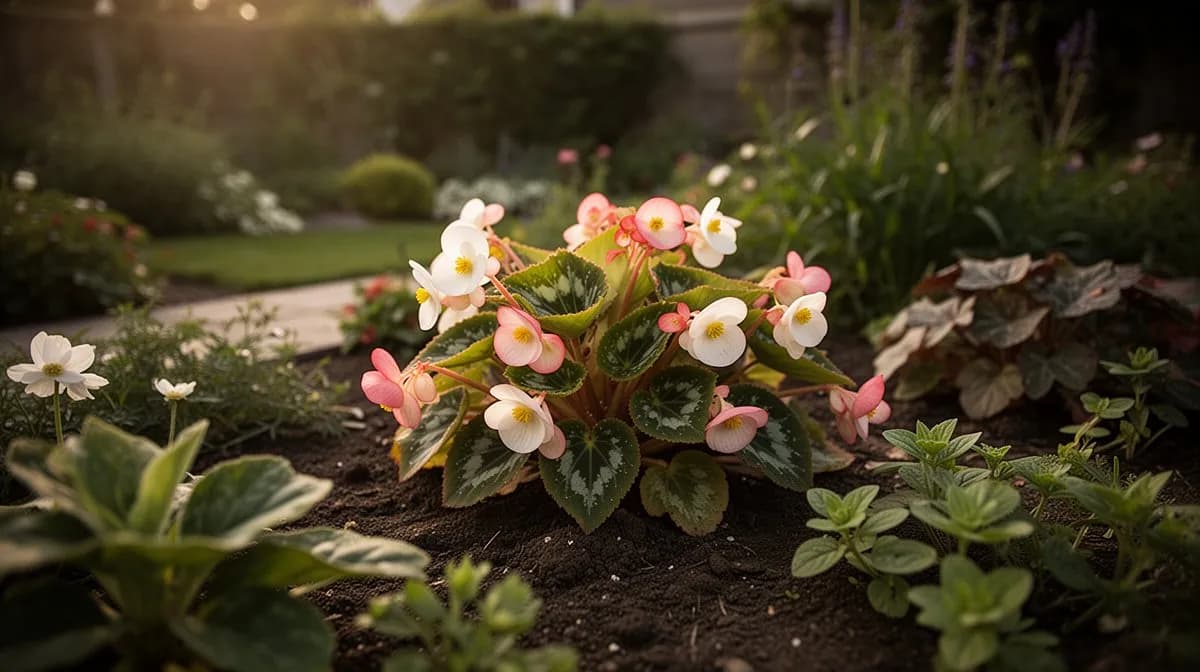
Begonias thrive in shaded borders alongside other shade-loving plants like ferns and hostas
- 1Always plant tuberous begonia tubers with the concave or hollow side facing up, as this is where the growth buds emerge. Place them just below the soil surface in moist peat-based compost and keep warm until shoots appear.
- 2Avoid overhead watering begonias, as wet foliage is highly susceptible to powdery mildew and botrytis blight. Water at the base of the plant in the morning so any splashed moisture can dry before evening.
- 3Provide bright indirect light or dappled shade for most begonia varieties. Direct afternoon sun will scorch the leaves, but too little light causes leggy, sparse growth with reduced flowering.
- 4Use a well-draining potting mix composed of equal parts peat moss, perlite, and quality potting soil. Begonias are extremely sensitive to waterlogged conditions, which quickly leads to root rot and stem collapse.
- 5Pinch out the small single female flowers that appear alongside the larger double male blooms on tuberous begonias. This redirects the plant's energy into producing fewer but much larger and more impressive display flowers.
- 6Maintain humidity levels between 50-70% for indoor begonias by grouping plants together, using pebble trays filled with water, or running a cool-mist humidifier nearby. Avoid misting the leaves directly.
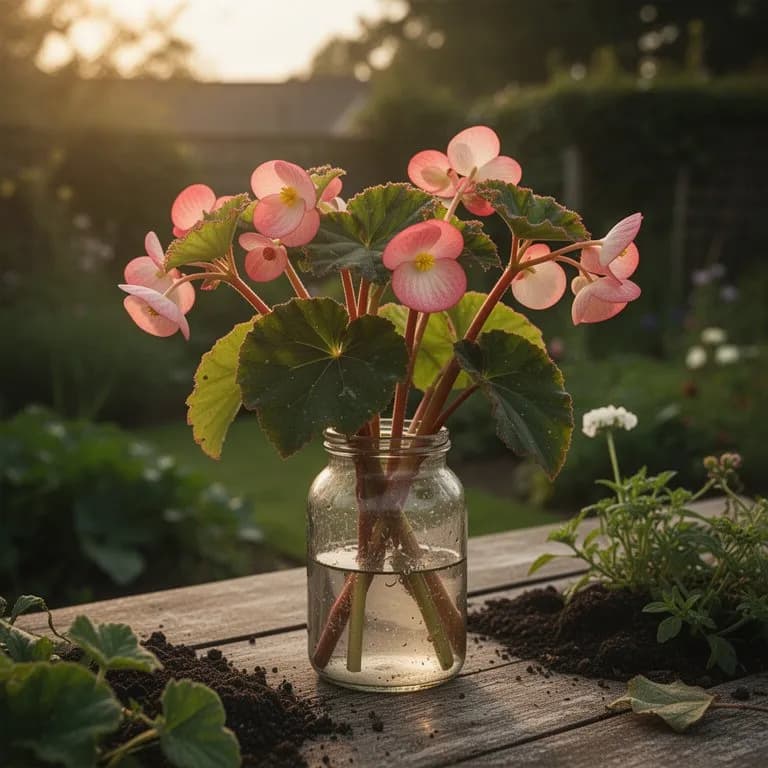
- 7Propagate wax and angel-wing begonias from stem cuttings taken in spring or early summer. Cut 8-10 cm sections with at least two nodes, remove the lower leaves, and root in moist perlite or a glass of water.
- 8Rex begonias can be propagated from individual leaf cuttings by scoring the main veins on the underside of a mature leaf, pinning it flat on moist propagation mix, and covering with a clear dome to maintain humidity until plantlets emerge.
- 9Stake tall angel-wing and cane-type begonias early in the season using bamboo stakes or small trellises. Their brittle stems snap easily under the weight of foliage and flowers, especially after watering or during wind.
- 10Fertilize begonias every two weeks during the active growing season with a water-soluble balanced fertilizer diluted to half strength. Switch to a higher-phosphorus formula once flower buds begin forming to encourage abundant blooms.
Begonia flowers are primarily enjoyed in the garden and container displays rather than as cut flowers. However, tuberous begonia blooms can be floated in shallow bowls of water for elegant tabletop displays. Deadhead tuberous begonias by pinching off spent male flowers and the small female flowers on either side of the showy male bloom. Wax begonias are self-cleaning and rarely need deadheading. At season's end, dig tuberous begonia tubers before frost for winter storage.
Tuberous begonia tubers should be dug after the first light frost, when foliage begins to yellow. Allow the stems to dry and fall off naturally, then brush soil from tubers and cure in a warm, dry place for one to two weeks. Store in dry peat moss or vermiculite at 45 to 55 degrees Fahrenheit through winter. Check periodically for rot and discard affected tubers. Wax begonias can be potted up before frost and grown as houseplants on a bright windowsill through winter, returning them outdoors the following spring.
Plan your garden with ease
Love growing Begonia? Use our free garden planner to design your beds, track planting dates, and get personalized care reminders.
Nutritional Info
Per 100g serving
15
Calories
Health Benefits
- Begonia leaves contain oxalic acid which gives them a tart, citrus-like flavor similar to sorrel and can be used sparingly in salads
- The flowers are edible and used as garnishes in Central and South American cuisine, providing small amounts of antioxidants
- Begonia stems contain mucilaginous compounds that have been used in traditional medicine as a mild digestive aid
- The leaves provide modest amounts of vitamin C and are sometimes used in herbal teas in parts of Southeast Asia and South America
- Edible begonia varieties should be consumed in moderation due to oxalic acid content, which may be problematic for individuals prone to kidney stones
- Some begonia species have been used in traditional Chinese and Ayurvedic medicine for their purported anti-inflammatory and antimicrobial properties
💰 Why Grow Your Own?
While begonias are primarily ornamental, growing them from tubers or cuttings rather than purchasing nursery plants each season can save $15-40 per plant annually. A single begonia tuber costs $3-8 and can be stored and replanted for five or more years. Propagation from stem cuttings is essentially free and allows you to multiply your collection indefinitely. Additionally, growing your own edible begonia varieties eliminates the premium cost of specialty edible flowers, which typically retail for $4-8 per small package at gourmet markets.
Quick Recipes
Simple recipes using fresh Begonia
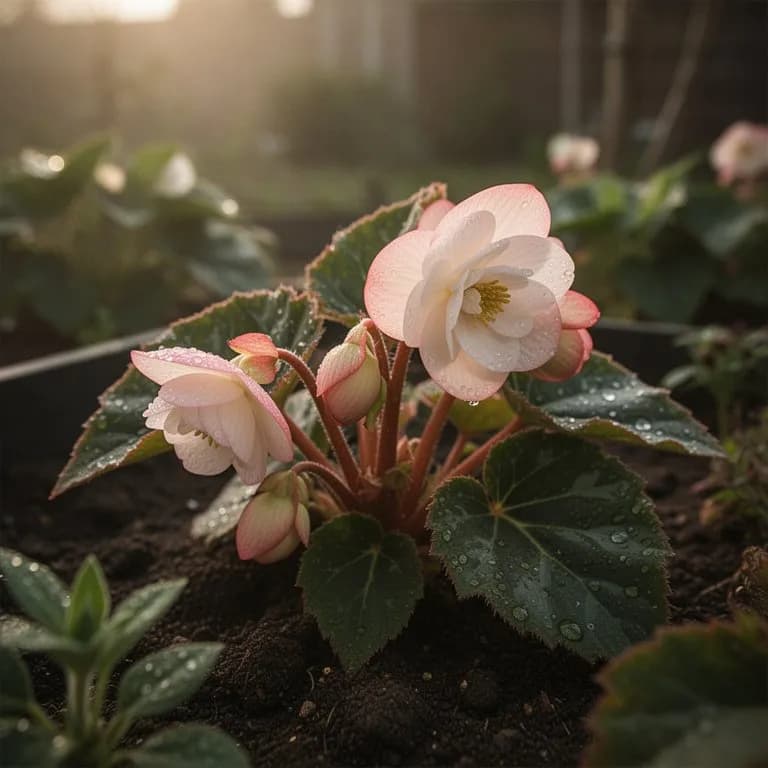
Begonia Petal and Citrus Salad
10 minutesA vibrant garden salad featuring edible begonia petals tossed with mixed greens, orange segments, and a light honey-citrus vinaigrette. The begonia petals add a refreshing tartness that complements the sweet citrus beautifully.
Candied Begonia Flowers
30 minutes plus drying timeDelicate crystallized begonia blossoms preserved with egg white and superfine sugar, perfect for decorating cakes, cupcakes, and other desserts. These edible decorations maintain their shape and color for several weeks when stored properly.
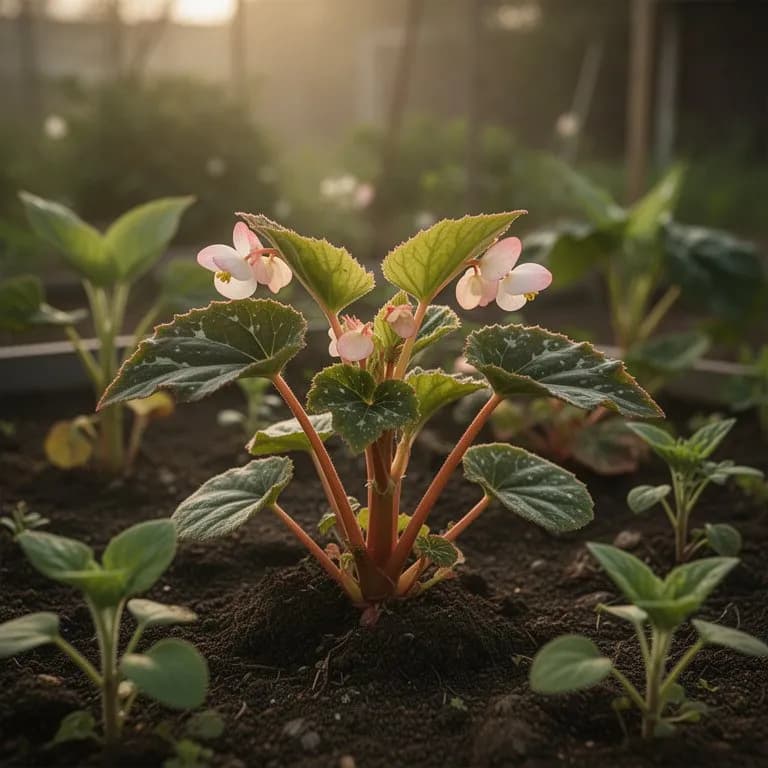
Begonia Leaf Infused Lemonade
15 minutes plus chillingA refreshing herbal lemonade infused with begonia leaves that adds a distinctive sour note reminiscent of hibiscus or sorrel. The natural tartness of the begonia leaves reduces the amount of lemon needed and creates a unique garden-fresh beverage.
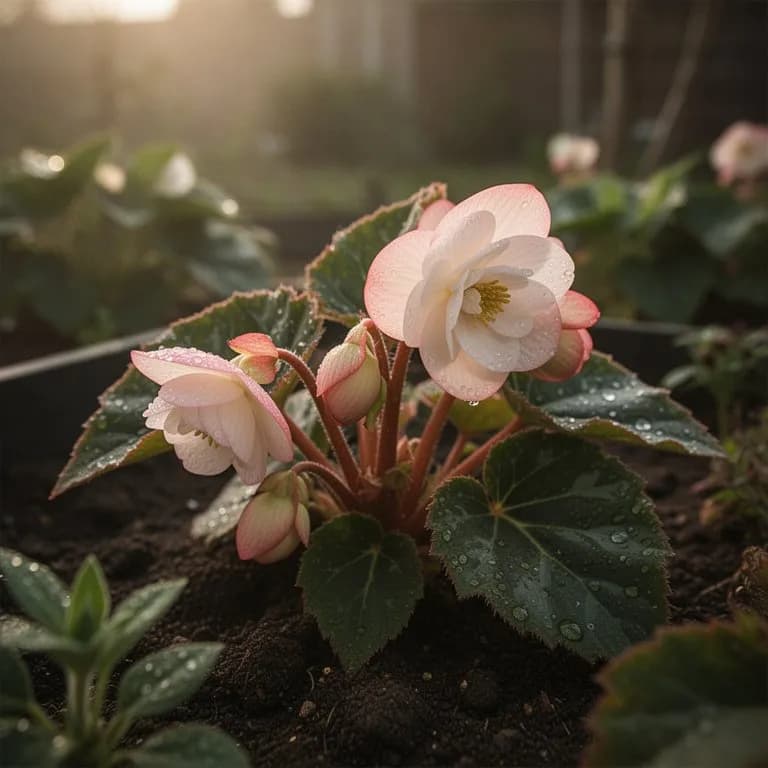
Tuberous begonias produce spectacular rose-like double blooms throughout the summer months
Yield & Spacing Calculator
See how many Begonia plants fit in your garden bed based on the recommended 25cm spacing.
16
Begonia plants in a 4×4 ft bed
4 columns × 4 rows at 25cm spacing
Popular Varieties
Some of the most popular begonia varieties for home gardeners, each with unique characteristics.
Wax Begonia (Semperflorens)
The most commonly grown begonia with waxy green or bronze leaves and small, continuous red, pink, or white flowers. Exceptionally heat-tolerant and self-cleaning.
Dragon Wing
Large angel-wing leaves with cascading clusters of red or pink flowers. Vigorous growth in both sun and shade, reaching eighteen inches tall and wide.
Nonstop Series (Tuberous)
Compact tuberous begonias with large, fully double flowers in a wide range of colors. Ideal for containers and shaded beds with continuous summer bloom.
Rex Begonia
Grown primarily for its spectacular painted foliage in swirled patterns of silver, pink, burgundy, and green. Primarily a houseplant or shade garden specimen.
Boliviensis Types (Bonfire, Santa Cruz)
Tropical tuberous begonias with narrow, pointed petals in fiery orange and red. Outstanding in hanging baskets with a graceful trailing habit.
Pendula begonias are ideal for hanging baskets with their graceful trailing growth habit
When should I plant Begonia?
Plant Begonia in April, May. It takes approximately 60 days to reach maturity, with harvest typically in June, July, August, September, October.
What are good companion plants for Begonia?
Begonia grows well alongside Pansy, Petunia, Geranium. Companion planting can improve growth, flavor, and natural pest control.
What hardiness zones can Begonia grow in?
Begonia thrives in USDA hardiness zones 9 through 12. With greenhouse protection, it may be grown in zones 7 through 13.
How much sun does Begonia need?
Begonia requires Shade (<3h). This means less than 3 hours of direct sunlight.
How far apart should I space Begonia?
Space Begonia plants 25cm (10 inches) apart for optimal growth and air circulation.
What pests and diseases affect Begonia?
Common issues include Powdery Mildew, Mealybugs, Botrytis Blight, Stem Rot (Pythium). Prevention through good garden practices like crop rotation, proper spacing, and companion planting is the best approach. See the detailed pests and diseases section above for symptoms, prevention, and treatment for each.
How do I store Begonia after harvest?
Tuberous begonia tubers should be dug after the first light frost, when foliage begins to yellow. Allow the stems to dry and fall off naturally, then brush soil from tubers and cure in a warm, dry place for one to two weeks. Store in dry peat moss or vermiculite at 45 to 55 degrees Fahrenheit throug...
What are the best Begonia varieties to grow?
Popular varieties include Wax Begonia (Semperflorens), Dragon Wing, Nonstop Series (Tuberous), Rex Begonia, Boliviensis Types (Bonfire, Santa Cruz). Each has unique characteristics suited to different growing conditions and culinary preferences. See the varieties section above for detailed descriptions.
What soil does Begonia need?
Begonias require rich, well-drained soil with a pH of 5.5 to 6.5. They prefer soil high in organic matter, so amend beds generously with compost, peat moss, or leaf mold. In containers, use a premium peat-based potting mix with added perlite for drainage. Feed with a balanced liquid fertilizer every...
Why are my begonia leaves turning brown and crispy at the edges?
Brown, crispy leaf edges on begonias are typically caused by low humidity, underwatering, or excessive direct sunlight. Begonias prefer humidity levels of 50-70% and bright indirect light rather than harsh direct sun. Move the plant away from south-facing windows, increase humidity with a pebble tray or humidifier, and ensure the soil stays evenly moist without becoming waterlogged. Fertilizer salt buildup can also cause leaf margin burn, so flush the soil thoroughly every few months.
Can I grow begonias indoors year-round as houseplants?
Yes, many begonia types make excellent year-round houseplants. Wax begonias, rex begonias, and angel-wing begonias adapt well to indoor conditions with bright indirect light and consistent temperatures between 16-24°C. Tuberous begonias are more challenging indoors because they require a dormancy period in winter. For best results with indoor begonias, provide good air circulation, maintain moderate humidity, and place them near an east-facing or north-facing window with filtered light.
How do I store tuberous begonia tubers over winter?
After the first light frost in autumn, cut back the stems to about 10 cm and carefully dig up the tubers. Allow them to dry in a warm, airy location for one to two weeks until the remaining stem pieces detach easily. Brush off loose soil without washing the tubers, then store them in a box or paper bag filled with dry peat moss, vermiculite, or wood shavings. Keep them in a cool, dark location at 7-10°C (45-50°F) and check monthly for signs of rot or excessive drying.
Why is my begonia dropping its flower buds before they open?
Bud drop in begonias is commonly caused by sudden environmental changes including temperature fluctuations, inconsistent watering, or being moved to a new location. Overwatering, underwatering, and low humidity can all trigger bud drop. Ensure your begonia receives consistent care without dramatic changes in its environment. Avoid placing plants near heating or cooling vents, and water when the top 2 cm of soil feels dry. Excessive nitrogen fertilizer can also cause bud drop, so switch to a phosphorus-rich formula during the flowering period.
Are begonias toxic to pets?
Yes, begonias are considered toxic to cats, dogs, and horses. The plants contain soluble calcium oxalates, which are most concentrated in the underground tubers. Ingestion can cause oral irritation, excessive drooling, vomiting, and difficulty swallowing. While serious poisoning is uncommon because the irritating taste usually prevents pets from consuming large quantities, it is best to keep begonias out of reach of curious pets. If ingestion occurs, contact your veterinarian or a pet poison control hotline for guidance.
What causes powdery mildew on begonias and how can I prevent it?
Powdery mildew appears as white, powdery patches on begonia leaves and is caused by fungal pathogens that thrive in warm, humid conditions with poor air circulation. Prevent it by spacing plants adequately to allow airflow, watering at the base rather than overhead, and avoiding crowding plants in stagnant corners. Remove and discard affected leaves promptly. Treat existing infections with a fungicide labeled for powdery mildew, or apply a homemade solution of one tablespoon baking soda and a few drops of liquid soap per liter of water sprayed on affected foliage weekly.
Ready to Grow Begonia?
Add Begonia to your garden plan and start designing your perfect layout.

Vladimir Kusnezow
Gardener and Software Developer
Zone 6b gardener. Growing vegetables and fruits in soil and hydroponics for 6 years. I built PlotMyGarden to plan my own gardens.
Jump to Section