Trailing Blackberry
A trailing-type blackberry with long, flexible canes that require a trellis or training system for best production.





On this pageOverview
Meet Trailing Blackberry
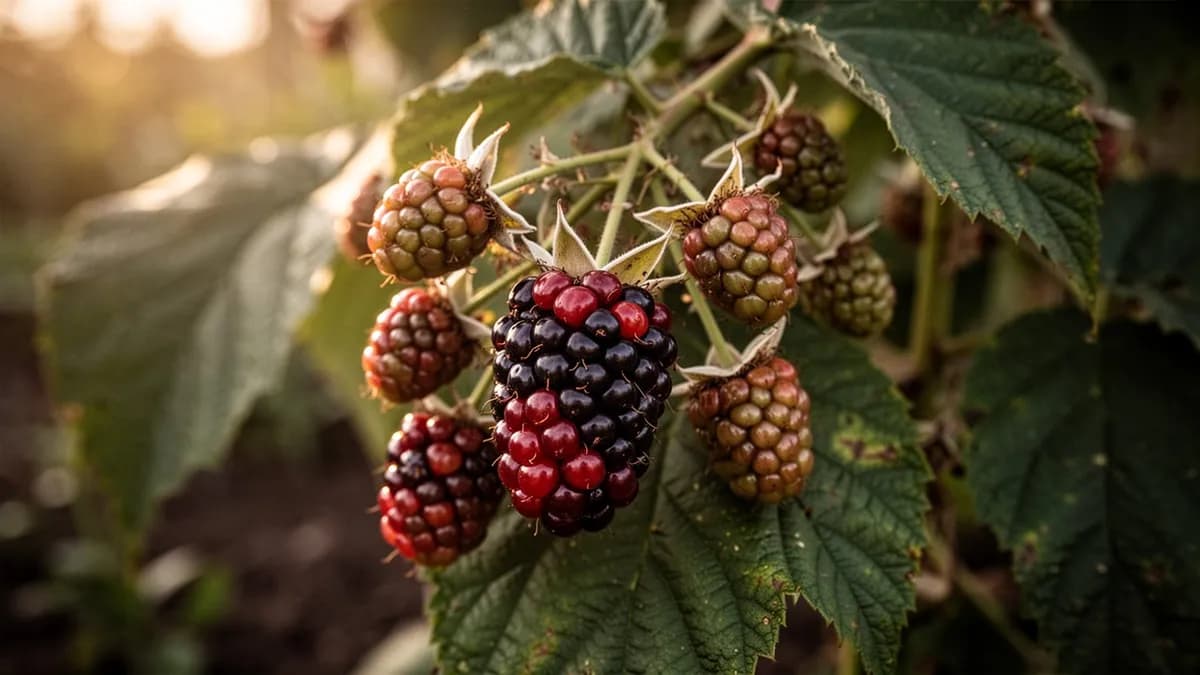
A trailing-type blackberry with long, flexible canes that require a trellis or training system for best production. Trailing blackberries generally produce the most flavorful berries of any blackberry type, with complex wine-like notes. They are the parent species of many hybrid berries including marionberries and boysenberries.
When to plant Trailing Blackberry
Trailing blackberries are propagated primarily by tip-layering and root cuttings. For tip-layering, bury the tip of a healthy primocane two to three inches deep in late summer and secure with a wire pin. Roots develop in six to eight weeks, and the new plant can be severed from the parent and transplanted the following spring. Root cuttings taken in late winter work well: cut four to six inch sections of pencil-thick roots and plant horizontally in moist potting mix. Stem cuttings from semi-hardwood can be rooted under mist with bottom heat and rooting hormone.
Your Trailing Blackberry Year
Composed for Zone 7 · typical seasons · frost passes Apr 2, returns Nov 1
Plant Trailing Blackberry Mar – Apr, pick Jun – Aug. Check the planting methods below and set your climate to personalize these windows.
How to grow Trailing Blackberry
Trailing blackberries produce the most intensely flavored berries of any blackberry type, with complex sweet-tart notes and a wine-like depth that earns them a premium among berry connoisseurs. Their long, flexible canes grow ten to twenty feet and must be trained on a trellis system, as they cannot support themselves. Install a sturdy trellis with two to three wires before planting, and space plants eight to twelve feet apart to accommodate the extensive cane growth.
Trailing blackberries are floricane-fruiting: primocanes produced in the current year are trained onto the trellis and fruit the following summer on lateral branches. After harvest, remove all spent floricanes at ground level and tie the new primocanes to the trellis. A common training method is to fan primocanes along the lower wires on one side while fruiting floricanes occupy the upper wire on the opposite side, keeping the two cane ages separated for easy management.
These blackberries are best adapted to the mild, maritime climates of the Pacific Northwest, where most commercial trailing varieties were developed. They are less cold-hardy than erect and semi-erect types and may suffer winter damage in zones below 6. In borderline areas, lay the canes on the ground after leaf fall and cover with straw or row cover for insulation. Water deeply during fruit development and mulch heavily to maintain soil moisture during the dry summers typical of their preferred growing regions.
Trailing Blackberry needs more room than a 4 × 8 ft bed gives
Each Trailing Blackberry wants 150 cm of elbow room. The planner keeps that spacing for you — every plant, every bed.
Trailing Blackberry's best neighbours
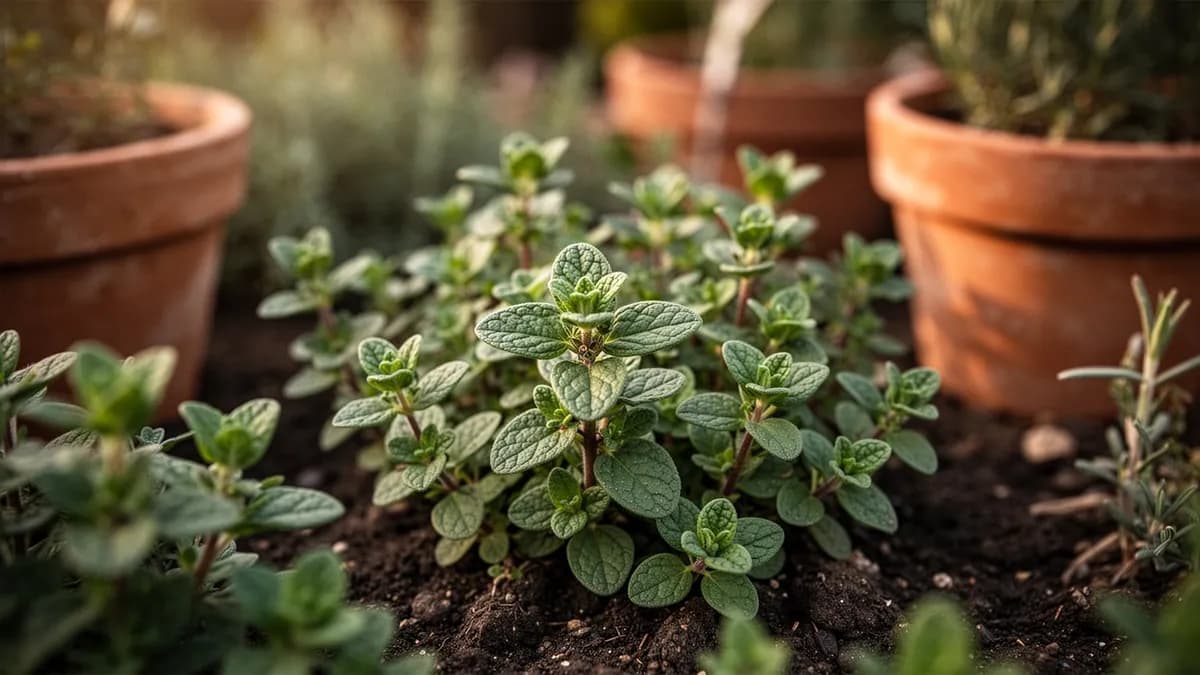
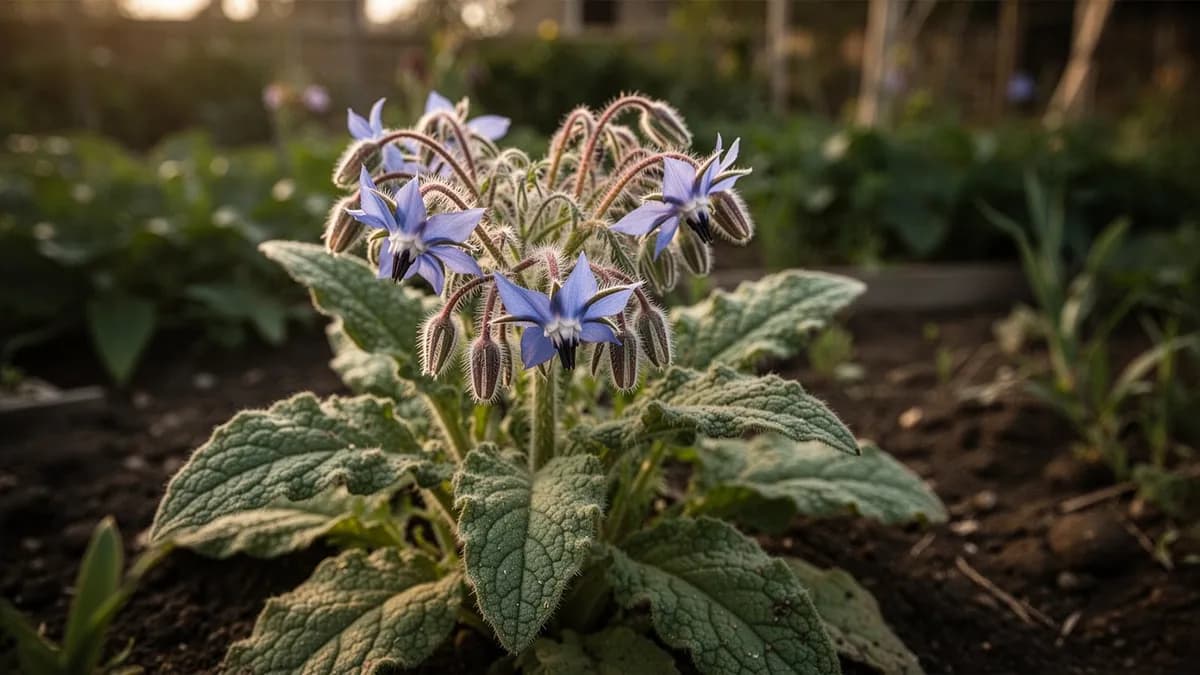
Trailing blackberries grow well alongside other trellis-trained plants like grape vines and kiwi in a dedicated vine area of the garden. Thyme and borage attract pollinators to improve fruit set. Comfrey planted beneath the trellis produces nutrient-rich mulch material and attracts beneficial insects. Avoid planting near raspberries to prevent cross-contamination of species-specific diseases. Keep away from nightshades and other plants that harbor verticillium wilt.
Thyme belongs beside it. Raspberry doesn't.
Old growers' knowledge, checked against Trailing Blackberry's real companion table below — test any plant you're growing.
Try Trailing Blackberry in a bed — right here
A real planner bed with Trailing Blackberry already in it. Tap a companion to place it and watch the pairing checks answer — green for good neighbours, red for a clash.


Related growing guides
Feed it well
Trailing blackberries thrive in deep, fertile, well-drained loam with a pH of 5.5 to 6.5, slightly more acidic than what erect varieties prefer. The Pacific Northwest growing regions have naturally acidic soils that suit them perfectly. Amend heavy soils with compost and aged bark to improve drainage. Apply nitrogen fertilizer in split applications in early spring and at bloom, as trailing types are heavier feeders than erect varieties. Avoid late-season nitrogen that delays cane hardening. Mulch with four inches of bark or straw.
Ideal Temperature
Hardiness Zone Compatibility
From seed to harvest, stage by stage
Dormant Crown / Bare Root Establishment
After planting a bare-root or dormant potted plant in late winter to early spring, the crown focuses entirely on root establishment. No visible top growth occurs yet but significant underground activity is taking place. The plant is drawing on stored carbohydrates to develop anchor roots and fine feeder roots into the surrounding soil.
Primocane Emergence
First-year canes, called primocanes, push up from the crown and grow rapidly in spring. These canes are purely vegetative in their first season, developing leaves and building carbohydrate reserves. Trailing blackberry primocanes are flexible, semi-prostrate, and will root at the tip if allowed to touch the ground, a process called tip-layering.
Floricane Flowering
In their second year, last season's primocanes become floricanes and produce clusters of white to pale pink five-petaled blossoms in late spring. Each flower is visited by bees and other pollinators that transfer pollen between blooms. A well-established plant can carry hundreds of flowers simultaneously across its floricanes.
Fruit Development
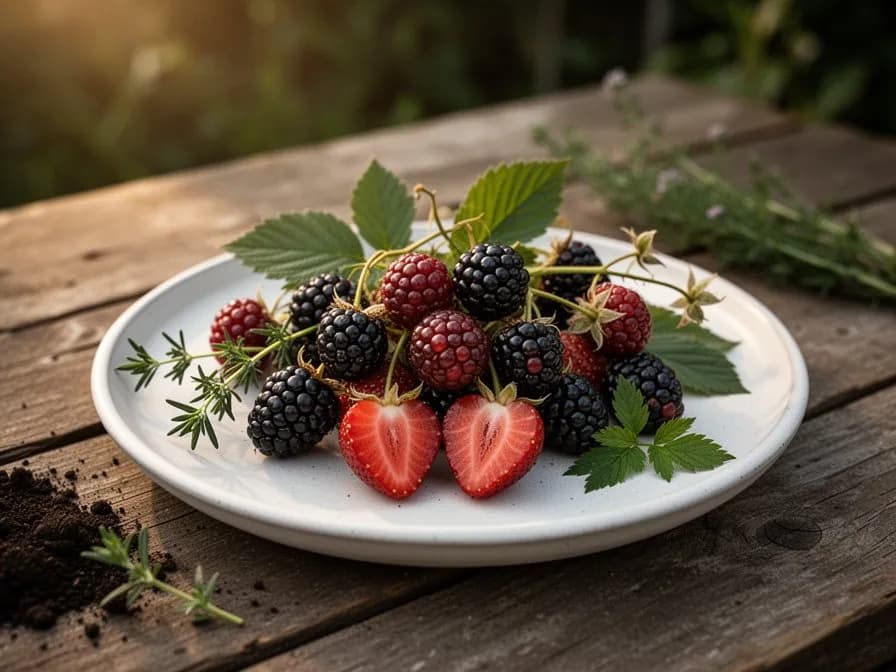
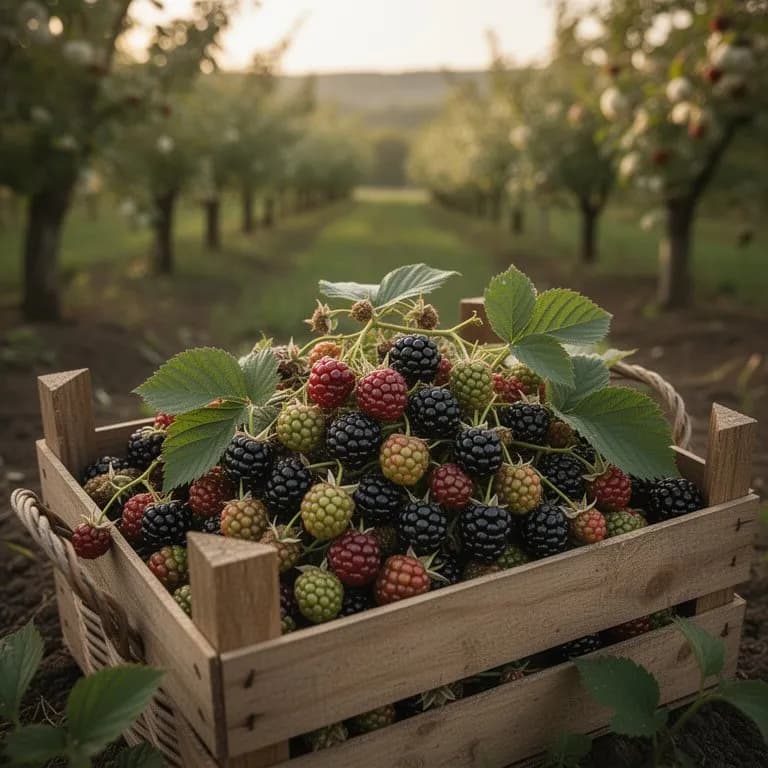
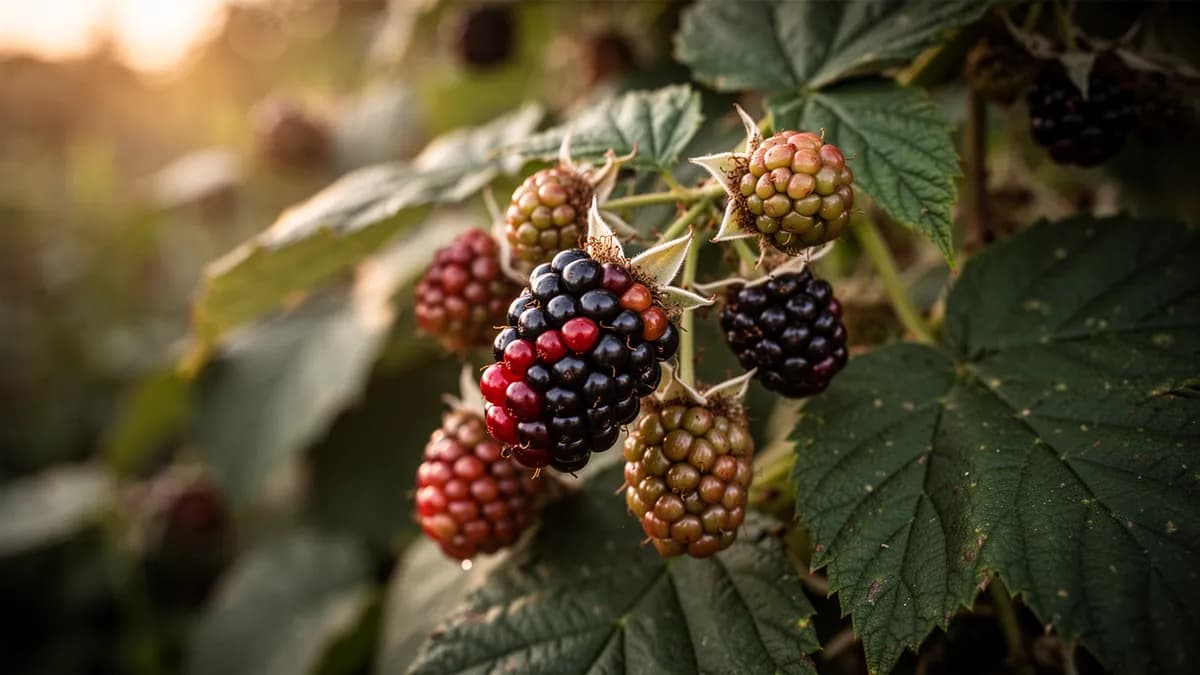
After pollination, green drupelets begin to form and swell into clusters. The fruit passes through a green stage, then turns red, and finally ripens to glossy black over a period of 4-6 weeks. During this phase, the plant requires adequate moisture for the drupelets to fill out fully. Dry spells during fruit development result in smaller, less juicy berries.
Peak Harvest
Berries are fully black, glossy, and begin to soften slightly. This is the peak harvest window, typically spanning 3-5 weeks depending on weather. Trailing blackberries ripen unevenly within each cluster, so check canes every 2-3 days. Ripe berries release from the receptacle with minimal force and have their deepest, most complex flavor.
Post-Harvest Floricane Removal
Once fruiting is complete, the spent floricanes begin to die back naturally. Removing them promptly is one of the most important maintenance tasks for a productive trailing blackberry patch. Leaving dead floricanes creates habitat for pests and diseases and makes the trellis unnecessarily crowded as the new primocanes develop.
Autumn Primocane Tipping and Winter Rest
As summer ends, the current season's primocanes finish their main extension growth. Tipping, or cutting the primocane tips back to approximately 1.5-1.8 meters, encourages lateral branching, which will produce the greatest quantity of fruiting spurs the following season. The plant then enters winter dormancy, resting in its trellis-trained position until spring.
Keep soil consistently moist but not waterlogged during establishment. Avoid fertilizing until you see new green growth emerging from the crown. Plant at the same depth as the original soil line on the crown.
Caring for Trailing Blackberry month by month
What to do each month for your Trailing Blackberry
October
You are hereFinish training and tying all primocane laterals in place before they become stiff and brittle. Apply a fresh layer of mulch around the base of plants to protect the crown and root zone through winter. Check for any signs of crown gall or root disease while the soil is still workable.
Know exactly what to do in your garden — every month
One email at the start of each month: what to sow, plant, and tackle right now — for your Trailing Blackberry and everything growing around it. Plus a short starter course that helps you dodge the classic mistakes.
- What to do, right now
- Matched to your season
- Starter course included
Harvesting Trailing Blackberry
Harvest trailing blackberries when the berries are fully black, slightly soft, and slip easily from the receptacle. Trailing varieties tend to produce larger, juicier berries than erect types but are more delicate and require careful handling. Pick into shallow containers to prevent crushing. The harvest period for trailing varieties is typically three to four weeks in early to mid-summer, earlier than most erect blackberry types. Berries are best picked in the morning when cool and firm for longest shelf life.
assuming you plant when the window opens — set your real date
Pick Trailing Blackberry promptly and the plant keeps producing.
Storage & Preservation
Trailing blackberries are more fragile than erect types and keep only two to three days in the refrigerator. Freeze promptly for longer storage by spreading on a tray and bagging once solid. These berries make the finest blackberry jam, syrup, and wine due to their superior complex flavor profile. They are the berries traditionally used for commercial Marionberry and boysenberry products. Trailing blackberry juice is also excellent for making shrubs, cordials, and artisanal sodas.
What goes wrong — and the fix
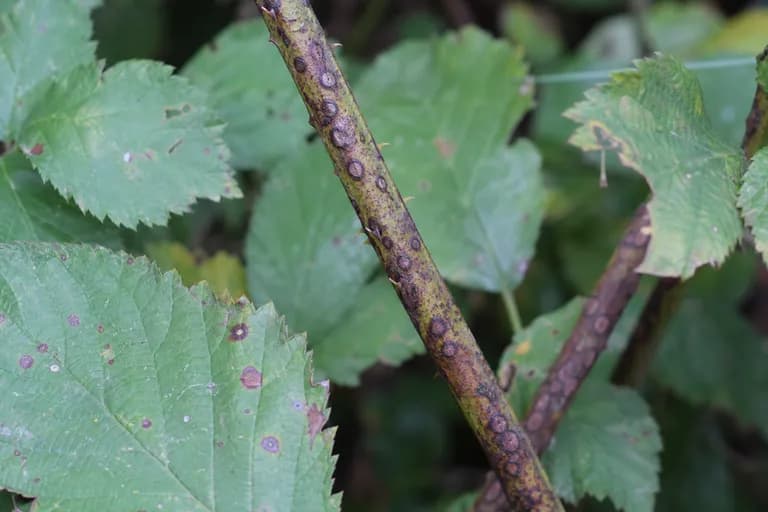
Cane Spot (Elsinoe veneta)
DiseaseSmall, round, purple spots on canes that enlarge and develop gray centers with raised purple borders; severe infection weakens canes.
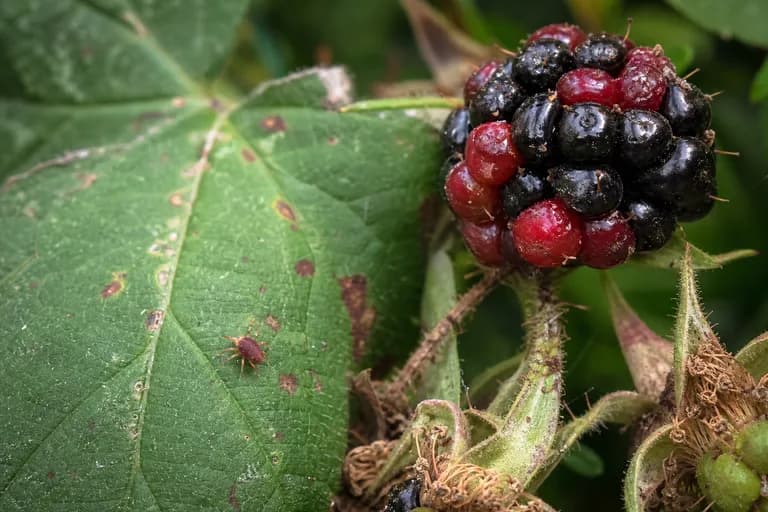
Berry Mite (Acalitus essigi)
PestIndividual drupelets remain red and hard while the rest of the berry ripens to black, creating unevenly colored, unmarketable fruit.
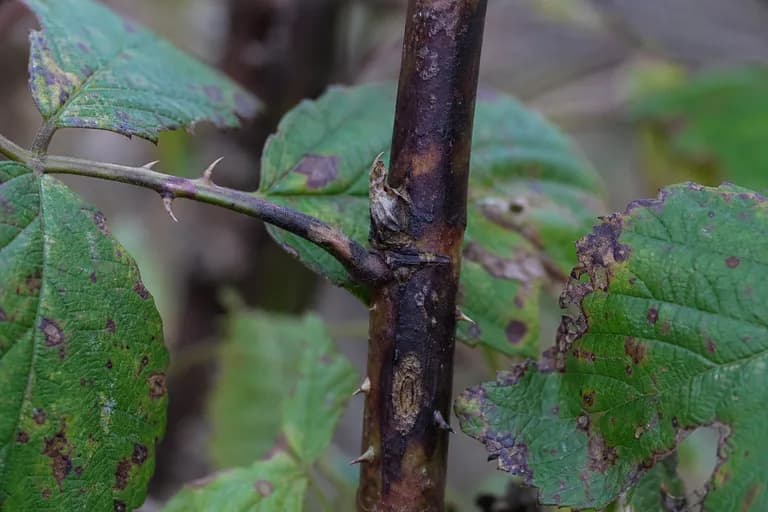
Purple Blotch (Septocyta ruborum)
DiseaseDark purple to black lesions on canes, often around leaf scars, that expand and girdle canes; affected canes produce weak laterals and reduced fruit.
Troubleshooting Common Problems
Limited cold hardiness is the main drawback of trailing blackberries, restricting reliable cultivation to zones 6 through 10 without winter protection. The long, flexible canes require dedicated trellis management and can become tangled if not properly trained. Berry mite causing red drupelets is a persistent problem in the Pacific Northwest and requires preventive dormant sprays. Thorniness is a challenge with classic varieties like Marion, though newer thornless selections are becoming available.
Growing Tips
- Install a proper T-bar or V-trellis system with two to three horizontal wires at 60 cm, 120 cm, and 150 cm before planting. Trailing blackberries are almost impossible to manage productively without a trellis, and retrofitting one around established canes is far more difficult than building it first.
- Keep this season's primocanes and last season's floricanes on opposite sides of the trellis by training primocanes along the lower wires and floricanes along the upper wires, or by using separate training systems for each. This separation makes post-harvest floricane removal much cleaner and reduces disease transfer between old and new wood.
- Tip primocanes at 1.5-1.8 meters in late summer rather than letting them grow unchecked. This forces the plant to push out lateral shoots from each node below the cut, and these laterals carry the highest density of fruiting spurs the following spring. Untipped canes produce far fewer total fruit buds.
- Water deeply and consistently from fruit set through harvest. Trailing blackberries are relatively drought-tolerant once established but inconsistent moisture during fruit development directly causes small, seedy, poorly flavored berries. Aim for 2-3 cm of water per week during the fruiting period.
- Apply a 7-10 cm layer of straw or wood chip mulch each spring, keeping it pulled back 10 cm from the crown to prevent rot. Mulch is one of the highest-return maintenance tasks you can do: it suppresses weeds, conserves moisture, moderates soil temperature, and slowly feeds the soil as it decomposes.
- Never apply high-nitrogen fertilizer after mid-spring. Excess nitrogen late in the season produces lush, soft vegetative growth that is highly susceptible to botrytis (grey mold), cane blight, and winter freeze damage. If you fertilize at all, use a balanced or low-nitrogen formula in early spring only.
- Remove spent floricanes immediately after harvest rather than leaving the cleanup until autumn. Dead floricanes harbor Botrytis cinerea spores, orange cane rust, and spider mites. Prompt removal dramatically reduces pest and disease pressure on the incoming primocanes and makes the next year's training task much easier.
- Space plants 2-3 meters apart along the trellis. Trailing blackberries are vigorous and will quickly fill their allotted space. Planting too close together forces excessive thinning work, reduces airflow between canes, and creates the damp, crowded conditions that fungal pathogens thrive in.
- Propagate new plants by tip layering in late summer: select a vigorous primocane, bend the tip to the ground, and peg it down 10-15 cm below the soil surface. By spring the tip will have rooted and a new plant can be severed from the parent and transplanted. This is the simplest and most reliable propagation method for home gardeners.
- In areas with hot, dry summers, plant trailing blackberries on the east or north side of a fence, wall, or taller crop where they receive morning sun but are shielded from the most intense afternoon heat. The fruit quality and plant vigor in climates above 32°C average summer temperatures improves noticeably with afternoon shade.
Grow your best Trailing Blackberry yet — and everything around it.
Start a free plan today. Lay out your beds, drop in your Trailing Blackberry, and let PlotMyGarden handle the timing, spacing, companions and reminders from seed to harvest basket.
Pick your Trailing Blackberry
Marion (Marionberry)
The gold standard of trailing blackberries with complex, earthy-sweet flavor, considered the world's finest blackberry for processing and fresh eating.
Boysen (Boysenberry)
A trailing hybrid producing very large, soft, intensely aromatic berries with a tangy, wine-like flavor; less productive but unmatched in taste.
Obsidian
An early-ripening trailing variety with large, firm berries and excellent fresh-market quality, extending the season ahead of Marion.
Columbia Star
A thornless trailing variety with the flavor complexity of Marion but without thorns, making harvesting much more pleasant.
A single trailing blackberry plant purchased as a bare-root or potted start typically costs $6-12. Once established after its first season, a single well-managed plant trained on a trellis can yield 3-5 kg of fresh berries per season for 15-20 years without replanting. Fresh organic blackberries retail for $6-10 per 170 g punnet, meaning a productive plant delivering 4 kg of fruit replaces roughly $140-235 worth of purchased berries each year. Over a 15-year producing life, a single plant represents a potential savings of $2,000-3,500 compared to buying equivalent fresh organic blackberries. Propagating new plants by tip layering costs nothing at all, and a well-maintained patch of three to four plants can supply more berries than most families can eat fresh, with plenty left for preserving.
Quick recipes
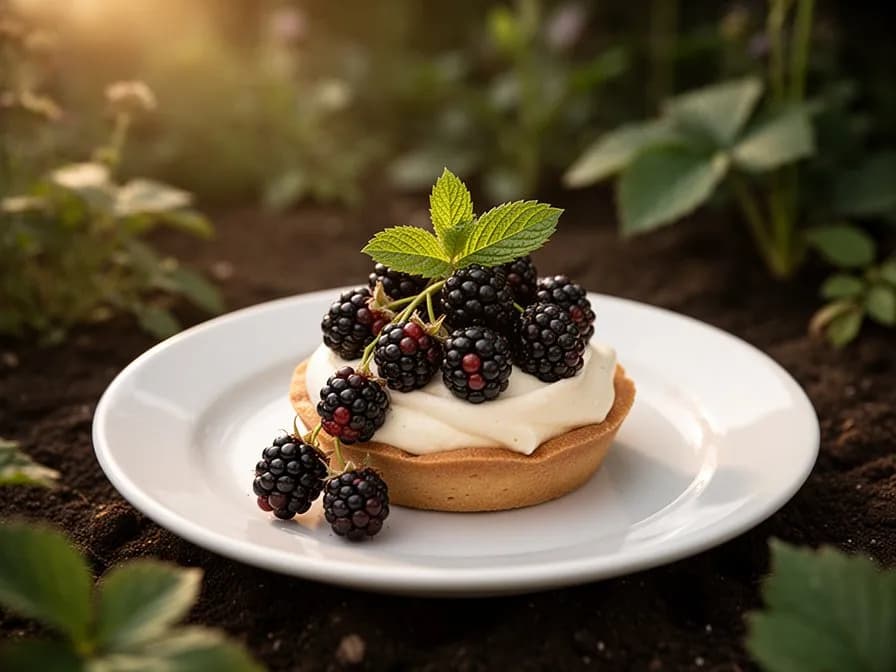
Trailing Blackberry Jam
15 minutes prep + 25 minutes cookingA classic small-batch jam that captures the intensely complex flavor of trailing blackberries. The natural pectin in slightly underripe berries combined with lemon juice produces a firm set without commercial pectin. This jam has a deeper, wilder character than supermarket varieties and makes an excellent gift from the garden.
5 ingredientsBlackberry and Apple Crumble
20 minutes prep + 35 minutes bakingA deeply satisfying late-summer dessert that pairs the tart intensity of trailing blackberries with sweet-tart cooking apples under a buttery oat crumble. The berries break down into a jammy, jewel-colored sauce that soaks into the apples and bubbles up through the golden topping. Best served warm with vanilla ice cream or thick cream.
8 ingredientsBlackberry Shrub Drinking Vinegar
10 minutes active + 48 hours infusingA refreshing, probiotic-friendly drinking vinegar that preserves the flavor of fresh trailing blackberries with no cooking required. Mixed with sparkling water it makes a sophisticated non-alcoholic drink; stirred into whiskey or gin it becomes an outstanding cocktail mixer. The vinegar acts as a natural preservative, giving this preparation a shelf life of several months.
5 ingredientsCulinary Uses
Trailing blackberries are the connoisseurs' choice for culinary use due to their complex, multi-layered flavor. Marionberries and boysenberries in particular are prized for pies, jams, syrups, and ice cream. Their robust flavor stands up to baking and cooking without losing character. Use in savory sauces for game, lamb, and duck. The juice makes outstanding wine, cordials, and shrub beverages. Pair with dark chocolate, port wine, blue cheese, and warm spices like cinnamon.
What's inside
Health Benefits
- Trailing blackberries are exceptionally rich in anthocyanins, which multiple clinical studies have associated with reduced markers of systemic inflammation, lower LDL oxidation, and improved arterial flexibility, all contributing to long-term cardiovascular health.
- The high fiber content of approximately 5.3 grams per 100 grams supports a healthy gut microbiome by serving as a prebiotic, feeding beneficial bacterial strains such as Lactobacillus and Bifidobacterium that are linked to improved immune function and mood regulation.
- Blackberries contain ellagic acid and ellagitannins, polyphenols that are converted by gut bacteria into urolithins, compounds that have shown promise in research for supporting mitochondrial health and healthy cellular aging.
- The combination of vitamin C and anthocyanins in trailing blackberries provides synergistic antioxidant protection, helping to neutralize free radicals generated by UV exposure, pollution, and metabolic processes that can contribute to accelerated cellular aging.
- Regular consumption of blackberries has been associated in epidemiological studies with improved cognitive function and memory, with the berry's polyphenols thought to cross the blood-brain barrier and reduce neuroinflammation that contributes to age-related cognitive decline.
- Trailing blackberry leaves have a long history of use in herbal medicine as a tannin-rich astringent tea for managing diarrhea and soothing inflamed mucous membranes of the throat and digestive tract, with traditional use supported by the demonstrated anti-inflammatory activity of the leaf tannins.
Where Trailing Blackberry comes from
Rubus ursinus, the Pacific trailing blackberry, is the only blackberry species truly native to the Pacific Coast of North America, with a natural range extending from southern British Columbia south through Washington, Oregon, and California, and eastward into Idaho and Nevada. It occupies a remarkably diverse range of habitats, from coastal bluffs and redwood understory to open prairies, forest edges, and recently disturbed ground at elevations from sea level up to approximately 1,800 meters. Fossil and pollen evidence indicates that Rubus species have been present in western North America for millions of years, making the trailing blackberry one of the most ancient cultivated food plants in the region rather than an introduced crop. For Indigenous peoples of the Pacific Northwest, including the Coast Salish, Chinook, Kalapuya, Tillamook, Yurok, and dozens of other nations, the trailing blackberry was among the most important summer fruits. Berries were eaten fresh in great quantities, dried into pressed cakes for winter storage, and mashed with other foods or fish oil as a calorie-dense travel food. Young spring shoots were peeled and consumed as a fresh vegetable, providing an early-season source of nutrients after the lean winter months. Leaves were brewed into teas used medicinally for diarrhea, sore throats, and to ease labor in childbirth. The plant's ecological role as a pioneer species was well understood; Indigenous land managers used controlled burning to periodically clear competing vegetation and stimulate vigorous new growth of trailing blackberry and other food-producing shrubs. European settlers in the Pacific Northwest quickly adopted trailing blackberry as a valuable wild food and began cultivating it in kitchen gardens by the mid-1800s. Its most lasting contribution, however, has been genetic: plant breeders recognized the outstanding flavor and disease resistance of Rubus ursinus and used it as a foundational parent in developing some of the most commercially successful blackberry varieties of the 20th century. The Loganberry, developed in California in 1883 by Judge James Harvey Logan, is believed to be a natural hybrid of Rubus ursinus and a red raspberry. The Boysenberry was bred in the 1920s by Rudolph Boysen using a complex cross involving the trailing blackberry, and the Marionberry, now the defining blackberry of Oregon agriculture and accounting for roughly one-third of all blackberries commercially grown in the United States, was released by Oregon State University in 1956 from a cross that includes Rubus ursinus genetics. Today trailing blackberry is cultivated by home gardeners throughout the Pacific Northwest and increasingly in the UK and northern Europe as a flavourful alternative to upright thornless cultivars, valued by those who prize its exceptional wild berry intensity over the convenience of more modern varieties.
Trailing Blackberry: did you know?
Fascinating facts about Trailing Blackberry
Rubus ursinus, the Pacific trailing blackberry, is the only blackberry species native to the west coast of North America and is considered the wild ancestor of several popular commercial varieties including the Marionberry, Boysenberry, and Loganberry, all of which were bred using it as a parent.
Trailing Blackberry questions, answered
When should I plant Trailing Blackberry?
What are good companion plants for Trailing Blackberry?
What hardiness zones can Trailing Blackberry grow in?
How much sun does Trailing Blackberry need?
How far apart should I space Trailing Blackberry?
What pests and diseases affect Trailing Blackberry?
How do I store Trailing Blackberry after harvest?
What are the best Trailing Blackberry varieties to grow?
What soil does Trailing Blackberry need?
Do I need more than one trailing blackberry plant to get fruit?
How do I tell when trailing blackberries are truly ripe and ready to pick?
Why are my trailing blackberry canes getting a reddish-orange powdery coating?
When and how should I prune my trailing blackberry?
Can I grow trailing blackberry in a container?
How do I prevent trailing blackberry from taking over my garden?
You just read the theory. Now grow it on autopilot.
Everything that makes Trailing Blackberry fiddly — the timing, the spacing, the companions, the harvest window — is exactly what PlotMyGarden handles for you, for every plant in your garden.
A plan that knows your weather
Set your location once. Get sow, feed and harvest dates built around your real last-frost date and live forecast — no more guessing from a generic seed packet.
From the “When to plant” sectionDrag-and-drop bed planner
Design beds on a grid. Every plant snaps to its proper spacing, and you can see your whole season laid out before you spend a cent on seed.
From the “Growing guide” sectionCompanion conflicts, caught early
200+ good-and-bad pairings checked live as you plant — so a season-wrecking mistake never makes it into the ground.
From the “Companions” sectionReminders you'll actually act on
“Water the beans.” “Pick today before it turns.” Timely, specific, and tied to the plants you're really growing.
From the “Harvest” sectionSuccession, scheduled
Want a harvest for six weeks, not six days? It spaces your sowings automatically and reminds you when each new block is due.
From the “When to plant” sectionA record that gets smarter
Every harvest you log teaches it your garden. Next year's plan starts from what actually worked in your soil, not a textbook's.
From the “Overview” sectionPlant these alongside Trailing Blackberry
More Berries
Keep Trailing Blackberry away from these
Grow your best Trailing Blackberry yet — and everything around it.
Start a free plan today. Lay out your beds, drop in your Trailing Blackberry, and let PlotMyGarden handle the timing, spacing, companions and reminders from seed to harvest basket.