Mangosteen
Garcinia mangostana
At a Glance
It's planting season for Mangosteen! Start planning your garden now.
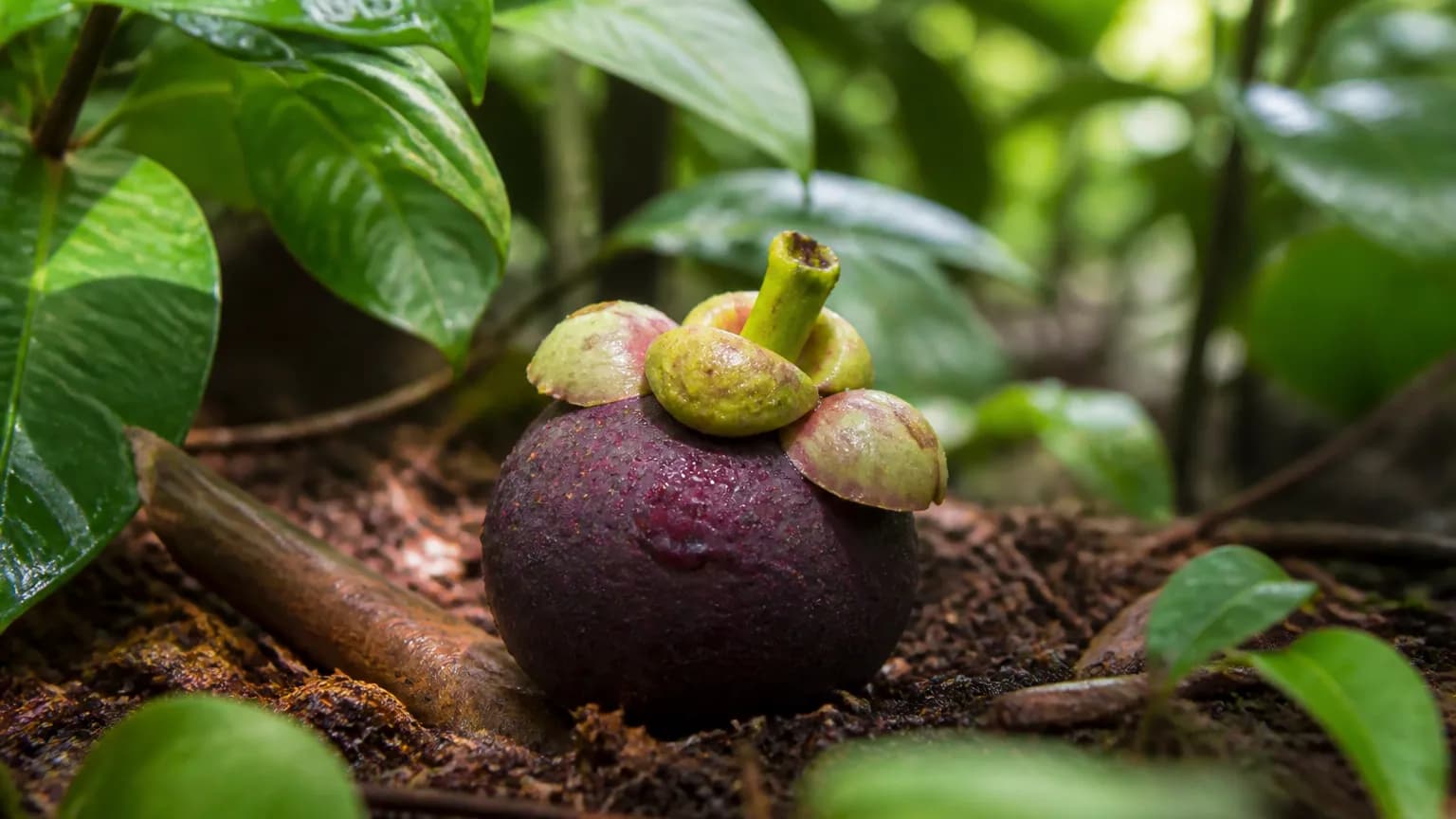
Often called the queen of fruits, mangosteen produces thick, purple-skinned fruits with snow-white, segmented flesh of sublime sweetness and delicate floral flavor. This is one of the most demanding tropical fruits to cultivate, requiring consistently warm temperatures, high humidity, and deep, rich soil. Trees are notoriously slow to bear, often taking 8-10 years from seed.
Planting & Harvest Calendar
Growth Stages
From Seed to Harvest
Seed Germination
Days 0–30
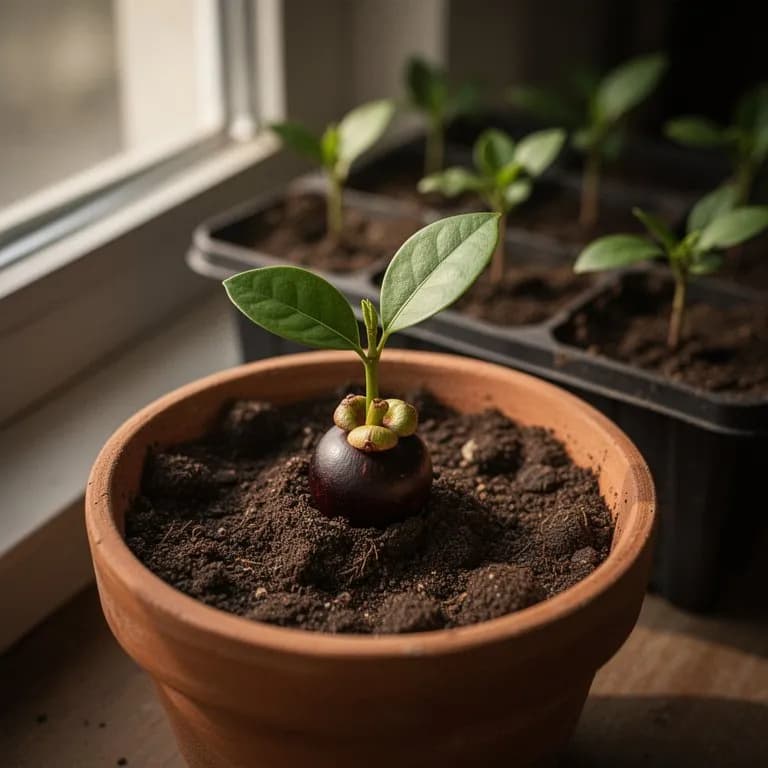
Mangosteen seeds are recalcitrant and must be planted fresh within days of extraction, as they lose viability rapidly when dried. Seeds are actually adventitious embryos (nucellar seedlings) rather than true sexual seeds, meaning they produce clones of the mother tree. Germination is slow, typically taking 20 to 30 days in warm, moist conditions at 25-30°C (77-86°F).
💡 Care Tip
Plant seeds immediately after removing them from the fruit. Use a deep container with well-draining, slightly acidic potting mix (pH 5.5-6.5). Keep the medium consistently moist and warm. Do not allow seeds to dry out at any point, as even brief desiccation is fatal.
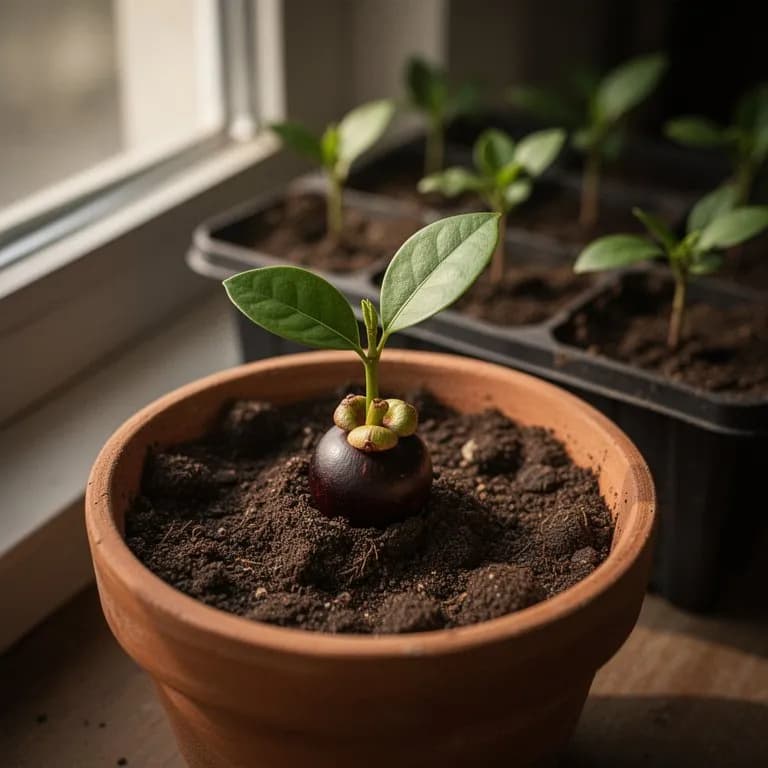
A mangosteen seedling at six months old showing the characteristically slow early growth
Monthly Care Calendar
What to do each month for your Mangosteen
May
You are hereFlowering typically peaks this month. Avoid overhead watering that can dislodge flowers. Begin monitoring for fruit set. Apply calcium foliar spray to reduce the incidence of translucent flesh disorder in developing fruits.
Did You Know?
Fascinating facts about Mangosteen
Mangosteen is known as the 'Queen of Fruits' in Southeast Asia, while durian holds the title of 'King of Fruits.' According to legend, Queen Victoria once offered a reward of 100 pounds sterling to anyone who could bring her a fresh mangosteen, though no one succeeded due to the long sea voyage from Asia.
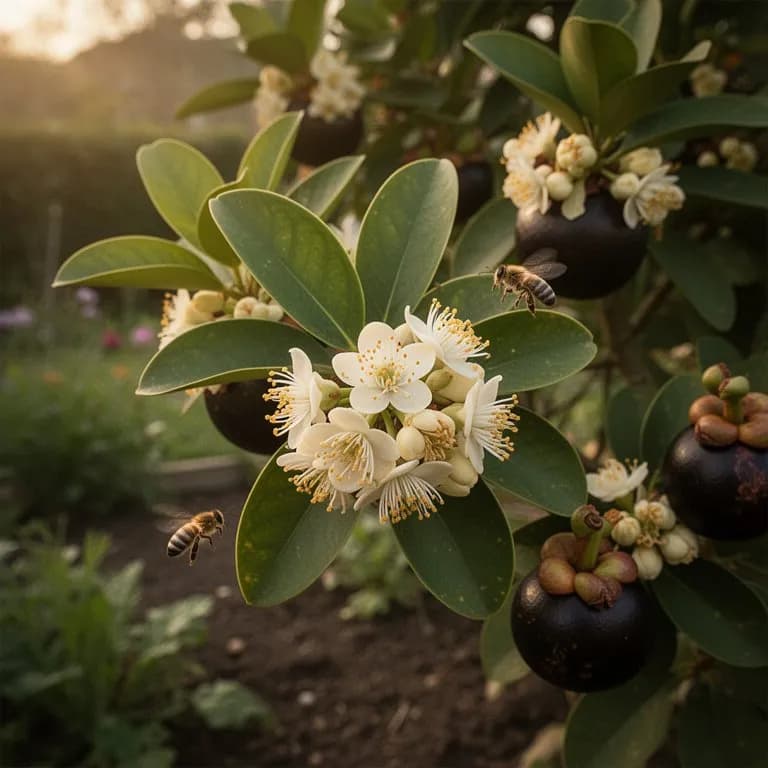
Female mangosteen flowers with their distinctive fleshy petals, which develop without pollination through apomixis
Mangosteen is one of the most challenging tropical fruits to grow, requiring consistently warm temperatures above 40 degrees Fahrenheit, high humidity above 80 percent, and deep, rich, well-drained soil. Plant in a sheltered location with partial shade when young, transitioning to full sun as the tree matures. Space trees 25 to 35 feet apart and dig a large planting hole enriched with compost and aged manure.
Water deeply and frequently to maintain consistently moist but not waterlogged soil. Mangosteen has a deep taproot system and requires regular irrigation, especially during dry periods. Mist foliage regularly to maintain high humidity in arid climates. Mulch heavily with organic matter to keep roots cool and retain soil moisture.
Fertilize every two to three months with a balanced organic fertilizer, supplemented with potassium during fruit development. Mangosteen is extremely slow-growing and may take eight to fifteen years to bear fruit from seed. Grafted trees may fruit in five to seven years. Prune minimally, as the tree develops a beautiful pyramidal shape naturally. Protect from any cold exposure, as even brief drops below 40 degrees Fahrenheit can cause severe damage or death.
The mangosteen (Garcinia mangostana) is believed to have originated in the Sunda Islands of Indonesia and the Malay Peninsula, though its exact wild origin remains uncertain because no truly wild populations have been definitively identified. The fruit has been cultivated in Southeast Asia for hundreds of years, with the earliest Western written accounts dating to the 17th century when the French explorer Jacques-Henri Bernardin de Saint-Pierre and later the botanist Laurentius Garcin described it. The genus Garcinia was named in honor of Garcin for his contributions to tropical botany. Mangosteen cultivation spread gradually from its Malay Archipelago homeland to Thailand, Myanmar, Vietnam, the Philippines, and Sri Lanka, largely following ancient trade routes and colonial-era agricultural exchanges. Thailand eventually became the world's largest producer, a position it still holds today, with the provinces of Chanthaburi and Rayong forming the heartland of commercial production. In the 19th century, European colonial botanists attempted repeatedly to grow mangosteen in greenhouses and tropical botanical gardens in England, the Netherlands, and the Caribbean. Most attempts met with limited success because of the tree's extreme sensitivity to temperatures below 4°C and its requirement for consistently high humidity and rainfall. Queen Victoria's legendary standing offer of a reward for anyone who could deliver a fresh mangosteen to the English court — whether apocryphal or not — cemented the fruit's mystique in Western imagination. In the 20th century, mangosteen plantations expanded to tropical regions of Central America, northern Australia, Hawaii, and parts of West Africa, though production outside Southeast Asia remains relatively modest. The 2007 lifting of the U.S. import ban marked a turning point in global market access and increased Western demand significantly.
Mangosteen seeds are recalcitrant and must be planted immediately after extraction from ripe fruit, as they lose viability within days. Plant seeds one inch deep in a deep container of rich, moist potting mix. Maintain temperatures of 77 to 86 degrees Fahrenheit with high humidity. Germination takes two to three weeks. Seedlings grow extremely slowly and require shade and consistent moisture for the first two to three years. Most mangosteen is propagated by seed, as grafting is difficult, though grafted trees bear significantly earlier.
Mangosteen requires deep, rich, well-drained soil with high organic matter and a pH of 5.5 to 6.5. The tree will not tolerate clay, compacted soil, or waterlogging. Amend planting areas generously with compost, aged manure, and coconut coir. Apply a balanced organic fertilizer every two to three months, with additional potassium during fruiting. Mangosteen is sensitive to salt, so avoid synthetic fertilizers in excess. Maintain a deep organic mulch layer at all times.
Check Your Zone
See if Mangosteen is suitable for your location.
25°C – 35°C
77°F – 95°F
Mangosteen thrives in uniformly warm tropical climates with temperatures consistently between 25-35°C (77-95°F). The tree cannot tolerate temperatures below 4°C (40°F), which cause leaf damage and can kill young trees. Even brief exposure to frost is fatal. The ideal growing environment features minimal temperature fluctuation between day and night (less than 8°C difference), high relative humidity of 75-90%, and evenly distributed annual rainfall of 1500-2500 mm. Mangosteen performs poorly in areas with pronounced dry seasons unless supplemental irrigation is provided.
Common issues affecting Mangosteen and how to prevent and treat them organically.
The extremely long juvenile period is the greatest challenge, with trees potentially taking a decade or more to fruit. Gamboge disorder causes yellow latex staining of the flesh due to irregular watering during fruit development. Cold sensitivity limits cultivation to truly tropical zones. The thick rind makes it difficult to judge internal fruit quality from the outside. Overwatering causes root rot, while underwatering causes fruit drop and gamboge. The tree does not transplant well once established.
- 1Plant mangosteen in a location protected from wind, as the tree's dense canopy can act as a sail in storms and the brittle wood is prone to branch breakage in high winds.
- 2Maintain soil pH between 5.5 and 6.5 using sulfur amendments if necessary — mangosteen is sensitive to alkaline conditions and will develop iron chlorosis in soils above pH 7.0.
- 3Provide consistent heavy shade (50-70%) for the first 4-5 years, then gradually transition to partial sun. Young mangosteen trees cannot tolerate full tropical sun and will suffer severe leaf scorch.
- 4Use raised beds or mounded planting in areas with heavy clay soil, as mangosteen roots are extremely sensitive to waterlogging despite the tree's high water requirements — good drainage is non-negotiable.
- 5Apply mycorrhizal inoculant at planting time and with each transplant, as mangosteen forms beneficial associations with arbuscular mycorrhizal fungi that dramatically improve phosphorus uptake and root health.
- 6Never allow the soil to dry out completely, but avoid standing water around the root zone. Install a drip irrigation system with a timer to maintain the consistent moisture levels this species demands.
- 7Mulch heavily with organic material (coconut coir, wood chips, or leaf litter) in a wide ring extending to the canopy drip line, maintaining a 15-20 cm gap around the trunk to prevent collar rot.
- 8Avoid heavy pruning — mangosteen naturally forms an attractive pyramidal shape and recovers slowly from major cuts. Limit pruning to removal of dead branches, water sprouts, and occasional thinning of the interior canopy.
- 9Protect young trees from temperatures below 10°C (50°F) using frost cloth, temporary enclosures, or heat lamps. Even subtropical growers in marginal zones should plan for overnight cold protection during winter months.
- 10Be patient with the notoriously slow early growth. Mangosteen seedlings may grow only 10-15 cm per year for the first 2-3 years. This is normal and not a sign of poor health — resist the urge to over-fertilize in an attempt to speed growth.
Mangosteen fruits are ready to harvest when the thick rind turns from green to deep reddish-purple. The fruit should yield slightly to gentle pressure but not feel soft or mushy. Clip fruit from the branch with pruning shears, leaving a short stem and the calyx cap attached. Handle carefully to avoid damaging the rind, which stains permanently. The number of white flesh segments inside corresponds to the number of lobes on the bottom of the fruit. Harvest every two to three days during the fruiting season.
Fresh mangosteen can be stored at room temperature for two to three days or refrigerated for up to two weeks at 50 to 55 degrees Fahrenheit. Do not freeze whole fruit, as the delicate flesh becomes watery upon thawing. The flesh can be frozen separately in airtight containers for up to three months for use in smoothies and desserts. Mangosteen is occasionally canned in syrup for export. The thick rind is sometimes dried and used in traditional medicine.
Plan your garden with ease
Love growing Mangosteen? Use our free garden planner to design your beds, track planting dates, and get personalized care reminders.
Nutritional Info
Per 100g serving
73
Calories
Health Benefits
- Exceptionally rich in xanthone antioxidants, with over 60 different xanthones identified in the fruit and rind
- Contains folate (31 mcg per 100g), important for cell division and particularly beneficial during pregnancy
- Provides B-complex vitamins including thiamin, niacin, and riboflavin for energy metabolism
- Low glycemic index fruit suitable for moderate consumption by those monitoring blood sugar levels
- Contains catechins and proanthocyanidins similar to those found in green tea and dark chocolate
- Good source of copper (0.07 mg per 100g) and magnesium (13 mg per 100g) for enzyme function
💰 Why Grow Your Own?
Fresh mangosteens retail for $8-15 USD per pound in Western markets due to import costs, irradiation requirements, and limited shelf life. A single mature home-grown tree in a suitable tropical climate can produce 500-1500 fruits per year (roughly 150-450 pounds), potentially providing $1,200-$6,750 worth of fruit annually after the lengthy 8-15 year wait to first harvest. While the initial time investment is substantial, mangosteen trees remain productive for over 100 years, making them an exceptional long-term investment for growers in USDA zones 11-12 or equivalent tropical climates.
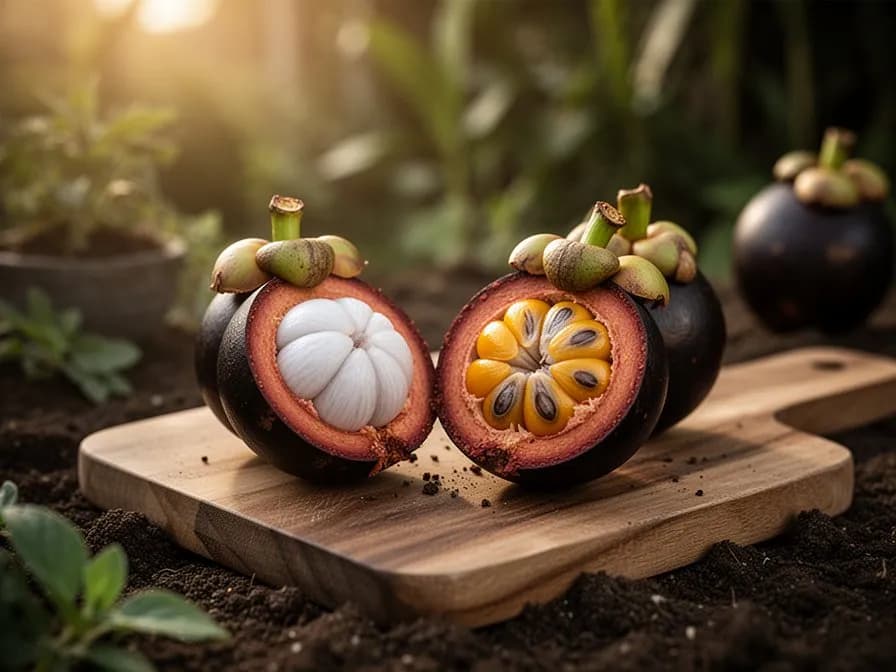
Cross-section of a mangosteen showing the snow-white aril segments — the number of segments matches the stigma lobes on the bottom
Quick Recipes
Simple recipes using fresh Mangosteen
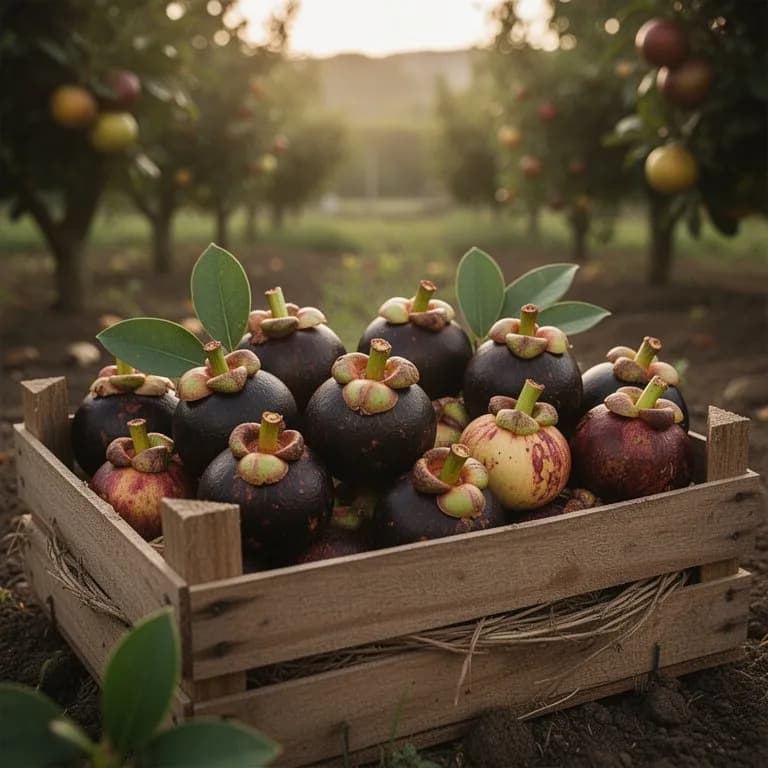
Mangosteen Coconut Sorbet
15 minutes plus freezing timeA refreshing tropical sorbet that showcases the delicate sweet-tart flavor of fresh mangosteen paired with creamy coconut milk. This dairy-free frozen treat highlights the fruit's natural complexity without overwhelming it with competing flavors. Perfect as a palate cleanser or light dessert on hot days.
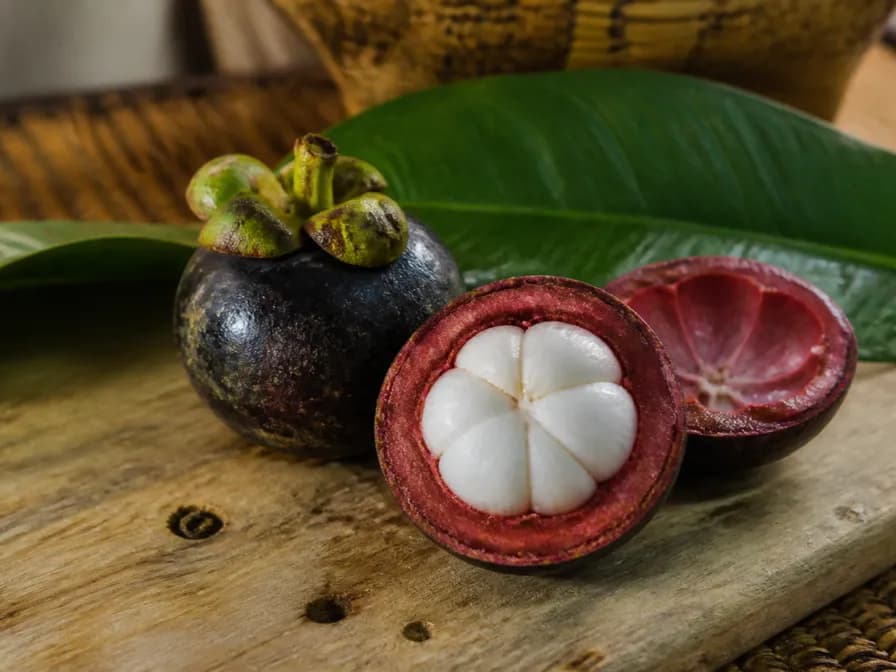
Mangosteen and Prawn Salad
20 minutesA vibrant Southeast Asian-inspired salad combining the sweet fragrant flesh of mangosteen with succulent prawns, crunchy vegetables, and a zesty lime-chili dressing. This dish balances sweet, sour, salty, and spicy elements in the traditional Thai flavor profile. Ideal as a light lunch or elegant starter.
Mangosteen Smoothie Bowl
10 minutesA nutrient-rich breakfast bowl featuring frozen mangosteen blended into a thick, creamy base and topped with tropical fruits, granola, and seeds. This antioxidant-packed morning meal provides sustained energy and delivers the full spectrum of mangosteen's nutritional benefits in an appealing, Instagram-worthy presentation.
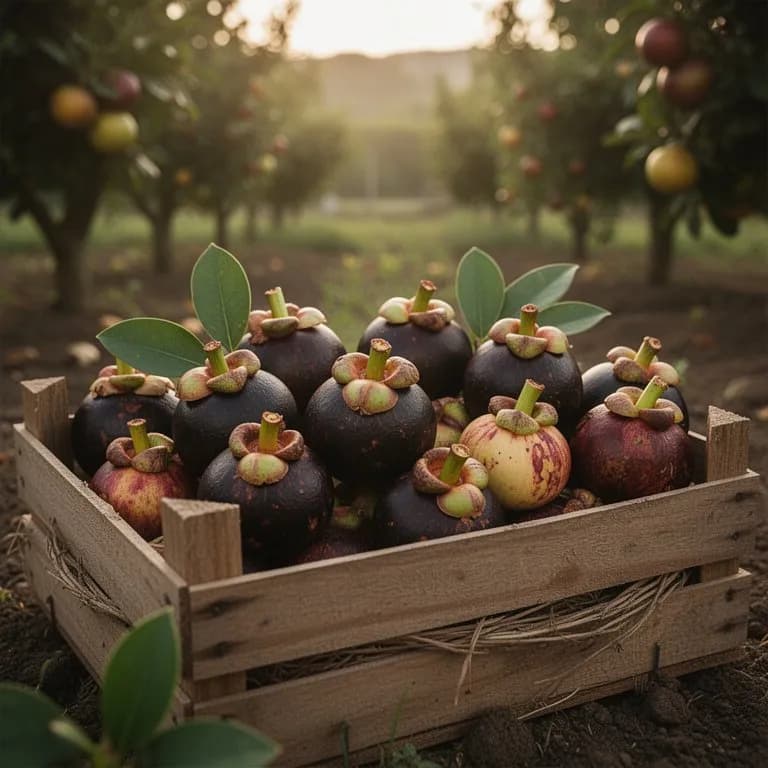
Harvesting mangosteen by hand when the rind turns fully dark purple and yields slightly to gentle pressure
Yield & Spacing Calculator
See how many Mangosteen plants fit in your garden bed based on the recommended 600cm spacing.
0
Mangosteen plants in a 4×4 ft bed
0 columns × 0 rows at 600cm spacing
Popular Varieties
Some of the most popular mangosteen varieties for home gardeners, each with unique characteristics.
Common Mangosteen
The standard variety grown throughout Southeast Asia, producing the classic deep-purple fruits with sweet, white flesh segments.
Mesta
A selection known for slightly larger fruits with more consistent quality and fewer seeds, favored in commercial orchards.
GA-1
An improved selection developed for earlier bearing and slightly better cold tolerance than the standard variety.
Mangosteen is considered one of the finest tropical fruits and is almost always eaten fresh. Cut around the equator of the thick rind and twist to reveal the white segments inside. The sweet, floral flesh is eaten as-is or added to tropical fruit salads. It makes excellent sorbet, juice, and cocktail ingredients. The flavor pairs beautifully with coconut and lime.
When should I plant Mangosteen?
Plant Mangosteen in May, June, July. It takes approximately 3650 days to reach maturity, with harvest typically in June, July, August.
What hardiness zones can Mangosteen grow in?
Mangosteen thrives in USDA hardiness zones 11 through 12. With greenhouse protection, it may be grown in zones 9 through 13.
How much sun does Mangosteen need?
Mangosteen requires Partial Sun (3-6h). This means 3-6 hours of sunlight, ideally morning sun with afternoon shade.
How far apart should I space Mangosteen?
Space Mangosteen plants 600cm (236 inches) apart for optimal growth and air circulation.
What pests and diseases affect Mangosteen?
Common issues include Gamboge Disorder, Leaf Miner, Root Rot (Phytophthora). Prevention through good garden practices like crop rotation, proper spacing, and companion planting is the best approach. See the detailed pests and diseases section above for symptoms, prevention, and treatment for each.
How do I store Mangosteen after harvest?
Fresh mangosteen can be stored at room temperature for two to three days or refrigerated for up to two weeks at 50 to 55 degrees Fahrenheit. Do not freeze whole fruit, as the delicate flesh becomes watery upon thawing. The flesh can be frozen separately in airtight containers for up to three months ...
What are the best Mangosteen varieties to grow?
Popular varieties include Common Mangosteen, Mesta, GA-1. Each has unique characteristics suited to different growing conditions and culinary preferences. See the varieties section above for detailed descriptions.
What soil does Mangosteen need?
Mangosteen requires deep, rich, well-drained soil with high organic matter and a pH of 5.5 to 6.5. The tree will not tolerate clay, compacted soil, or waterlogging. Amend planting areas generously with compost, aged manure, and coconut coir. Apply a balanced organic fertilizer every two to three mon...
Why is my mangosteen tree growing so slowly?
Extremely slow growth is completely normal for mangosteen, especially in the first 2-5 years. Seedlings may grow only 10-15 cm per year initially. This is an inherent characteristic of the species, not a sign of problems. Ensure adequate shade, consistent moisture, and light fertilization, but accept that this tree simply cannot be rushed. Growth accelerates noticeably after year 5-6.
How long does it take for a mangosteen tree to produce fruit?
Mangosteen is one of the slowest tropical fruit trees to reach bearing age, typically requiring 8-15 years from seed to first fruit. Some trees grown in ideal conditions with excellent care may produce a few fruits as early as year 7-8, but consistent, commercial-level production usually begins around year 10-12. Vegetatively propagated trees (grafted or air-layered) do not offer a significant shortcut, as the species responds poorly to most grafting techniques.
Can I grow mangosteen in a container or greenhouse outside the tropics?
While it is technically possible to keep a mangosteen tree alive in a large container or heated greenhouse, fruiting outside the tropics is extremely difficult. The tree requires consistent warmth (25-35°C), very high humidity (75-90%), and specific light conditions year-round. Greenhouse-grown trees rarely produce fruit because they typically lack the subtle seasonal triggers (brief dry periods, specific day-length changes) that initiate flowering. Container culture can work as an ornamental curiosity but should not be expected to yield edible fruit.
What causes the yellow rubbery substance in my mangosteen fruit?
The yellow, resinous substance is gamboge, a latex produced by the rind that seeps into the flesh due to physical damage, insect injury, or fluctuations in soil moisture during fruit development. To minimize gamboge disorder, maintain consistent irrigation during the fruiting period, handle developing fruits carefully, and control fruit-piercing insects with traps. Affected segments are safe to eat but have an unpleasant bitter taste.
Why are the arils in my mangosteen translucent or watery instead of white?
Translucent flesh disorder is caused by excessive rain or overwatering during the final stages of fruit development, leading to excess water uptake by the arils. It can also occur in fruits left on the tree too long past peak ripeness. To prevent this, moderate irrigation in the weeks before harvest and pick fruits promptly when the rind reaches full dark purple color. Affected arils have reduced flavor but are safe to consume.
Does mangosteen need a pollinator tree or can a single tree produce fruit?
A single mangosteen tree can produce fruit on its own. Mangosteen reproduces through apomixis — the seeds develop from maternal tissue without fertilization, so no pollen or pollinator is required. In fact, the flowers have only vestigial (non-functional) stamens, and viable male trees are virtually unknown. Every mangosteen seedling is a genetic clone of its mother tree, and a lone tree will fruit normally once it reaches maturity.
Ready to Grow Mangosteen?
Add Mangosteen to your garden plan and start designing your perfect layout.

Vladimir Kusnezow
Gardener and Software Developer
Zone 6b gardener. Growing vegetables and fruits in soil and hydroponics for 6 years. I built PlotMyGarden to plan my own gardens.
Jump to Section